As an Amazon Associate, SturdyPaws earns from qualifying purchases. This article contains affiliate links; buying through them costs you nothing extra. Read our affiliate disclosure.
Car rides get harder as dogs age. A stiff senior dog may slide off a slippery leather seat when you brake, slip a back leg into the footwell, or struggle to stand on a soft surface that moves under it. A good back-seat hammock or seat extender can make the ride steadier and protect your seats from hair and accidents.
Most car hammock guides focus on dirt and hair. This one focuses on what matters for older dogs: a stable surface to lie on, easy entry through the door, and safety. It is research-based, using maker and listing specifications and veterinary travel advice. We have not tested these products in our own cars.
Key takeaways
- A hammock is not a crash restraint. It protects your seats, not your dog. Pair it with a crash-tested harness or crate.
- Hard-bottom extenders give a firm, flat platform over the footwell, which suits stiff or wobbly dogs.
- Soft hammocks are cheaper and simpler, but can sag.
- Side flaps that unzip let your dog step in through the door without climbing over fabric.
- Fit matters. A cover that slides around defeats the point.
Safety first: a hammock does not hold your dog in a crash
Cornell University's College of Veterinary Medicine says the safest way for a dog to travel is in a crash-tested harness, seat belt or travel crate, and points owners to recommendations from the Center for Pet Safety. It also says dogs should never ride loose in the car. RSPCA Australia makes the same point and warns that many products on the market have not passed any crash testing.
A car hammock or seat extender is a seat cover. It does not hold your dog in place in a crash or hard stop. Use it with a properly fitted, crash-tested restraint for your dog's size. For senior dogs, also avoid the front seat, and never let your dog ride with its head out of the window.
Soft hammock or hard bottom?
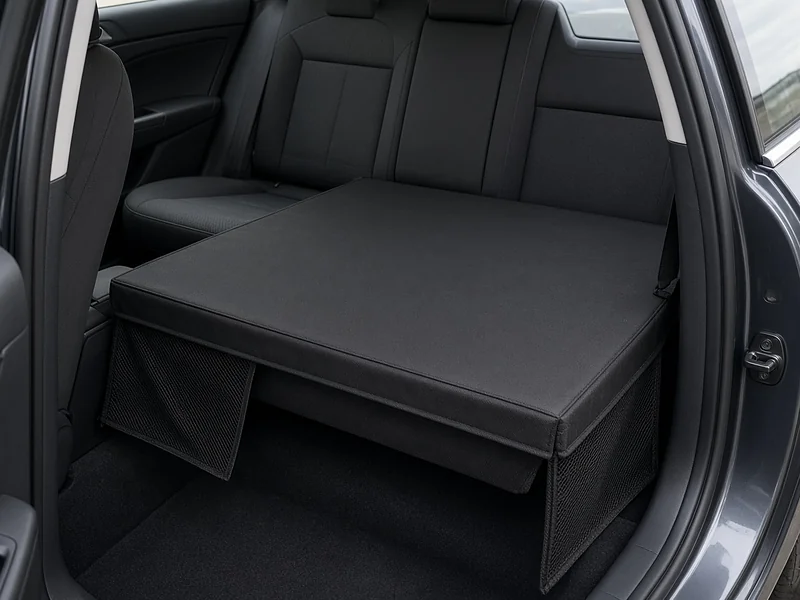
This is the biggest decision for an older dog.
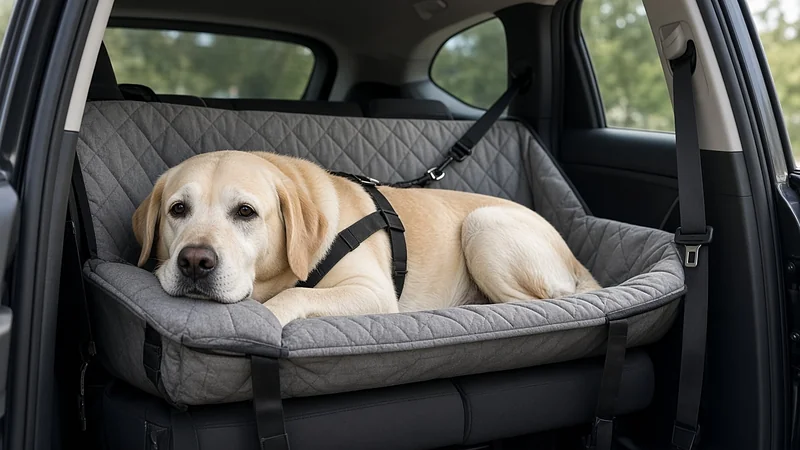
- Soft hammocks clip to the front and rear headrests, making a fabric sling across the back seat. They block the footwell, so a dog cannot slip a leg into the gap. But the middle can sag, and a stiff dog may find a moving, dipping surface hard to stand or turn on.
- Hard-bottom extenders add a rigid board over the footwell, making the back seat one flat platform. That gives a stable surface to lie on and more room to stretch, which suits large, wobbly or arthritic dogs. They are bulkier and take longer to fit.
Car hammocks compared
| Product | Key specs | Link |
|---|---|---|
| URPOWER Hard Bottom Back Seat Extender | Hard bottom 51 x 23.6 in made of detachable honeycomb boards; listed to hold up to 400 lb; zippered side flaps; mesh window and pocket; not recommended for captain's chairs or bucket seats | Check price on Amazon (opens in a new tab) |
| URPOWER Waterproof Dog Hammock with Side Flaps | Standard size for back seats close to 54 in; zippered side flaps that open for getting in and out; non-slip backing, headrest and seat anchors; soft bottom without a rigid board; 6-month warranty per the listing | Check price on Amazon (opens in a new tab) |
| Kurgo Rover Hammock Seat Cover | 55 in wide x 56 in long; 6 attachment points; center zipper lets one side fold down for a passenger; water resistant and machine washable | Check price on Amazon (opens in a new tab) |
| Kurgo Half Hammock Seat Cover | Covers half the back seat; attaches to all four headrests plus an under-seat paracord; four Bench Beans anchors; waterproof 400D polyester; side flap protects the seat edge; lifetime warranty per the listing | Check price on Amazon (opens in a new tab) |
Specs are from manufacturer and retailer listings and can change between versions; check the listing before you buy. We don't show prices because they change often; the button shows the current price on Amazon.
The picks
Best for stiff or wobbly dogs: URPOWER Hard Bottom Back Seat Extender
URPOWER Hard Bottom Back Seat Extender
Hard bottom 51 x 23.6 in made of detachable honeycomb boards; listed to hold up to 400 lb; zippered side flaps; mesh window and pocket; not recommended for captain's chairs or bucket seats
Pros
- Firm, flat platform over the footwell so the dog does not sink
- Bigger space to lie down
- Boards come out for cleaning
Cons
- Will not fit captain's chairs or bucket seats
- Takes up the whole back seat
- Not a crash restraint
This extender uses detachable honeycomb boards to make a 51 x 23.6 in hard platform across the back seat. The listing says it holds up to 400 lb. It has zippered side flaps, a mesh window so your dog can see you, and a storage pocket. The listing says it is not recommended for captain's chairs or bucket seats, so check your car's layout. A flat, firm surface is easier for a senior dog to lie down and get up on than a sagging hammock.
Best for: large or arthritic dogs that need a stable surface and room to lie flat.
Best soft hammock for easy entry: URPOWER Waterproof Dog Hammock
URPOWER Waterproof Dog Hammock with Side Flaps
Standard size for back seats close to 54 in; zippered side flaps that open for getting in and out; non-slip backing, headrest and seat anchors; soft bottom without a rigid board; 6-month warranty per the listing
Pros
- Side flaps unzip so a stiff dog can step in at the door
- Non-slip backing and seat anchors
- Converts to a bench cover or cargo liner
Cons
- Soft bottom, so it dips over the footwell
- Check your seat width against 54 in
- Not a crash restraint
A classic soft hammock with zippered side flaps that open so your dog can step in at the door, rather than climbing over a fabric wall. It has a non-slip backing, a headrest strap and seat anchors to reduce sliding. The standard size is listed for back seats close to 54 in wide.
Best for: medium dogs and owners who want a simple, affordable cover.
Best split-seat hammock: Kurgo Rover Hammock
Kurgo Rover Hammock Seat Cover
55 in wide x 56 in long; 6 attachment points; center zipper lets one side fold down for a passenger; water resistant and machine washable
Pros
- Hammock blocks the footwell a senior dog can slip into
- Split zipper shares the seat with a passenger
- Machine washable
Cons
- Soft bottom sags a little under a heavy dog
- Measure your bench seat width first
- Not a crash restraint
The Rover is 55 in wide by 56 in long with six attachment points. A center zipper lets one side fold down so a passenger can still sit in the back. It is water resistant and machine washable.
Best half-seat cover: Kurgo Half Hammock
Kurgo Half Hammock Seat Cover
Covers half the back seat; attaches to all four headrests plus an under-seat paracord; four Bench Beans anchors; waterproof 400D polyester; side flap protects the seat edge; lifetime warranty per the listing
Pros
- Leaves half the seat free for a passenger or child seat
- Several anchor points reduce sliding
- Fits left or right side
Cons
- Smaller area for a large dog to lie flat
- Soft base, no rigid board
- Not a crash restraint
Covers half the back seat, attaching to all four headrests and an under-seat cord, with four seat anchors. That leaves the other half free for a passenger or child seat. Good for small and medium seniors.
Getting a senior dog into the car
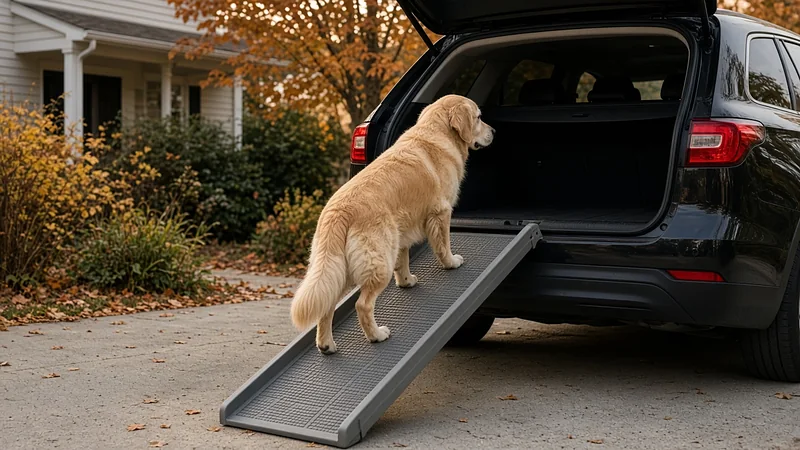
A hammock solves the ride, not the climb. Jumping into a car is hard on arthritic joints and backs. VCA Animal Hospitals' advice for dogs with osteoarthritis includes using a ramp to help them into vehicles. Options:
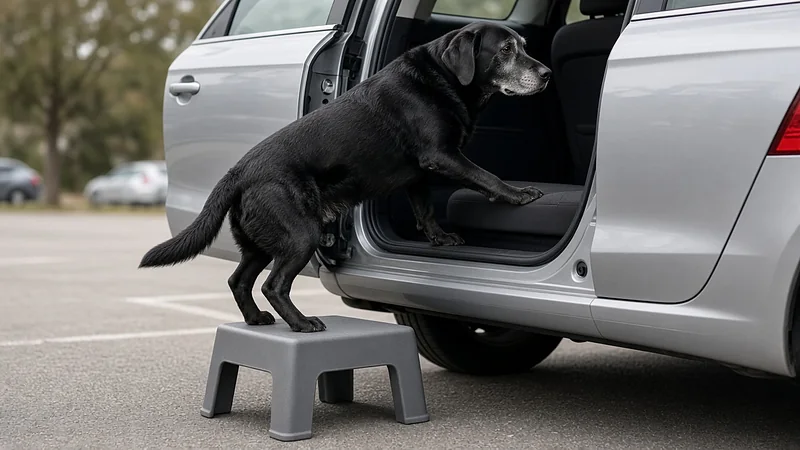
- Back seat of a sedan: see ramps and steps for sedan doors.
- SUV: see ramps for SUVs.
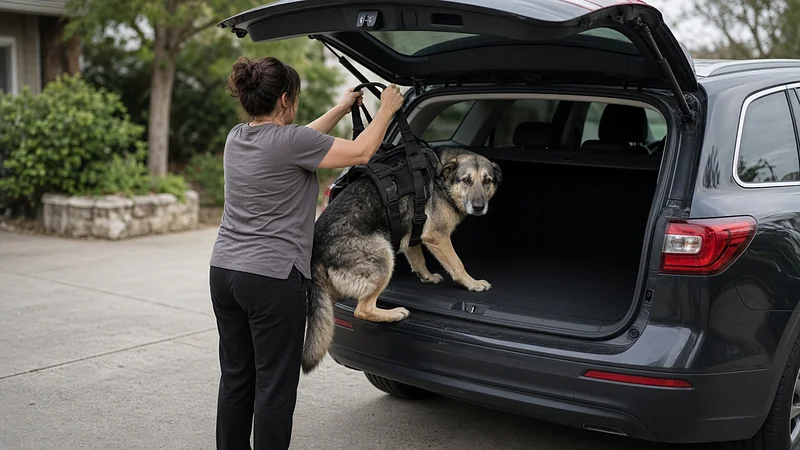
- Lifting: a harness with handles lets you share the dog's weight. See lift harnesses for getting into the car.
Side flaps matter here. If the flaps stay closed, your dog has to step over or onto loose fabric at the door, which is where stiff dogs trip.
Fitting tips
- Measure your back seat width and check it against the listing before buying.
- Clip the headrest straps snugly so the hammock is level, not hanging low.
- Push the seat anchors well into the gap between seat back and cushion; they stop the cover sliding.
- Check that seat belt openings line up so you can attach your dog's crash-tested restraint.
- Recheck the straps before each trip.
Which setup suits which dog?
Think about your dog's size, how steady it is on its feet, and who else rides in the back.
- Large dog with arthritis or hip problems: a hard-bottom extender gives the most stable surface and space to lie flat. Pair it with a ramp, because the extender does not reduce the height of the climb.
- Medium dog that is still fairly steady: a soft hammock with side flaps is usually enough, and it is easier to remove when you need the seats.
- Small senior dog: a half hammock or a crash-tested carrier secured on the seat or floor may make more sense than a full-width hammock. Cornell's veterinary college says that, if a crash-tested option is not available, a carrier secured on the floor behind a front seat offers the most protection.
- Dog that rides with passengers: a split or half hammock leaves room for people.
- Dog with incontinence: choose a waterproof cover and add a washable pad on top, so you can clean up quickly after a trip.
Common mistakes
- Treating the hammock as a seat belt. It is not one. Always add a crash-tested restraint.
- Leaving the side flaps closed. Your dog then has to step over loose fabric at the door, the point where stiff dogs most often trip.
- Letting it hang low. A sagging hammock tips a stiff dog into the middle. Tighten the straps until it is level.
- Buying for the car you wish you had. Hard-bottom extenders need a bench seat and enough width. Measure first.
- Forgetting the climb. A nicer seat does not help if your dog hurts itself jumping in. Use a ramp, steps or a lift harness.
Comfort for older dogs on longer trips
- Add a thin non-slip mat or folded blanket on a hard bottom for bony dogs.
- Stop every couple of hours so stiff dogs can stretch and toilet.
- Keep the car cool. Older dogs handle heat poorly, and you should never leave a dog in a parked car.
- Use a waterproof cover if your dog has accidents.
Cleaning and care
Senior dogs shed, drool and sometimes have accidents in the car, so plan for washing. Check the care label before you buy: some covers are machine washable, while others are wipe-clean only. Shake out hair after each trip, and wipe spills quickly so they do not soak through to the seat. If a cover has removable boards, take them out before washing. Let everything dry fully before refitting, because a damp cover can smell and may slip more on the seat. Check straps, clips and seams every few weeks, since a worn clip can let the hammock drop just as your dog steps on.
FAQ
Is a dog car hammock safe?
It is safe as a seat cover, but it is not a crash restraint. Use it with a crash-tested harness or crate, as Cornell's veterinary college recommends.
Hard-bottom or soft hammock for an old dog?
A hard bottom gives a firmer, flatter surface, which many stiff or unsteady dogs find easier. A soft hammock is cheaper and simpler and works for dogs that settle quickly.
Will a hard-bottom extender fit my car?
Check the listing's dimensions against your back seat. The URPOWER listing says it is not recommended for captain's chairs or bucket seats.
Can my dog wear a seat belt harness with a hammock?
Most hammocks have openings for seat belt buckles. Check before buying, and attach the restraint through those openings.
How do I stop the hammock sliding?
Use the seat anchors, tighten the headrest straps, and choose a cover with a non-slip backing.
Prices change often, so we do not list them. Check the current price on Amazon.
Sources
- Cornell University College of Veterinary Medicine, Traveling safely with your dog.
- RSPCA Australia Knowledgebase, Do I need to restrain my dog when travelling in my car?
- Center for Pet Safety, crash-test research.
- VCA Animal Hospitals, Helping your dog with osteoarthritis.
- Product specifications from the linked Amazon listings, checked 2 November 2026.