As an Amazon Associate, SturdyPaws earns from qualifying purchases. This article contains affiliate links; buying through them costs you nothing extra. Read our affiliate disclosure.
An arthritic dog that circles its bed, hesitates, then lies down on the floor next to it is telling you something. Often the bed is not the wrong softness. It is the wrong height, or it has a wall the dog no longer wants to climb over. Getting in and out of bed happens many times a day, and every one of those moments loads sore hips, elbows and knees.
This guide covers beds built around easy entry: low, flat foam mattresses with no bolster to step over, and when a raised cot is the better answer. It is research-based. We compared manufacturer specifications and veterinary guidance; we have not tested each bed with our own dogs.
Key takeaways
- Height is the hidden spec. A dog with stiff joints should be able to step onto the bed, not climb into it. Around 4 in of foam is a low step for most medium and large dogs.
- No wall at the entry. Flat mattresses, or beds with bolsters only on the back and sides, are easier than fully bolstered "donut" beds.
- Solid foam, not loose fill. VCA recommends padded orthopedic or memory-foam bedding for dogs with osteoarthritis.
- Anchor it. A bed that slides on hardwood when the dog pushes off is a fall risk. Put it on a rug or a non-slip surface.
- Thicker is only better for heavy dogs. Giant breeds may need 6–7 in of foam, which is a real step up. Weigh support against entry height.
Why entry height matters so much
Lying down and getting up are some of the hardest movements for a dog with osteoarthritis. To lie down, the dog folds its hind legs under a sore hip and lowers its weight in a controlled way. To get up, it pushes off with stiff hind legs. Every extra inch of height, or a bolster to step over, adds a balancing act to that movement.
VCA Animal Hospitals' advice for dogs with osteoarthritis includes soft, padded orthopedic or memory-foam bedding placed somewhere warm and free from drafts, and it stresses a bed the dog does not have to climb into. VCA's guidance on creating a home for a mobility-compromised dog also highlights the hazard of slippery floors, which matters here: the first step off the bed often lands on hardwood or tile.
Put together, that gives three rules for the bed itself:
- Low. The sleeping surface should be a step, not a climb.
- Open. No wall to clear at the place the dog enters.
- Stable. The bed should not slide when the dog stands up from it.
Quick comparison
| Product | Key specs | Link |
|---|---|---|
| Dogbed4less Orthopedic Gel Memory Foam Dog Bed | 4 in single solid gel-infused memory foam pad, 3.2 lb density; waterproof internal zip liner plus washable external cover (Amazon listings add a bonus second cover); 7 sizes from 35x20 to 55x47 in | Check price on Amazon (opens in a new tab) |
| Brindle Waterproof Memory Foam Pet Bed | 4 in total: 2 in memory foam over 2 in high-density support foam; waterproof inner encasement; removable machine-washable zip cover | Check price on Amazon (opens in a new tab) |
| K&H Superior Orthopedic Indoor/Outdoor Dog Bed | Orthopedic foam with water-resistant vinyl backing; Small 36x27x4 in; 1-year warranty (per K&H) | Check price on Amazon (opens in a new tab) |
| Coolaroo Original Cooling Elevated Dog Bed | Raised cot with breathable HDPE fabric on a frame; Large about 51 x 31.5 x 8 in; hose off or wipe clean | Check price on Amazon (opens in a new tab) |
Specs are from manufacturer and retailer listings and can change between versions; check the listing before you buy. We don't show prices because they change often; the button shows the current price on Amazon.
Low, flat foam mattresses
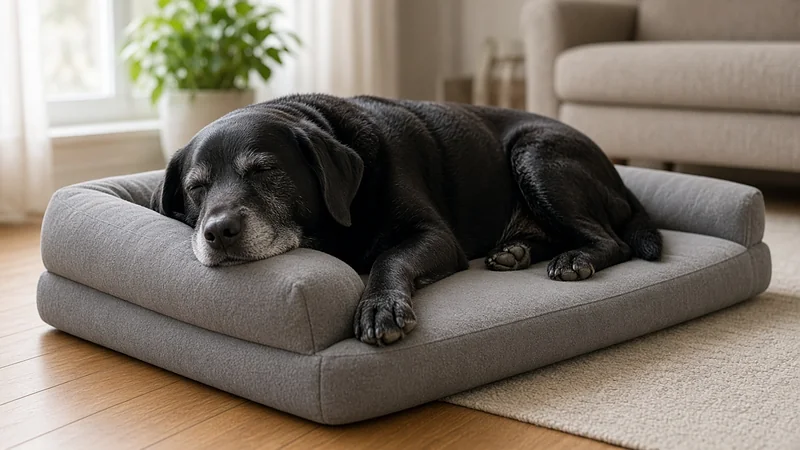
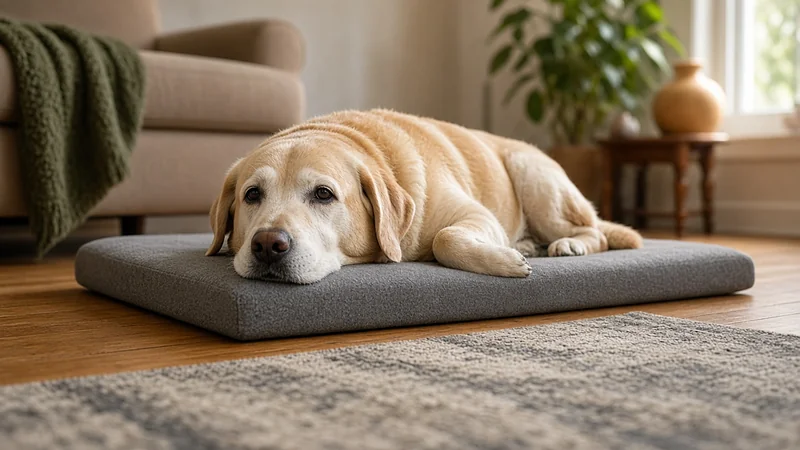
A flat mattress with no bolster is the simplest low-entry bed. The dog can walk onto it from any side, which helps a dog that wobbles or does not walk straight. The trade-off is that there is no headrest, and some dogs like to lean on something. A folded blanket at one end can give that without creating a wall.
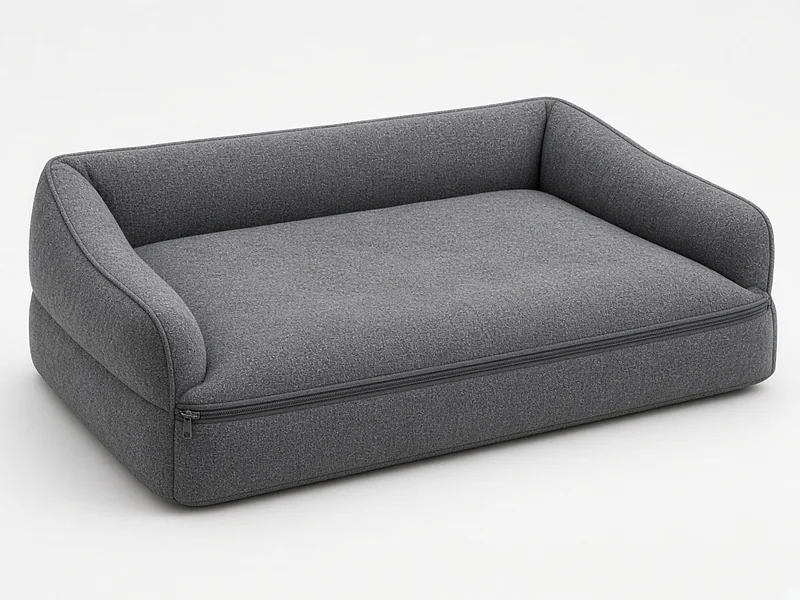
Dogbed4less Orthopedic Gel Memory Foam Dog Bed
4 in single solid gel-infused memory foam pad, 3.2 lb density; waterproof internal zip liner plus washable external cover (Amazon listings add a bonus second cover); 7 sizes from 35x20 to 55x47 in
Pros
- Stated foam density published (3.2 lb), which few brands do
- Liner plus a spare cover suits frequent washing
- Flat, low mattress is easy to step onto; large sizes available
Cons
- No bolster
- 4 in may be thin for the heaviest giant breeds
- Only the inner liner is waterproof, not the outer cover
The Dogbed4less pad is a single 4 in slab of gel-infused memory foam, with a waterproof inner liner and a washable outer cover. Seven sizes from 35 x 20 in to 55 x 47 in mean you can size it generously without making it taller. For most medium and large arthritic dogs, 4 in is a reasonable balance of support and a low step.
Brindle Waterproof Memory Foam Pet Bed
4 in total: 2 in memory foam over 2 in high-density support foam; waterproof inner encasement; removable machine-washable zip cover
Pros
- Waterproof inner encasement
- Low, flat profile
- Lower relative cost
Cons
- CertiPUR-US not stated on the pages we checked
- 4 in total is thin for large dogs
- No bolster
The Brindle bed is also 4 in in total, built from 2 in of memory foam over 2 in of firmer support foam, with a waterproof inner encasement. The layered build gives a softer top with a firmer base. It suits dogs that are starting to leak urine, a common companion to old age and reduced mobility.
K&H Superior Orthopedic Indoor/Outdoor Dog Bed
Orthopedic foam with water-resistant vinyl backing; Small 36x27x4 in; 1-year warranty (per K&H)
Pros
- Vinyl-backed construction resists moisture
- Indoor/outdoor use
- Lower relative cost
Cons
- Not a fully sealed bed: liquid can still reach seams
- Firm, flat design without bolsters
- Short warranty
The K&H bed is a plain orthopedic foam mattress with a water-resistant vinyl backing. The small size is 36 x 27 x 4 in. It is a practical choice for a second bed in a kitchen, a utility room or a covered porch, where water resistance matters.
Open-front and three-sided beds
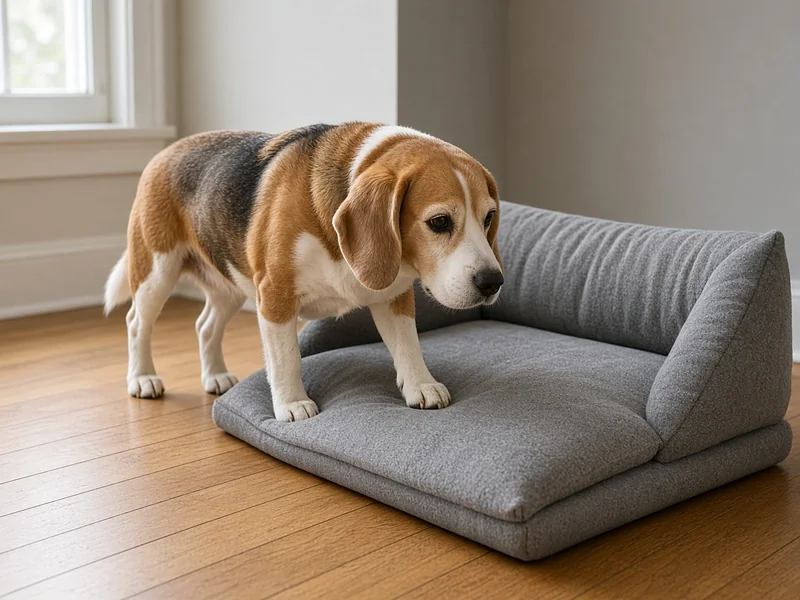
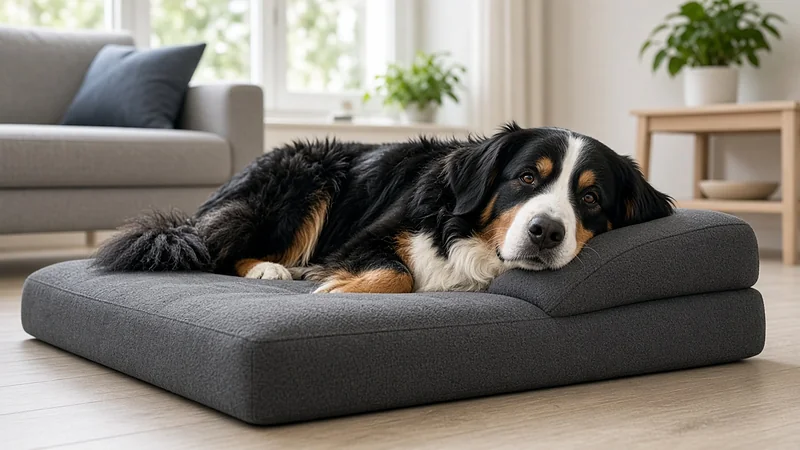
Many dogs love to curl against a bolster. If yours does, look for a bed whose bolster runs along the back and one or both sides, leaving the front open at foam height. The dog steps straight on without climbing, and still has something to lean on. Avoid fully enclosed round "donut" beds with a raised rim all the way around: they ask the dog to step over and down into a soft hollow, which is exactly the movement stiff hips find hardest.
When you look at a bolster bed, check the listing photos and dimensions for the height of the front edge, not just the foam thickness. Some beds have a slightly raised lip at the entry, which matters for a dog that drags its back feet.
When thicker foam is worth the extra height
Very heavy dogs compress foam more. A thin bed can "bottom out" under a 120 lb dog's hips, leaving it effectively on the floor. For giant breeds, a thicker bed such as the 7 in Big Barker can be the better trade, even though it is a bigger step. If you go thick, make the step easier: place the bed on a rug so the dog has grip when it pushes up, and choose a model with a low, firm edge. We cover this trade-off in Is the Big Barker dog bed worth it? and our guide to orthopedic beds for large dogs with hip dysplasia.
A rough guide based on what makers offer: about 3–4 in of solid foam suits small and medium dogs, and 6–7 in suits giant breeds. For everyone in between, 4 in of dense foam is usually a sensible starting point.
When an elevated cot is the better answer
Elevated cots are not "low entry", so why include one? Because for some arthritic dogs, standing up from a raised, taut surface is easier than pushing up from the floor. The dog's legs are already partly under it when it rises, a little like getting up from a chair rather than from the ground. Cots also stay cool and are easy to hose off.
Coolaroo Original Cooling Elevated Dog Bed
Raised cot with breathable HDPE fabric on a frame; Large about 51 x 31.5 x 8 in; hose off or wipe clean
Pros
- Taut fabric spreads weight evenly and does not sink
- Stays cool; good for dogs that overheat on foam
- Easy to clean after accidents
Cons
- Raised about 8 in, a real step up for a stiff dog
- No foam cushioning; add a thin pad if your dog is bony
- Frame edges can be a trip point
The Coolaroo is a fabric cot on a frame. The large size is about 51 x 31.5 x 8 in. That 8 in height is the key point: test whether your dog can step onto it comfortably before committing. Cots suit dogs that can still step up confidently but struggle to rise from the floor, and dogs that overheat on foam. They do not suit dogs with weak or wobbly hind legs, or dogs that already struggle with a curb-height step.
How to choose: a short checklist
- Measure the step. Can your dog step over a book of the same height without hesitating? That is a rough test of whether a bed of that height is low enough.
- Measure the dog. Measure from nose to the base of the tail while your dog lies stretched out, then add 8–12 in. Arthritic dogs often sleep stretched out rather than curled.
- Check the foam. Look for a stated foam type and thickness, not "orthopedic fill". Solid foam keeps its shape; loose fill flattens and shifts.
- Check the cover. Removable, washable, ideally with a waterproof liner.
- Check the base. A non-slip underside helps, but a rug under the bed helps more.
Where to put the bed
Placement matters as much as the bed. VCA recommends a warm, draft-free spot. In practice:
- Put the bed where the dog already chooses to rest, usually somewhere it can see you.
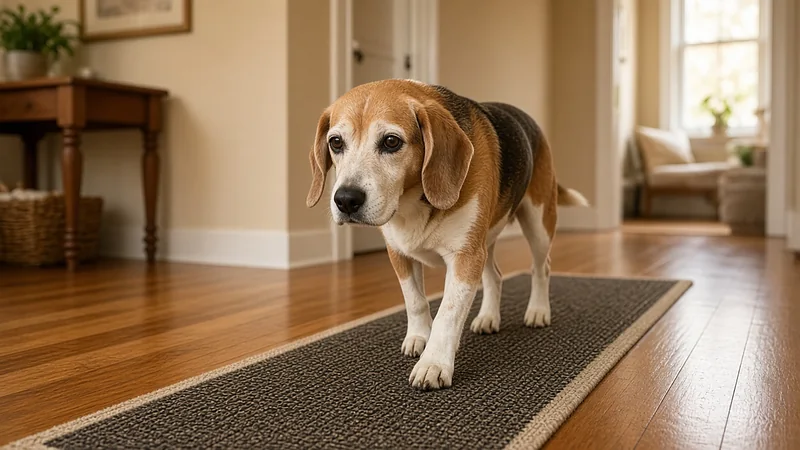
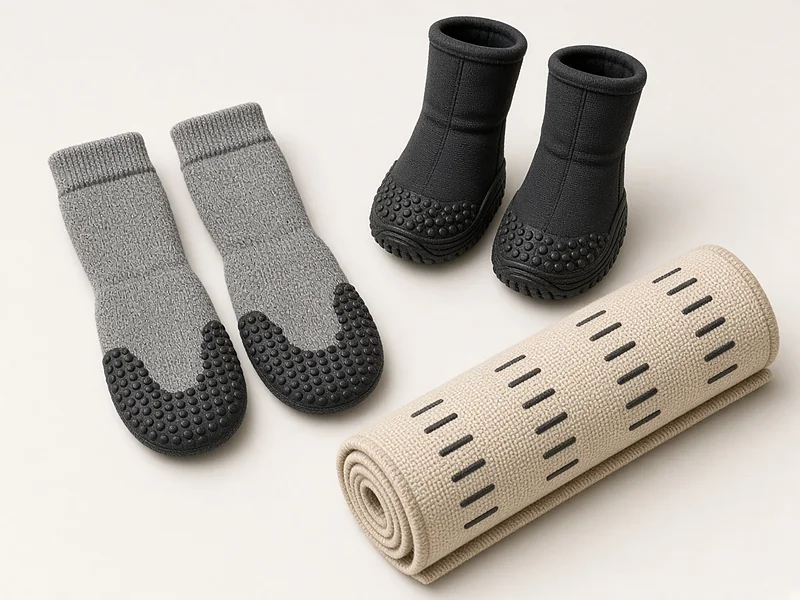
- Lay a rubber-backed rug or runner in front of and around the bed, so the first step off is not onto bare hardwood. See our guide to non-slip runner rugs.
- Keep the route from bed to water bowl and door short and covered. Our guide to stopping a senior dog slipping on hardwood floors explains how.
- If your dog also sleeps on your bed or sofa, give it a safe way up rather than a jump. See dog stairs for small senior dogs and bed ramps for small dogs.
Signs the bed is not working
- Your dog sleeps next to the bed rather than on it.
- It hesitates, paws at the edge or circles many times before lying down.
- It slips or scrambles when getting off.
- The foam keeps a dent where the dog lies, or you can feel the floor through it when you press with your fist.
If you see these, try a lower or firmer bed, move it onto a rug, or ask your vet whether pain control needs adjusting.
For toy and small breeds, see orthopedic beds for small senior dogs.
FAQ
What kind of bed is best for a dog with arthritis?
A supportive solid-foam bed that is easy to step onto, with a washable cover. VCA recommends padded orthopedic or memory-foam bedding in a warm, draft-free place for dogs with osteoarthritis.
Are bolster beds bad for arthritic dogs?
Not if the entry is open. A bolster along the back and sides gives a headrest without a wall to climb. Fully enclosed round beds with a raised rim are harder for stiff dogs.
Is an elevated dog bed good for arthritis?
It can be for dogs that can still step up confidently, because rising from a raised surface may be easier than from the floor. It is not a good fit for dogs with weak hind legs or poor balance.
How thick should an orthopedic bed be for a senior dog?
About 3–4 in of solid foam for small and medium dogs, and 6–7 in for giant breeds that would compress a thinner bed.
Prices change often, so we do not list them. Check the current price on Amazon.
Sources
- VCA Animal Hospitals, Helping Your Dog with Osteoarthritis.
- VCA Animal Hospitals, Creating a Comfortable Home for Your Mobility Compromised Dog.
- VCA Animal Hospitals, Behavior Changes and Pain in Aging Dogs.
- Manufacturer and Amazon listing specifications for each bed (checked November 2026).