As an Amazon Associate, SturdyPaws earns from qualifying purchases. This article contains affiliate links; buying through them costs you nothing extra. Read our affiliate disclosure.
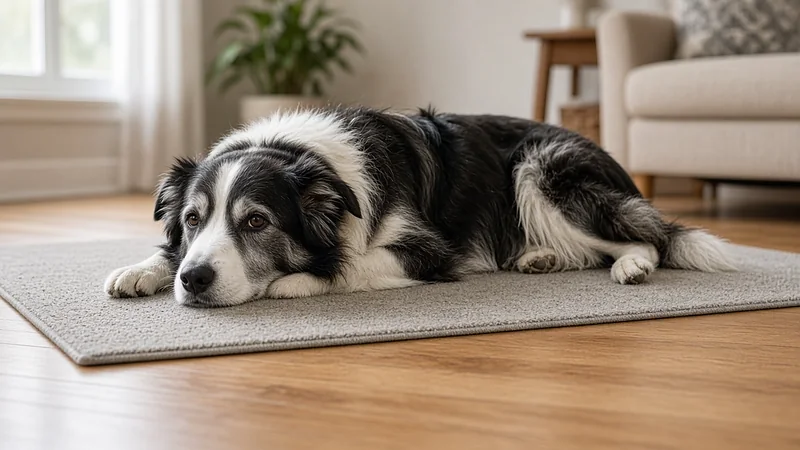
A senior dog splaying on a hardwood floor is hard to watch, and it is more than an inconvenience. VCA Animal Hospitals explains that dogs with mobility problems walk hard floors "very cautiously... with a short stride and hunched back to guard against falling," which can lead to stiffness and soreness and, ultimately, less activity around the house (VCA). Less movement means weaker muscles, which means more slipping.
The good news: most fixes are cheap, and you can combine them. This research-based guide walks through them in the order we would try them. We have not tested every product on our own dogs; product details come from manufacturer and retailer pages.
Start with a vet check
Slipping is a symptom. It can come from arthritis pain, muscle loss, nerve or spinal problems, or simply long nails. VCA lists "avoiding slippery floor surfaces" among behaviors that suggest pain in aging dogs (VCA). A sudden change, wobbling, crossing the back legs, or knuckling paws should be checked by your veterinarian before you buy anything.
Free fixes first
1. Trim the nails
Long nails stop the toes flexing and gripping the floor properly. VCA says most dogs need a nail trim at least once a month and compares long nails on a slipping senior to "putting high heels on a grandparent and asking them to walk on an ice rink." If nail trims stress your dog, ask your vet about help with handling or medication.
2. Trim the fur between the pads
Long fur growing over the paw pads acts like a sock. Keeping it trimmed flush with the pads restores contact with the floor. VCA recommends this as well.
3. Keep paws dry and floors clean
Wet paws after a walk, or a floor that has just been polished, make things worse. Towel paws at the door and avoid shiny floor finishes in your dog's areas.
Fix the floor: rugs, runners and tiles
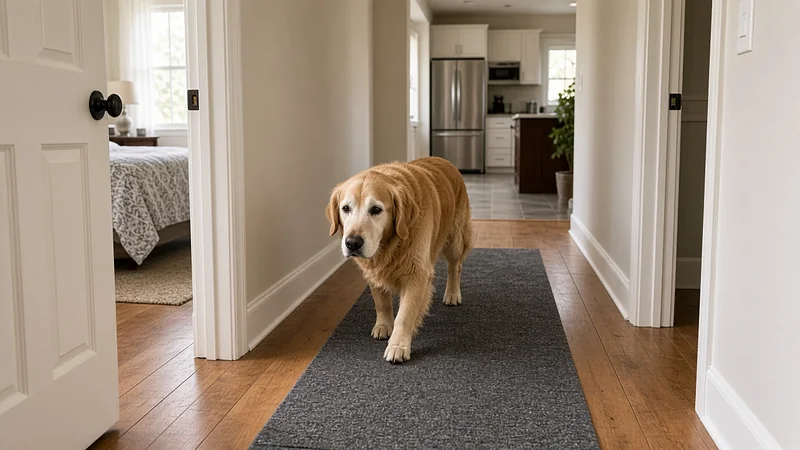
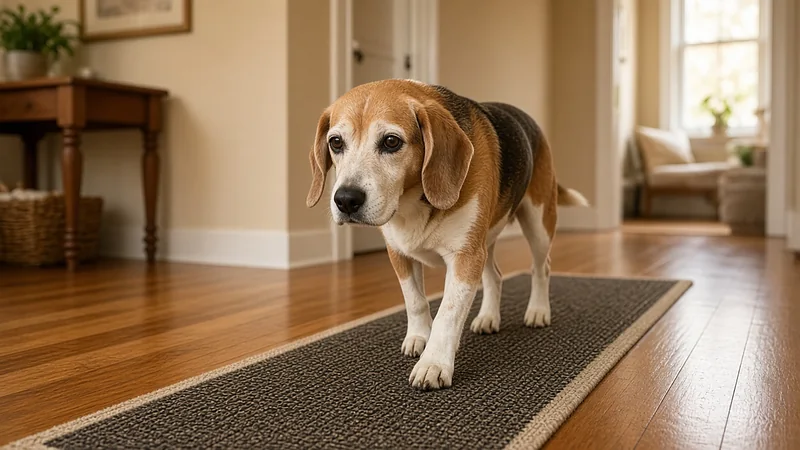
VCA's recommendation is practical: you could carpet the whole house, "or more realistically," lay non-slip area rugs and runners where your dog spends the most time. Map your dog's actual routes: bed to water bowl, to the back door, to wherever you sit.
Rubber-backed washable runner rugs
Low-pile, non-slip backing, machine washable
Pros
- Fixes the floor once for every dog in the house
- No fitting needed
Cons
- Need enough coverage on your dog's real routes
- Edges can curl; choose low pile and flat edges
Choose low pile with a rubber or non-slip backing and flat edges. VCA specifically warns against raised corners or edges that could trip your dog. Washable runners make sense if accidents are part of senior life.
Interlocking foam or carpet tiles
EVA foam or carpet squares that click together
Pros
- Cover an odd-shaped room or a recovery pen
- Replace one tile if soiled
Cons
- Foam can be chewed
- Seams can lift on very smooth floors
Useful for an odd-shaped kitchen, a recovery pen or around a bed. Surgery recovery guides from MedVet suggest carpet, rugs or yoga mats to give safe footing in a confinement area.
Also add traction on stairs, with a carpet runner or stick-down grip tape, and use a baby gate if your vet wants your dog off stairs.
Fix the feet: grips, boots and socks compared
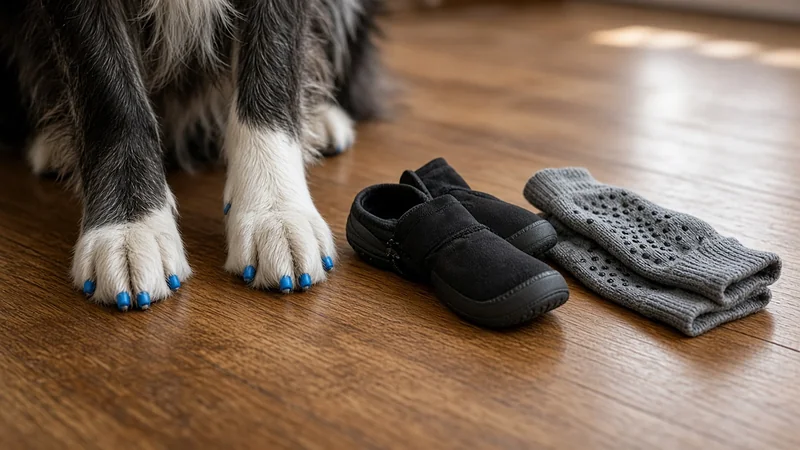
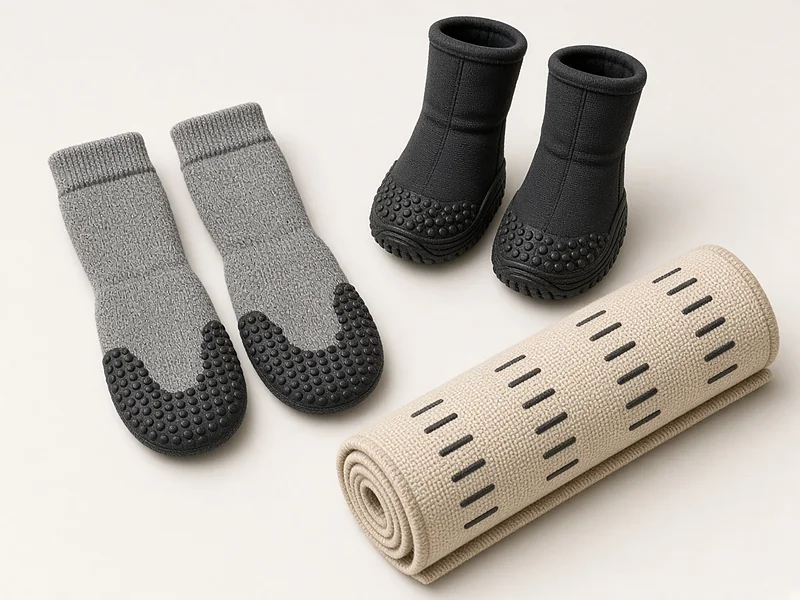
When rugs cannot cover every route, traction on the dog itself helps. VCA notes that nail caps, pad coverings and boots work differently on each pet, and suggests talking to your vet or rehab therapist about which to try.
| Product | Key specs | Link |
|---|---|---|
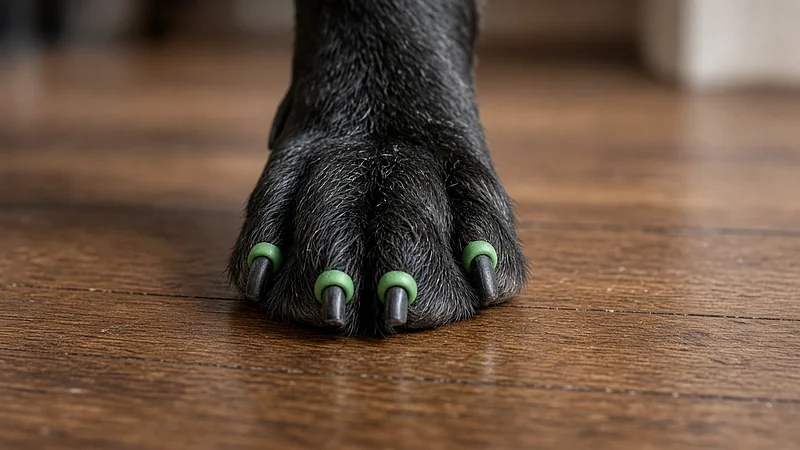
| Dr. Buzby's ToeGrips | Rubber rings that slip over toenail tips; sized by nail; 20 per pack (16 weight-bearing nails plus 4 spares); last 1–3 months per the maker. Linked listing is Medium (the listing says Medium suits dogs with an ideal weight of 15–39 lb) | Check price on Amazon (opens in a new tab) |
| Pawz Rubber Dog Boots | Thin natural-rubber disposable boots, reusable for a while | Check price on Amazon (opens in a new tab) |
| Ruffwear Grip Trex Boots | Vibram rubber outsole, breathable mesh upper, sold in pairs | Check price on Amazon (opens in a new tab) |
| Non-slip dog grip socks (various brands) | Cotton socks with rubber dots | Check price on Amazon (opens in a new tab) |
Specs are from manufacturer and retailer listings and can change between versions; check the listing before you buy. We don't show prices because they change often; the button shows the current price on Amazon.
Dr. Buzby's ToeGrips
Rubber rings that slip over toenail tips; sized by nail; 20 per pack (16 weight-bearing nails plus 4 spares); last 1–3 months per the maker. Linked listing is Medium (the listing says Medium suits dogs with an ideal weight of 15–39 lb)
Pros
- Leaves paw pads free; nothing over the foot
- Developed by a veterinarian
Cons
- Fitting takes patience and correct sizing
- Can fall off or need replacing every 1–3 months
- Not suitable for every nail shape
ToeGrips are rubber rings that slip over the toenails, developed by veterinarian Dr. Julie Buzby. The idea is to add grip where dogs naturally use their nails for traction while leaving the paw pads uncovered. The maker says they can be worn constantly and usually need replacing every one to three months. Correct sizing by nail is essential, and some nail shapes do not hold them well.
Pawz Rubber Dog Boots
Thin natural-rubber disposable boots, reusable for a while
Pros
- Inexpensive and thin, so many dogs tolerate them
- Waterproof
Cons
- Tear with nails and heavy use
- Can trap moisture if worn for hours
Pawz are thin, balloon-like natural rubber boots. Because they are thin, many dogs feel the ground and walk fairly normally. Long nails puncture them, and rubber holds moisture, so take them off when your dog is resting.
Ruffwear Grip Trex Boots
Vibram rubber outsole, breathable mesh upper, sold in pairs
Pros
- Durable rubber sole with strong grip
- Good outdoors on rough ground too
Cons
- Bulkier; some seniors high-step or refuse them
- Need the right width; sold in pairs, so buy two
Ruffwear's Grip Trex boots have a rubber outsole and a breathable upper. They grip well and last, and they double as outdoor boots on hot pavement or rough ground. The downside for seniors is bulk: some dogs high-step or refuse them, and they must be the correct width.
Non-slip dog grip socks (various brands)
Cotton socks with rubber dots
Pros
- Cheapest traction fix
- Soft and easy to try
Cons
- Twist and slide down so the grip ends up on top
- Rubber dots wear quickly
The cheapest option, and worth trying for a lightweight dog. On many dogs the socks twist so the rubber dots end up on top, and the dots wear off.
Which foot option for which dog?
- Dog that drags or scuffs its feet: a covered option (boots) protects the tops of the toes. Post-operative IVDD instructions from VSCD Surgery Centers mention socks or booties for dogs scuffing their paws, and advise removing them when the dog is inactive so moisture is not trapped.
- Dog that hates anything on its feet: toe grips leave the paws free; rugs need nothing on the dog at all.
- Dog that wears things for hours: breathable boots or toe grips, not rubber balloons. Check skin daily.
Other helpful changes
- Raise the food and water bowls slightly if your dog splays when it bends to eat.
- Light the routes. dvm360 notes that seniors losing vision may hesitate at boundaries between light and dark, so good lighting helps.
- Use a support sling for the most difficult spots (see our harness comparison).
- Keep moving. Your vet or a rehab therapist can suggest gentle exercises to maintain muscle.
If your dog also struggles with the sofa or bed, compare a dog ramp vs pet stairs for arthritis and IVDD.
Once your dog can move around safely, give it somewhere supportive to rest: see our guide to the best orthopedic dog beds for senior dogs with arthritis.
A simple plan
- Vet check for pain or neurological signs.
- Trim nails and pad fur this week.
- Runners on the main routes and grip on any stairs.
- Add toe grips or boots if slipping continues in uncovered areas.
- Re-check as your dog ages; needs change.
For help choosing the rugs themselves, see our guide to non-slip runner rugs for dogs on hardwood. For the floors you cannot cover, compare toe grips vs dog boots vs grip socks.
For a closer look at nail grips, read our Dr. Buzby's ToeGrips review, and for the rest of the house, our room-by-room arthritis home checklist.
FAQ
Why does my old dog suddenly slip on floors it walked on for years?
Usually a combination of weaker muscles, joint pain, long nails or reduced nerve function. A sudden change deserves a vet visit.
Are toe grips better than boots?
Neither is universally better. Toe grips keep paws uncovered; boots protect scuffing toes. Many owners use rugs first and then the option their dog tolerates.
Do I need to replace my floors?
Rarely. Runners and rugs on the routes your dog uses give most of the benefit for a fraction of the cost.
Sources
- VCA Animal Hospitals, "Creating a Comfortable Home for Your Mobility Compromised Dog."
- VCA Animal Hospitals, "How to Recognize Pain in Aging Dogs."
- dvm360, "My senior patient presented with mobility issues, now what?"
- MedVet, TPLO/TTA home care guide.
- VSCD Surgery Centers, IVDD post-operative instructions.
- Dr. Buzby's ToeGrips, "Tips to Stop Your Dog Slipping on the Floor."
- Ruffwear and retailer product pages (prices, Nov 2026).