As an Amazon Associate, SturdyPaws earns from qualifying purchases. This article contains affiliate links; buying through them costs you nothing extra. Read our affiliate disclosure.
If you share a bed with a dachshund, corgi or French bulldog, you probably know the nightly leap: up onto the mattress, and worse, down again in the dark. For a breed prone to intervertebral disc disease (IVDD), that jump is the habit vets most want to stop. Veterinary Neurology of Chesapeake's advice after an IVDD diagnosis is simple: don't let your dog jump, especially on or off furniture.
A bed ramp is the usual answer, but many ramps on sale are too short and too steep for a tall bed, or have a carpet that small paws slide on. This research-based guide explains what to measure and compares ramps and bed stairs from manufacturer and Amazon listings we read in November 2026. We have not tested them ourselves.
Key takeaways
- Measure the top of your mattress from the floor first. Bed height decides everything else.
- For a given height, a longer ramp means a gentler slope. Short ramps on tall beds become slides.
- Look for side rails, a grippy walking surface, a walkway at least as wide as your dog, and a way to anchor the top to the bed.
- For IVDD, a ramp is usually preferred over stairs because it avoids repeated hopping, but ask your vet or neurologist, especially during crate rest.
- A ramp only works if your dog uses it every time. Train it, and block the jump.
Why the bed jump matters for IVDD-prone breeds
Short-legged (chondrodystrophic) breeds such as dachshunds, corgis and French bulldogs are known to be prone to early disc degeneration. A jump down from a high bed lands the front legs hard and flexes the spine. Veterinary Neurology of Chesapeake lists avoiding jumping on and off furniture, and into or out of cars, among its key recommendations after an IVDD diagnosis. Many owners also use ramps in breeds at risk before any diagnosis, because once the habit is learned it is hard to change.
A ramp does not cure or prevent IVDD. It removes one repeated stress. Keeping your dog lean and limiting stairs matter too; ask your vet what else applies to your dog. For a fuller comparison of ramps and stairs, see our ramp vs stairs guide.
How to choose a bed ramp for a small dog with IVDD
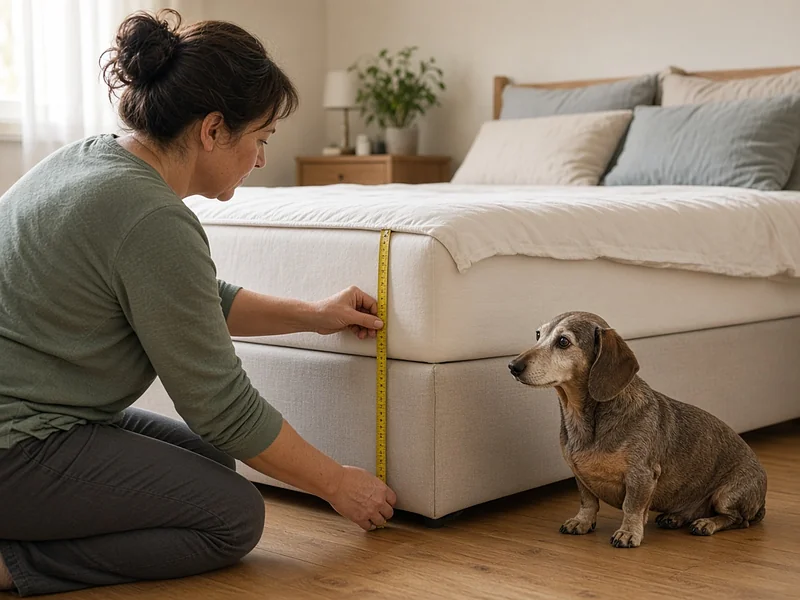
1. Measure your bed
Measure from the floor to the top of the mattress, including any topper. Many adult beds are well over 20 in tall; a ramp that tops out at 24 in will not reach a 30 in bed. Check the ramp's height range against your number.
2. Work out the slope
The slope depends on the height you need to reach and the ramp's length. As a worked example, PetSafe's CozyUp bed ramp is 70 in long and reaches 25 in. That is a rise of about 1 in for every 2.8 in of ramp, an angle of roughly 21 degrees. A 40 in ramp reaching the same 25 in would be closer to 39 degrees: far too steep for a short-legged dog. Our ramp vs stairs guide explains the angle in more detail.
3. Grip
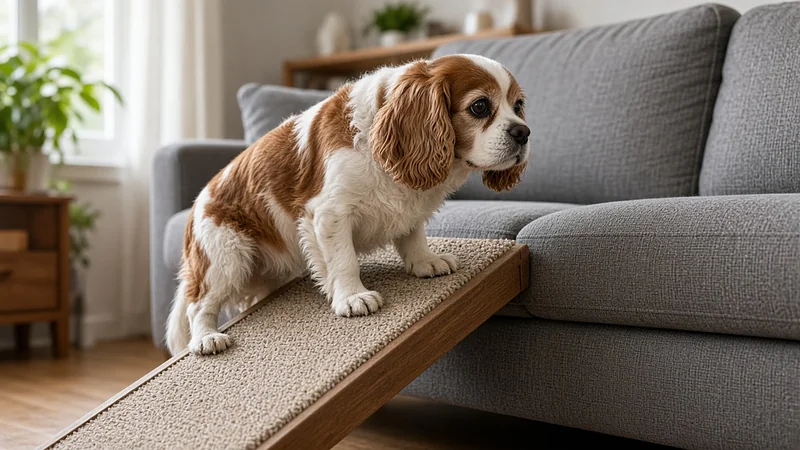
Carpet is common but not always grippy, and some owners of carpeted ramps report slipping. A rubber or rubber-like surface usually gives better traction. Whatever the surface, put a rug or non-slip mat at the bottom so the ramp cannot slide on hardwood.
4. Side rails and width
Rails stop a dog from stepping off the side or taking a shortcut jump halfway up. As a rule of thumb, a walkway of around 12–16 in suits most small breeds.
5. Stability at the top
The top of the ramp should sit level with, or just below, the mattress edge and should not slide away from the bed. Some ramps include straps or ropes to anchor them.
6. Footprint
A long ramp needs floor space beside or at the foot of the bed. Measure the space before you order. Folding ramps can be stored under the bed during the day.
Ramp or bed stairs?
Pet stairs take less floor space but ask the dog to hop each step. The AKC notes that sloping ramps are gentler on sore joints, and for IVDD-prone dogs a ramp avoids repeated hopping; for an arthritic small dog with a healthy back, deep, low stairs can be fine. If you choose stairs, pick deep treads and low risers.
Our picks
- Best on Amazon for tall beds: PetSafe CozyUp Bed Ramp (reaches 25 in over 70 in of ramp)
- Best bed stairs: Pet Gear Easy Step Bed Stair (26 in tall, L-shaped)
- Best small and flexible: Pet Gear StRamp (steps or ramp)
- Worth knowing, sold direct: DoggoRamps Small Dog Ramp for Bed and Alpha Paw PawRamp
| Product | Key specs | Link |
|---|---|---|
| PetSafe CozyUp Bed Ramp | 70 x 16 x 25 in tall, wood with carpet, rated to 120 lb | Check price on Amazon (opens in a new tab) |
| Pet Gear Easy Step Pet Bed Stair | L-shaped, 37.5 x 14 x 26 in, rated 75 lb | Check price on Amazon (opens in a new tab) |
| Pet Gear StRamp Pet Step & Ramp | Converts between steps and a short ramp, indoor use | Check price on Amazon (opens in a new tab) |
Specs are from manufacturer and retailer listings and can change between versions; check the listing before you buy. We don't show prices because they change often; the button shows the current price on Amazon.
PetSafe CozyUp Bed Ramp
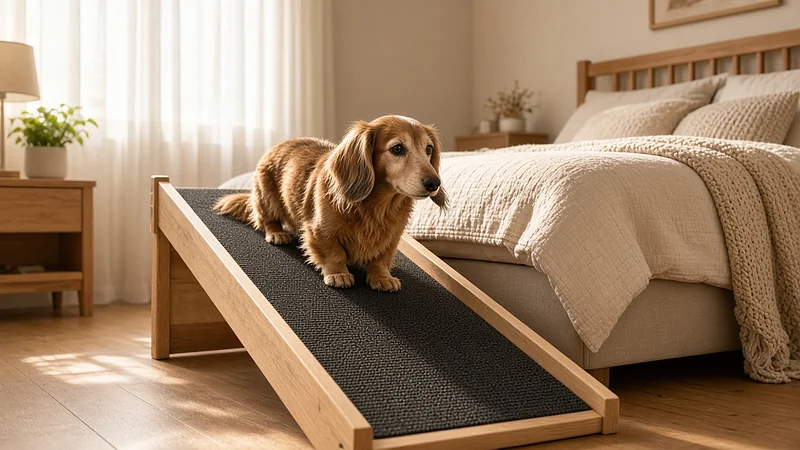
The CozyUp is a wooden ramp with a carpeted walkway, 70 x 16 in, reaching a bed 25 in tall, and rated to 120 lb. Its length is the main reason we rate it: 70 in keeps the slope reasonable for a standard bed. It looks like furniture, which helps if it will live in the bedroom. The downsides are the floor space it needs and the carpet: some owners report slipping, and adding rubber pads underneath helps on hard floors.
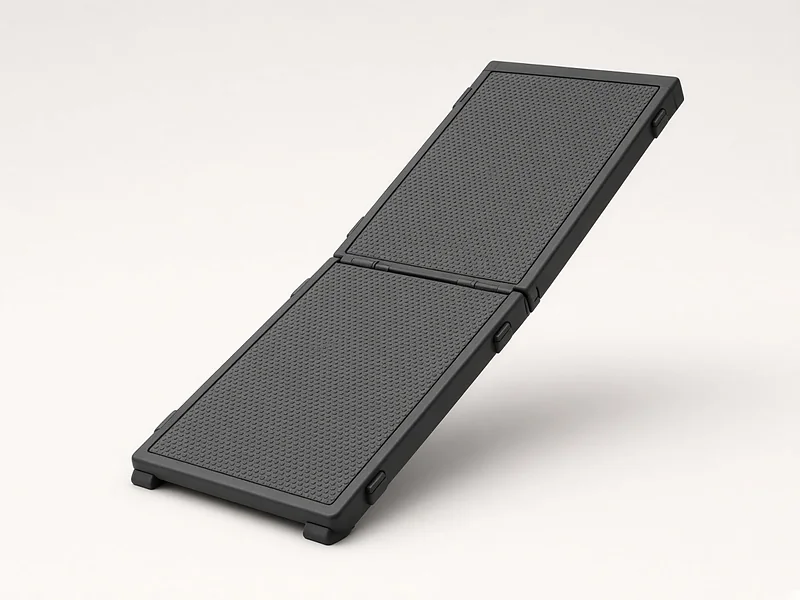
PetSafe CozyUp Bed Ramp
70 x 16 x 25 in tall, wood with carpet, rated to 120 lb
Pros
- Reaches a 25 in bed at a long, gradual slope
- Sturdy wood frame
- Looks like furniture
Cons
- 70 in long: needs real floor space
- Some owners report slipping on the carpet and on hard floors underneath (adding rubber pads helps)
Pet Gear Easy Step Bed Stair
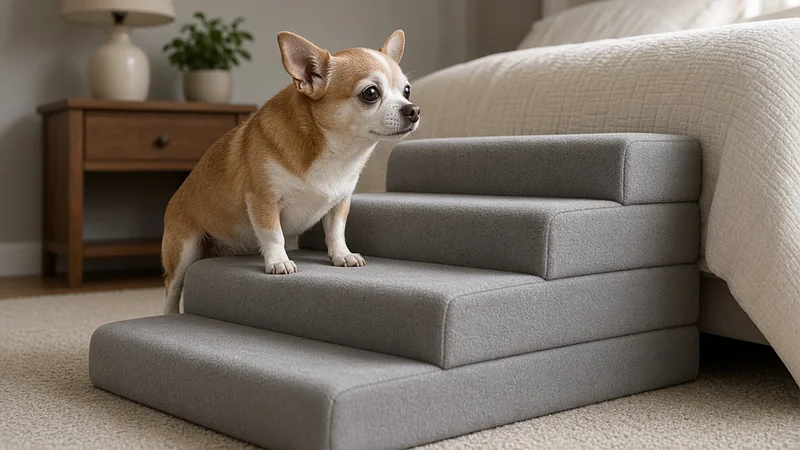
An L-shaped bed stair, 37.5 x 14 x 26 in, rated to 75 lb. The L shape lets it sit along the side of the bed, using less floor space than a long ramp. It is stairs, not a ramp, so your dog still steps up each level. That suits a small senior with arthritis better than a dog in active IVDD recovery.
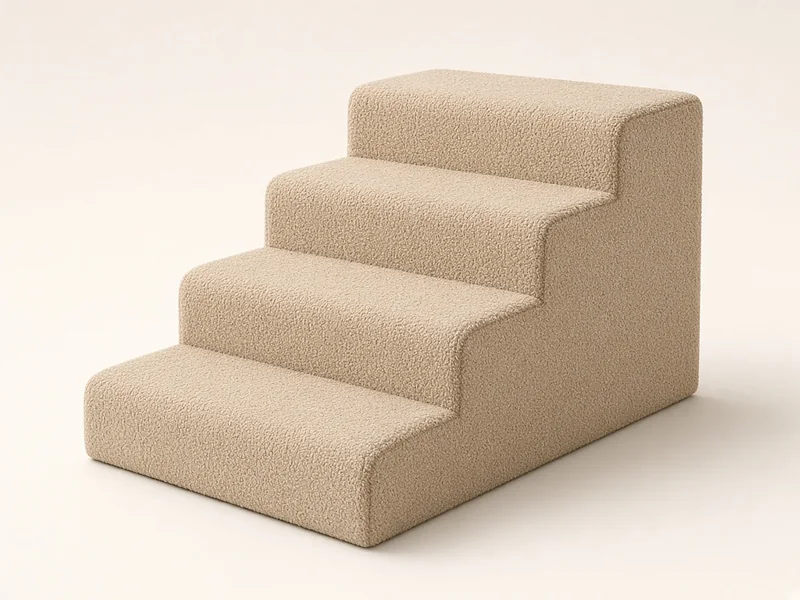
Pet Gear Easy Step Pet Bed Stair
L-shaped, 37.5 x 14 x 26 in, rated 75 lb
Pros
- Deep steps so the whole body fits on each step
- L-shape saves floor space
- Washable tread
Cons
- Still stairs: not ideal while a vet has restricted stair use
- 75 lb limit
Pet Gear StRamp
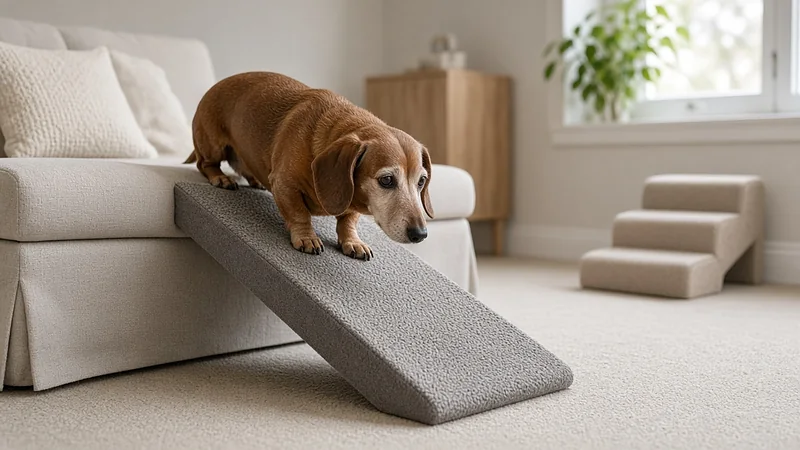
The StRamp converts between steps and a short ramp, for indoor use. It is best for low furniture such as a sofa or a low bed. On a tall bed, a short ramp becomes steep, so check your bed height first.
Pet Gear StRamp Pet Step & Ramp
Converts between steps and a short ramp, indoor use
Pros
- Two tools in one for a couch or low bed
- Removable washable tread
Cons
- Too short for cars
- Short ramps are steep for tall furniture
Sold direct by the maker (not on our Amazon links)
Two ramps designed specifically for small dogs came up repeatedly in our search. We link to the makers' pages for reference; we do not earn from these.
- DoggoRamps Small Dog Ramp for Bed. The maker's page lists a solid hardwood frame, seven height settings from 12 to 37 in, a 14 in walkway, 8 in double-tier side rails, a rubbery "PAWGRIP" surface, an anchor rope to secure it to the bed, a 50 lb dog limit, and a fold-flat depth of 3.5 in. The company says the original was designed for a dachshund with IVDD. It is one of the most expensive options here and was listed as sold out when we checked.
- Alpha Paw PawRamp. Four adjustable heights up to 24 in, a carpet walking surface, and a stated limit of 80 lb. Fine for lower beds and sofas; it will not reach very tall beds.
Teaching your dog to use the ramp
- Lay the ramp flat on the floor first and reward your dog for walking along it.
- Set it against the bed at the lowest useful height. Lead your dog up on a harness with treats; reward at the top.
- Teach the way down too, slowly. Coming down is where most jumps happen.
- Block the jump: when you are not there, close the bedroom door or remove access to the bed.
- Be consistent. Lift your dog on and off until the ramp is reliable.
The AKC suggests letting a dog sniff and explore a new ramp first, placing it where there is a barrier on at least one side, and starting with short sessions.
Other things that help IVDD-prone dogs at home
- Traction. Slipping on hardwood twists the back. See our hardwood floor guide.
- A low, supportive bed of their own. See the best orthopedic dog beds for seniors.
- Car access. Lift your dog in and out, supporting chest and rear together, or see our sedan ramp and stairs guide.
- Browse all ramps and stairs.
If your small dog does not have a back problem and you are short of space, dog stairs for small senior dogs may suit it.
For sofas rather than beds, see dog ramps for couches.
Related reading: our guides to IVDD crate rest setup and slings for IVDD recovery.
FAQ
Is a ramp or stairs better for a dachshund?
For most dachshunds, especially those with IVDD or a history of back pain, a long ramp with rails is preferred because it avoids repeated hopping. Low, deep stairs can suit an arthritic dog with a healthy back. Ask your vet.
How long should a bed ramp be?
Long enough to keep the slope gentle at your bed height. As a reference point, a 70 in ramp reaching 25 in is about 21 degrees; shorter ramps at that height are much steeper.
Can my dog use a ramp during IVDD crate rest?
Usually not. Strict crate rest normally means no furniture at all. Ask your vet when ramp use can start.
How do I stop my dachshund jumping off the bed?
Train the ramp both ways, lift your dog down until the ramp is a habit, and remove bed access when you are not there.
Prices change often, so we do not list them. Check the current price on Amazon.
Sources
- Veterinary Neurology of Chesapeake, 10 Things to Know After Your Dog's IVDD Diagnosis.
- American Kennel Club, Dog Stairs vs. Ramps.
- DoggoRamps, Small Dog Ramp for Bed and FAQs.
- Alpha Paw, Dog Ramp for Bed (PawRamp).
- PetSafe CozyUp Bed Ramp and Pet Gear Easy Step Bed Stair and StRamp listings on Amazon (checked November 2026).