As an Amazon Associate, SturdyPaws earns from qualifying purchases. This article contains affiliate links; buying through them costs you nothing extra. Read our affiliate disclosure.
If your older dog has torn a cruciate ligament or has hip dysplasia, you will see braces advertised as a way to support the joint, avoid surgery or speed recovery. Some dogs do benefit from a brace, but the evidence is thinner than the marketing suggests, and braces have real downsides, especially skin sores.
This guide explains what veterinary surgeons and published research say about knee (stifle) braces, what we could and could not find on hip braces, the complications to look for and how to fit and introduce one. It draws on the American College of Veterinary Surgeons (ACVS), VCA Animal Hospitals and a peer-reviewed study of orthosis complications. We have not tested these braces and do not publish ratings or prices.
Key takeaways
- Braces are one part of non-surgical care, not a replacement for a vet's plan. ACVS lists them as "possibly" part of conservative treatment.
- Complications are common. ACVS warns of sores, continued pain and intolerance. In one study, 58% of dogs with custom knee braces had at least one skin complication in the first three months.
- Size matters for knees. VCA says dogs under 33 lb (15 kg) have a better chance with non-surgical treatment, while heavier dogs generally do better with surgery.
- Hip braces have little evidence. We found no published veterinary studies on off-the-shelf hip supports among the sources we reviewed.
- Weight, rest and rehab are the foundation for both conditions.
Knee braces and cruciate ligament disease
The cranial cruciate ligament (CCL) is the dog's equivalent of the human ACL. ACVS explains that CCL disease is likely a degenerative process in dogs and that up to 50% of dogs diagnosed in one knee will develop the same condition in the other knee, usually within 12–18 months of diagnosis. It lists poor physical condition and excess body weight as risk factors.
The first big decision is between surgery and non-surgical (conservative) management. ACVS says non-surgical treatment usually combines pain medication, exercise modification, joint supplements, physical rehabilitation and possibly braces or orthotics.
VCA adds that dogs under 33 lb (15 kg) have a better chance of doing well with conservative treatment, though there is limited evidence for this approach, while dogs over 33 lb, and dogs with other orthopaedic conditions such as patellar luxation, generally have better outcomes with surgery. Its non-surgical plan is strict rest followed by a gradual return to activity, with pain medication, weight management and veterinary rehabilitation.
So a brace, if your vet suggests one, sits inside that plan. It does not replace rest, weight control or rehab.
What the research says about complications
ACVS puts it plainly: braces can be pricey and have potential complications such as sores, continued pain and patient intolerance.
A 2022 prospective study in Frontiers in Veterinary Science followed dogs fitted with custom orthoses and prostheses for 12 months. At least one skin complication, such as abrasions, hair loss or sores, was reported in the first three months for 8 of 14 dogs (58%) with knee (stifle) orthoses. Two of 15 dogs (14%) with knee orthoses did not accept the device. The study also found that all 11 dogs with stifle orthoses that had gait analysis showed improved weight-bearing on the affected leg by their most recent follow-up. The authors note that research on how well these devices work, and on their complications, is limited.
Two points matter for owners. First, these were custom-made braces fitted by professionals; off-the-shelf braces may fit less precisely. Second, skin problems were common even with professional fitting, so daily skin checks are essential.
Hip braces and hip dysplasia
ACVS lists the signs of canine hip dysplasia as limping, reluctance to rise or jump, shifting weight to the front legs, loss of muscle on the back legs and hip pain. Off-the-shelf hip supports are usually neoprene wraps over the hips and lower back, sometimes with straps around the thighs or chest.
We could not find published veterinary studies testing these hip supports among the sources we reviewed, and the ACVS and VCA hip dysplasia pages we read do not recommend them. What those sources do stress is weight and exercise. VCA says moderate daily exercise and avoiding high-impact activities such as jumping may help keep a dog mobile and strengthen the surrounding structures, and a review on hip dysplasia in PMC notes that maintaining optimum body weight has long been considered one of the most effective ways to reduce signs of dysplasia and osteoarthritis.
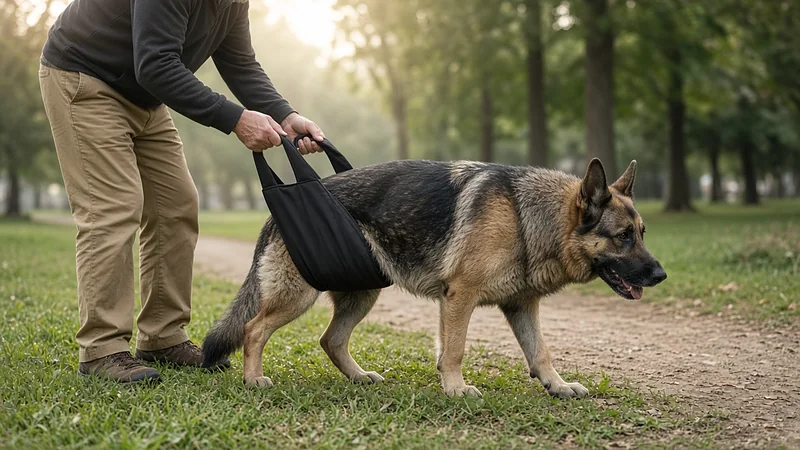
If your vet thinks a hip support is worth trying for warmth or comfort, treat it as a trial, watch your dog closely and stop if it rubs or your dog resists it. For practical help, a rear support harness lets you take weight off weak hips during walks and is well suited to many dogs with dysplasia. Our guide to hip dysplasia home aids covers flooring, beds and ramps.
Three braces compared
Ortocanis knee brace (non-hinged neoprene)
The Ortocanis knee brace is a flexible neoprene support that the maker says gives compression and stability while allowing natural movement. It is sized by measuring the upper thigh where the leg meets the body, with the leg straight, and Ortocanis advises choosing the smaller size if you are between sizes. It comes in left and right versions. The linked listing is XS, right leg; choose your dog's size and side on the page.
This kind of brace gives support and warmth but does not hold the knee rigidly.
Ortocanis Dog Knee Brace
Non-hinged HDR neoprene knee support with compression; sized by upper-thigh circumference with the leg straight (choose the smaller size if between); left and right versions. Linked listing is XS, right leg (8.3–9.4 in); choose size and side on the page
Pros
- Light, flexible neoprene (3.87 oz in XS)
- Simple thigh-based sizing
- Allows natural knee movement
Cons
- Compression support only; does not immobilise the knee
- Neoprene can rub or overheat; check skin
- Must order the correct side
Labra hinged knee brace
Labra's brace has a metal hinge on the outer side of the knee and three adjustable straps. It is sized by two measurements, the circumference just above the knee and the length from there to an inch above the hock, plus weight. Labra says it is meant for walks, not all-day wear, and should be used with a chest harness. The linked listing is medium, left knee, for 50–75 lb dogs.
Note that a 50–75 lb dog with a CCL tear is in the weight range where VCA says surgery generally gives better outcomes. Discuss this with your vet before choosing a brace instead.
Labra Hinged Knee Stifle Brace
Knee wrap with metal hinge on the outer side and three adjustable straps; sized by circumference just above the knee and length from there to an inch above the hock, plus weight; maker says it is for walks, not all-day wear, and to use with a chest harness. Linked listing is Medium, left knee, 50–75 lb
Pros
- Metal hinge for more side-to-side support
- Two-measurement sizing
- Clear 'walks only' wear guidance
Cons
- Heavier and more rigid than neoprene
- More straps means more rub points
- Needs a separate chest harness
Ortocanis hip support
The Ortocanis hip support is a neoprene wrap over the hips and lower back with hook-and-loop straps, sized by chest circumference; the medium fits a 55–68 cm chest. The maker says it reduces stiffness and supports the hips. We found no published studies on it or similar products.
Ortocanis Hip Support for Dogs
HDR neoprene hip support with hook-and-loop straps, worn over the hips and lower back; sized by chest circumference (Medium: chest 55–68 cm); 9.5 oz
Pros
- Soft, flexible neoprene
- Adjustable straps
- Sized by chest, which is easy to measure
Cons
- No published evidence we could find for hip supports
- Can trap heat and rub
- Covers the back end, so check for urine soiling
| Product | Key specs | Link |
|---|---|---|
| Ortocanis Dog Knee Brace | Non-hinged HDR neoprene knee support with compression; sized by upper-thigh circumference with the leg straight (choose the smaller size if between); left and right versions. Linked listing is XS, right leg (8.3–9.4 in); choose size and side on the page | Check price on Amazon (opens in a new tab) |
| Labra Hinged Knee Stifle Brace | Knee wrap with metal hinge on the outer side and three adjustable straps; sized by circumference just above the knee and length from there to an inch above the hock, plus weight; maker says it is for walks, not all-day wear, and to use with a chest harness. Linked listing is Medium, left knee, 50–75 lb | Check price on Amazon (opens in a new tab) |
| Ortocanis Hip Support for Dogs | HDR neoprene hip support with hook-and-loop straps, worn over the hips and lower back; sized by chest circumference (Medium: chest 55–68 cm); 9.5 oz | Check price on Amazon (opens in a new tab) |
Specs are from manufacturer and retailer listings and can change between versions; check the listing before you buy. We don't show prices because they change often; the button shows the current price on Amazon.
Fitting a brace
- Measure carefully, as the maker's chart describes, ideally with someone helping to hold your dog.
- Check the side. Knee braces are left or right. Labra suggests standing behind your dog to work out which is which.
- Snug, not tight. The brace should not slide down, but you should be able to slip a finger under the straps.
- Ask your vet or rehab therapist to check the fit at your next visit.
Introducing a brace
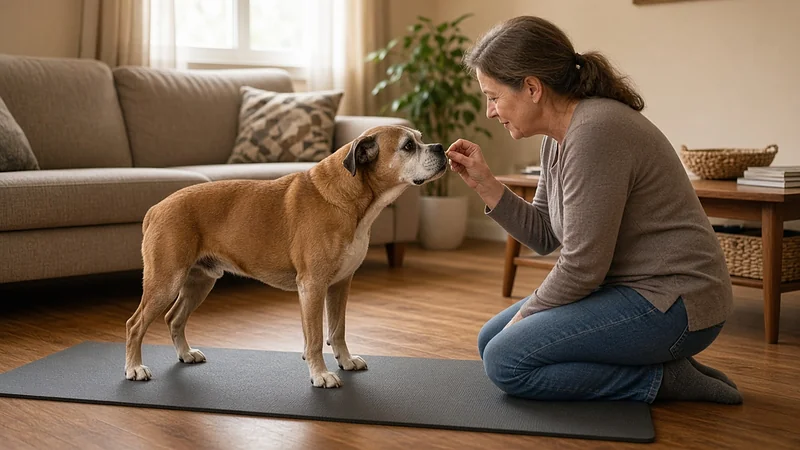
Put the brace on for a few minutes at a time with treats, then take it off. Build up slowly over several days. Walk your dog on a leash in the brace on a flat, non-slip surface and watch how it moves. A dog that holds the leg up, chews at the brace or refuses to walk is telling you something; stop and ask your vet. Labra advises patience and a treat or two while your dog gets used to it.
Daily skin checks
Because skin complications are so common, check under the brace every time you take it off:
- Look for redness, hair loss, rubbing, swelling or sores, especially at strap edges and behind the knee.
- Keep the brace and the leg clean and dry.
- Do not leave a brace on overnight unless your vet tells you to.
- Call your vet if you see any sore or if your dog seems in more pain.
What matters more than a brace
For both knees and hips, the sources agree on the same foundations: a healthy body weight, controlled activity, pain management and rehabilitation. VCA notes many dogs receive physical therapy after knee surgery, and may benefit from "prehab" before surgery to build strength. If your dog is losing muscle in its back legs, see our guide to muscle loss in the back legs.
Remember too that ACVS warns many dogs with CCL disease in one knee go on to have problems in the other. Protecting the good leg, with traction at home, no jumping and controlled walks, matters as much as supporting the bad one.
FAQ
Can a knee brace replace CCL surgery?
For some small dogs, non-surgical care may be enough. VCA says dogs under 33 lb have a better chance with conservative treatment, though evidence is limited. Heavier dogs generally do better with surgery. Ask your vet.
Do dog hip braces work?
We found no published veterinary studies on off-the-shelf hip supports among the sources we reviewed. Weight control and suitable exercise have much better support.
How long should my dog wear a brace each day?
Follow your vet's advice and the maker's instructions. Labra says its brace is for walks, not all-day wear.
What are the risks of a dog brace?
ACVS lists sores, continued pain and intolerance. A study found 58% of dogs with custom knee braces had a skin complication in the first three months.
Hinged or non-hinged?
Hinged braces give more side-to-side support but are heavier and more rigid. Ask your vet or rehab therapist which suits your dog.
Prices change often, so we do not list them. Check the current price on Amazon.
Sources
- American College of Veterinary Surgeons, Cranial cruciate ligament disease.
- American College of Veterinary Surgeons, Canine hip dysplasia.
- VCA Animal Hospitals, Cruciate ligament rupture in dogs.
- VCA Animal Hospitals, Hip dysplasia in dogs.
- Prospective evaluation of complications associated with orthosis and prosthesis use in canine patients, Frontiers in Veterinary Science, 2022 (PMC).
- Canine hip dysplasia review, PMC.
- Product specifications from the linked Amazon listings, checked 2 November 2026.