As an Amazon Associate, SturdyPaws earns from qualifying purchases. This article contains affiliate links; buying through them costs you nothing extra. Read our affiliate disclosure.
Most dog ramp problems are length problems. An owner buys a ramp, props it against the car, and the dog takes one look at the slope and refuses. Or the dog tries it, slips halfway and never trusts it again. The ramp itself may be perfectly good. It was simply too short for the height it had to climb.
This guide shows you how to measure the height your dog needs to reach, how to work out the angle a given ramp will produce, and how long a ramp you need for the slope you want. It includes a ready-made chart so you do not have to do the maths. It draws on guidance from the American Kennel Club, VCA Animal Hospitals and an evidence review on ramp angles. We have not tested these ramps on our own dogs; product lengths come from the listings and makers.
Key takeaways
- Measure the rise, not the car. The rise is the vertical height from the ground to the surface the dog steps onto.
- Length controls the angle. For the same rise, a longer ramp is a gentler slope.
- There is no single proven safe angle. We found no veterinary guideline that sets one; treat angle figures as geometry, and watch your dog.
- Gentler is easier, within reason. A very long ramp is heavy and awkward; find the shortest ramp your dog uses calmly in both directions.
- Grip and stability matter as much as slope. A gentle ramp that slides or flexes is still unsafe.
Rise, run and ramp length: the three numbers
Three measurements describe any ramp set-up, and it helps to keep them straight before you shop.
Rise is the vertical height the dog has to climb, from the ground to the top surface. For a car, that is the cargo floor or the seat. For a bed, it is the top of the mattress. For a porch, it is the top step or the deck.
Ramp length is the length of the sloping surface the dog walks on. Product listings give this number, usually as a maximum for telescoping ramps.
Run is the horizontal ground distance from the foot of the ramp to the point under its top end. You need enough clear space for the run, which matters in a garage, a narrow driveway or a bedroom.
The angle of the ramp depends only on the rise and the length. A 24 inch rise with a 72 inch ramp gives the same slope whether the ramp is plastic or aluminium. That is why measuring the rise accurately is the single most useful thing you can do before buying.
How to measure the rise
Use a tape measure and a helper if you can. Measure straight up, not along a slant.
- Park where you will usually load. Measure on the driveway or the spot you use most. A sloping road or a kerb changes the rise.
- Find the landing point. For an SUV, this is the cargo floor just inside the bumper, not the bumper itself, unless the ramp will rest on the bumper. For a sedan, it is the top of the seat cushion where the ramp will rest.
- Measure from the ground to that point. Hold the tape vertical. Note the number in inches or centimetres.
- Check with the car loaded. Suspension sinks a little with passengers and luggage, so a loaded car may be slightly lower. Measuring empty gives you the worst case.
- For furniture, measure to the top of the cushion. A soft mattress compresses under the ramp's top edge, so measure the height the ramp will actually sit at.
Write the rise down. Every calculation below starts from it.
Chart: ramp length needed for a given angle
This chart shows the approximate ramp length needed to reach a given rise at three example angles. We chose 18, 20 and 25 degrees because they are the figures most often quoted online. They are not a veterinary standard: an evidence review by Mobility Dog Guide found no veterinary guideline or peer-reviewed study that sets one universal safe angle for dog ramps. Treat the columns as a way to compare options, not as a pass or fail line.
| Rise (inches) | Length at 18° | Length at 20° | Length at 25° |
|---|---|---|---|
| 12 (low bed, porch step) | 39 in | 35 in | 28 in |
| 16 (sofa, sedan seat) | 52 in | 47 in | 38 in |
| 20 (high bed, low hatchback) | 65 in | 58 in | 47 in |
| 24 (many SUV cargo floors) | 78 in | 70 in | 57 in |
| 28 (taller SUV) | 91 in | 82 in | 66 in |
| 32 (large SUV, low truck) | 104 in | 94 in | 76 in |
| 36 (pickup tailgate) | 116 in | 105 in | 85 in |
The formula behind the chart is simple: ramp length equals the rise divided by the sine of the angle. You do not need to use it; find your rise in the left column and read across.
Chart: the angle a ramp gives at your height
Most people already have a ramp in mind and want to know how steep it will be. This second chart works the other way. Find the ramp's listed length and read across to your rise.
| Ramp length | 16 in rise | 20 in | 24 in | 28 in | 32 in | 36 in |
|---|---|---|---|---|---|---|
| 62 in | 15° | 19° | 23° | 27° | 31° | 36° |
| 69 in | 13° | 17° | 20° | 24° | 28° | 31° |
| 72 in | 13° | 16° | 20° | 23° | 26° | 30° |
| 87 in | 11° | 13° | 16° | 19° | 22° | 24° |
Two cautions. First, the listed length is the full length of the ramp. Some of it hooks over the bumper or rests on the ground, so the walking surface is a little shorter and the real angle a little steeper. Second, a telescoping ramp only reaches its listed length when fully extended; a shorter setting is steeper.
Which angle should you aim for?
Here the honest answer is that it depends on the dog. The geometry is certain; the safe limit is not. The review mentioned above found that published studies of dogs on ramps measure joint movement and gait, not a point at which a household ramp becomes unsafe. Research angles should not be treated as targets for an older or arthritic dog.
What the evidence and expert advice do support is this: a longer ramp lowers the slope, and the dog's strength, pain, balance, vision and confidence decide what it can manage. The American Kennel Club notes that an advantage of ramps over stairs is that you can start with a low angle and increase it gradually as the dog becomes comfortable. VCA Animal Hospitals recommends ramps for getting in and out of vehicles for dogs with osteoarthritis, and says most dogs learn quickly.
A practical way to decide:
- Weak back legs, recent surgery or pain: choose the longest ramp you can store and carry, and expect to spend longer training.
- Stiff but steady dogs: a mid-length ramp may be enough. Watch the descent, which is usually harder than the climb.
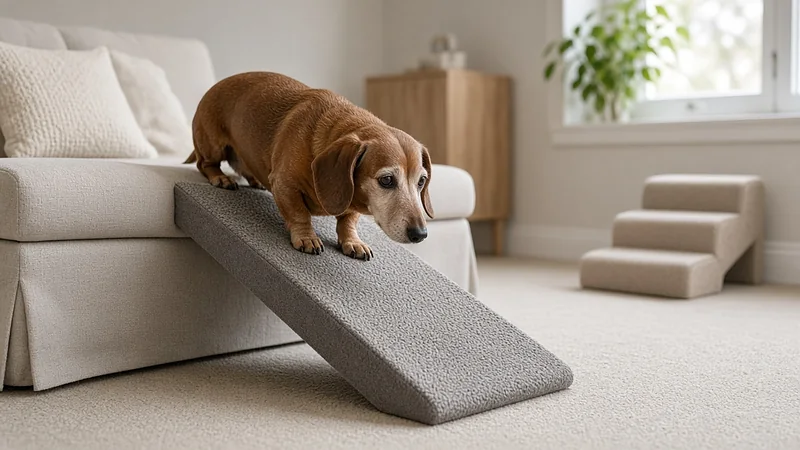
- Small dogs: short legs mean each step covers less ramp. A slope that looks gentle to a Labrador can feel steep to a Dachshund.
- Dogs that freeze or rush: both are signs the slope or the surface is too much. Lower it if you can.
Worked examples
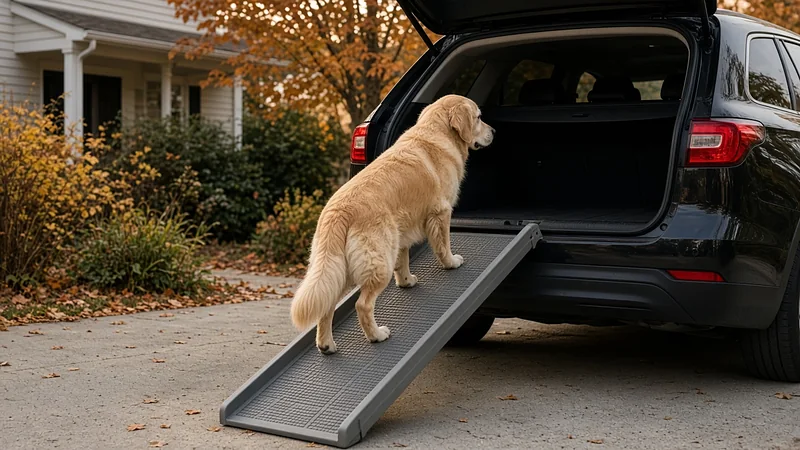
A Labrador and a mid-size SUV. The cargo floor measures 26 inches. A 62 inch folding ramp would sit at about 25 degrees; a 72 inch ramp at about 21 degrees; an 87 inch ramp at about 17 degrees. If the dog is still fairly strong, the 72 inch ramp may do. If its back legs are weak, the longer ramp gives more margin, at the cost of extra length to store.
A small terrier and a sedan back seat. The seat is 18 inches up. A 62 inch ramp gives roughly 17 degrees. The bigger challenge in a sedan is often the door opening and the space to set the ramp, not its length; see our guide to sedan ramps and stairs.
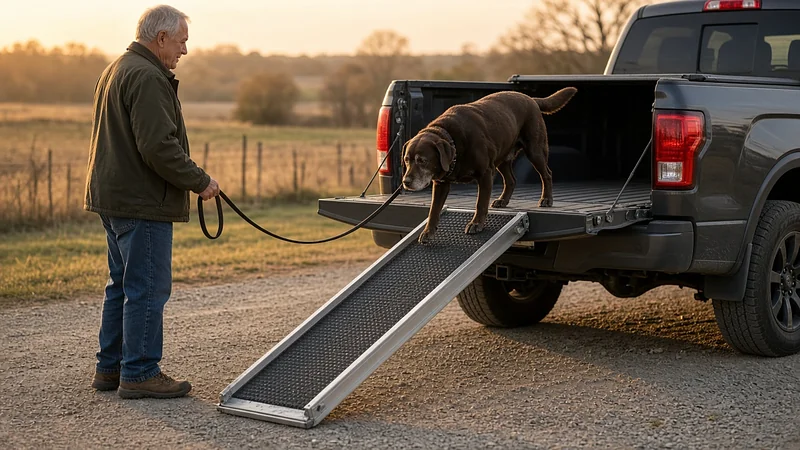
A German Shepherd and a pickup. The tailgate is 34 inches. Even an 87 inch ramp is about 23 degrees here. For trucks, the tallest vehicles, we cover the options in ramps for pickup trucks.
Ramp lengths of the models we cover
These are the ramps from our other guides, with their listed lengths. Use the charts above to see what angle each gives at your height.
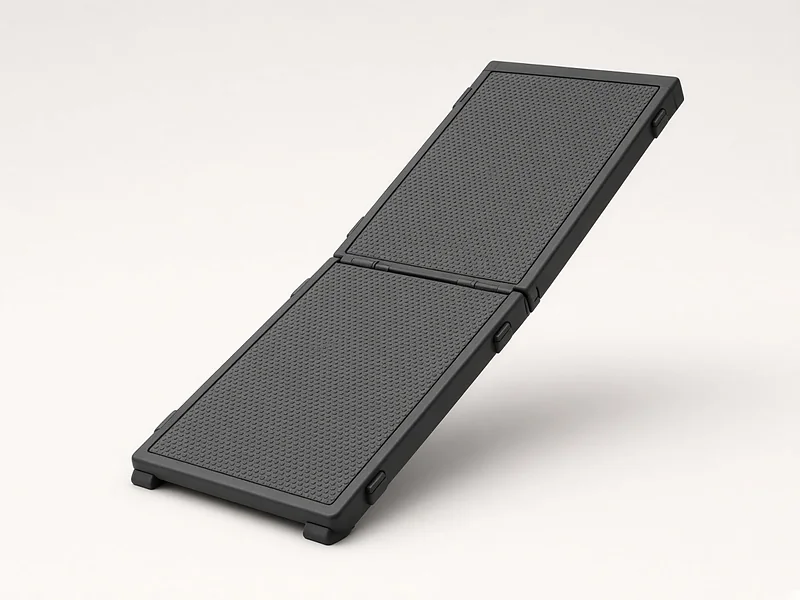
PetSafe Happy Ride Extra Long Telescoping Dog Ramp
47–87 in long, 20 in wide, aluminum, 18 lb, rated to 300 lb
Pros
- Longest common telescoping ramp: 87 in gives a gentler angle into tall SUVs and trucks
- 20 in walking width suits big or unsteady dogs
- Light for its length (18 lb)
Cons
- Long and bulky to stow in smaller cargo areas
- Pricier than folding ramps
- Some dogs need time to trust any ramp surface
PetSafe Happy Ride Deluxe Telescoping Dog Ramp
39–72 in long (99–183 cm), aluminum, rated up to 400 lb per PetSafe
Pros
- Telescopes to suit both sedans and mid-height SUVs
- Very high weight rating
- Side rails
Cons
- At 72 in it is steeper than the XL into tall vehicles
- Heavier than folding plastic ramps
Gen7Pets Natural Step Ramp (72 in)
72 x 16 in, poly-grass tread, 17 lb, folds to 36 x 16 x 3 in, rated 250 lb
Pros
- Grass-like tread many owners find grippier than sandpaper strips
- Folds in half for storage
- Rubber grippers and a safety tether
Cons
- 16 in path is narrower than the PetSafe XL
- 72 in is steep for very tall trucks
TRIXIE Heavy Duty 69" Telescoping Pet Ramp
Telescopes from about 31 to 69 in (78–175 cm), about 15.7 in (40 cm) wide, about 15 lb, rated to 198 lb (90 kg) per TRIXIE
Pros
- Telescoping design for different vehicles
- Rated to 198 lb per TRIXIE
Cons
- Shorter than 87 in ramps, so steeper at tall cargo heights
- Narrower (about 15.7 in) than 20 in wide ramps
PetSafe Happy Ride Folding Dog Ramp
Bi-fold plastic ramp, 62 x 16 in, about 10 lb, rated to 150 lb per PetSafe
Pros
- Cheapest of the well-known brand ramps
- Easy to carry and fold
Cons
- Shorter length means a steeper angle
- Less suitable for heavy dogs than aluminum telescoping ramps
| Product | Key specs | Link |
|---|---|---|
| PetSafe Happy Ride Extra Long Telescoping Dog Ramp | 47–87 in long, 20 in wide, aluminum, 18 lb, rated to 300 lb | Check price on Amazon (opens in a new tab) |
| PetSafe Happy Ride Deluxe Telescoping Dog Ramp | 39–72 in long (99–183 cm), aluminum, rated up to 400 lb per PetSafe | Check price on Amazon (opens in a new tab) |
| Gen7Pets Natural Step Ramp (72 in) | 72 x 16 in, poly-grass tread, 17 lb, folds to 36 x 16 x 3 in, rated 250 lb | Check price on Amazon (opens in a new tab) |
| TRIXIE Heavy Duty 69" Telescoping Pet Ramp | Telescopes from about 31 to 69 in (78–175 cm), about 15.7 in (40 cm) wide, about 15 lb, rated to 198 lb (90 kg) per TRIXIE | Check price on Amazon (opens in a new tab) |
| PetSafe Happy Ride Folding Dog Ramp | Bi-fold plastic ramp, 62 x 16 in, about 10 lb, rated to 150 lb per PetSafe | Check price on Amazon (opens in a new tab) |
Specs are from manufacturer and retailer listings and can change between versions; check the listing before you buy. We don't show prices because they change often; the button shows the current price on Amazon.
Run, width and the space you need
Length is not the only number to check. The run, the ground distance the ramp covers, is close to the ramp length at gentle angles. An 87 inch ramp at a 24 inch rise needs roughly seven feet of clear ground behind the car, plus room for you to stand beside it. In a tight garage or a parallel parking spot that may not exist.
Width matters for unsteady dogs. A narrow walking surface leaves less room for a dog that drifts or splays. Large or wobbly dogs generally do better on a wider ramp, and side rails can help some dogs feel secure. Check the ramp's weight rating against your dog's weight too, and allow a margin.
Surface, stability and training
A ramp at a gentle angle still fails if the dog's feet slip or the ramp moves. Before your dog uses it, put your own weight on the top, middle and bottom and check that it does not rock, slide or bow. Rubber feet at the base and a lip or strap at the top reduce shifting.
The tread matters. Sandpaper-like grit, rubber and artificial grass all give grip; smooth plastic, wet or icy surfaces do not. Keep the surface clean, and dry it in rain.
Start training on the flat. Lay the ramp on the ground and reward the dog for walking along it. Then raise one end a little, for example onto a step, and build up over several short sessions. Keep a hand or a harness handle on the dog for the first real climbs and descents. The AKC advises encouraging regular use without overdoing it at first, especially for older dogs and dogs recovering from injury.
When a ramp is not the answer
Some dogs never accept a ramp, and some situations make one impractical. A dog with severe weakness may need lifting with a harness instead; our guide to getting an old dog into an SUV without a ramp covers that. For furniture, low stairs or a lower bed may be simpler; see ramp vs stairs.
Common mistakes
- Measuring to the bumper instead of the landing point. The dog has to reach the floor it will stand on.
- Using the ramp at a shorter telescoping setting. Extend it fully for the gentlest slope.
- Buying the shortest ramp to save space. A ramp the dog will not use saves nothing.
- Skipping the stability check. One slide can make a dog refuse the ramp for good.
- Forgetting the way down. Descending is where many dogs rush or slip; keep control on the way out.
FAQ
What angle should a dog ramp be?
No veterinary guideline sets a single safe angle. A longer ramp gives a gentler slope; choose the gentlest practical slope and watch how your dog manages both directions.
How long a ramp do I need for an SUV?
Measure the rise to the cargo floor. For a 24 inch rise, a 72 inch ramp gives about 20 degrees and an 87 inch ramp about 16 degrees.
How do I calculate a ramp's angle?
Divide the rise by the ramp length and take the inverse sine. Or use the chart above, which has done it for common lengths.
Is a steeper ramp ever better?
A shorter ramp is lighter and easier to store, which matters if you will not carry a long one. But a slope your dog will not use is no help.
Why does my dog refuse the ramp?
Common reasons are a slope that feels too steep, a slippery or moving surface, or too little training on the flat first.
Prices change often, so we do not list them. Check the current price on Amazon.
Sources
- Mobility Dog Guide, How steep should a dog ramp be? (review of the evidence on ramp angles).
- American Kennel Club, Dog stairs vs. ramps: choosing the right option.
- VCA Animal Hospitals, Helping your dog with osteoarthritis.
- VCA Animal Hospitals, Creating a comfortable home for your mobility-compromised dog.
- Angles calculated by us from rise and listed ramp length; product lengths from the linked Amazon listings, checked 2 November 2026.