As an Amazon Associate, SturdyPaws earns from qualifying purchases. This article contains affiliate links; buying through them costs you nothing extra. Read our affiliate disclosure.
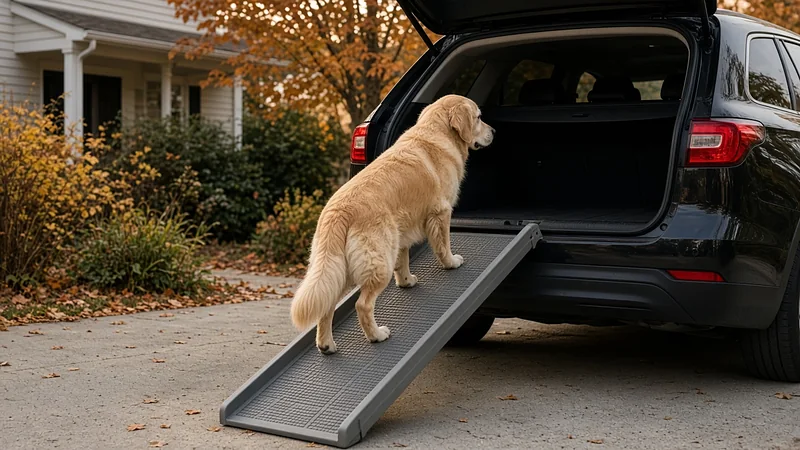
An SUV's cargo floor sits high off the ground. A young dog clears it in one bound. An older dog with stiff hips, weak back legs or a recent injury may stand at the bumper and look at you, or try, miss and scrabble. Ramps are one answer, and we have a separate guide to SUV ramps. But many owners do not want one: no space in the boot, a dog that refuses to walk on it, a car park with no room to unfold it, or a dog that is simply too unsteady for a ramp.
This guide covers the alternatives, from lifting technique to harnesses and back-seat entry, with the trade-offs of each. It draws on guidance from the American Kennel Club, Cornell University's Riney Canine Health Center, Help 'Em Up and VCA Animal Hospitals. We have not tested these harnesses on our own dogs.
Key takeaways
- Stop the jump first. Repeated jumping in and out jolts sore joints, especially the landing.
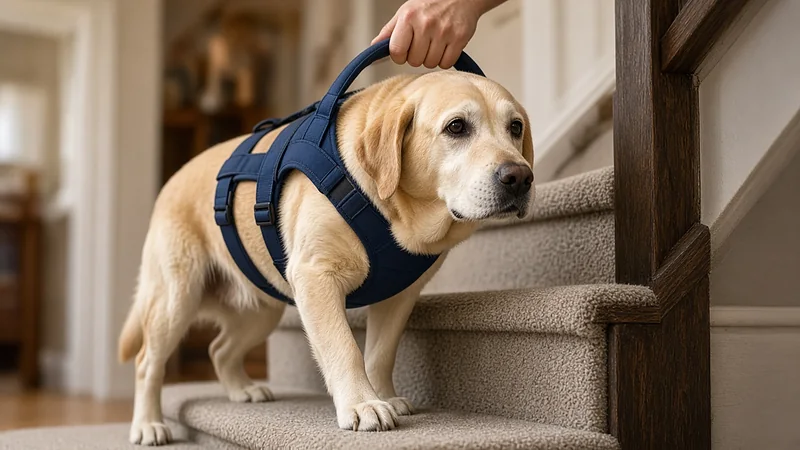
- A lifting harness spreads the load. It gives you handles at the chest and hips instead of grabbing the dog's belly.
- Two people for big dogs. One at the front, one at the back, lifting together.
- Front paws up, then lift the back. Most dogs can still place their front legs; let them.
- The way out matters as much as the way in. Never let a senior dog leap down from the cargo floor.
Why jumping into the car is the problem
For an arthritic or weak dog, the hard part is not just getting up. Jumping down from a high cargo floor lands the dog's weight on its front legs and then its back legs, on hard ground. Jumping up asks the hind legs for a burst of power they may no longer have, and a missed jump means a fall against the bumper. VCA's advice on caring for mobility-compromised dogs recommends steps and ramps for dogs that get onto furniture, and the same principle applies to cars: replace the jump with something controlled.
If a ramp is not an option, that "something controlled" is you, ideally with a harness that gives you good handholds.
Option 1: The lifting harness
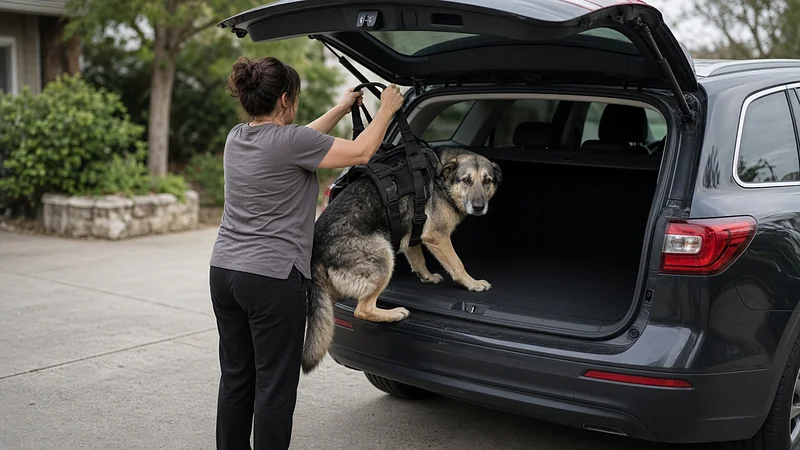
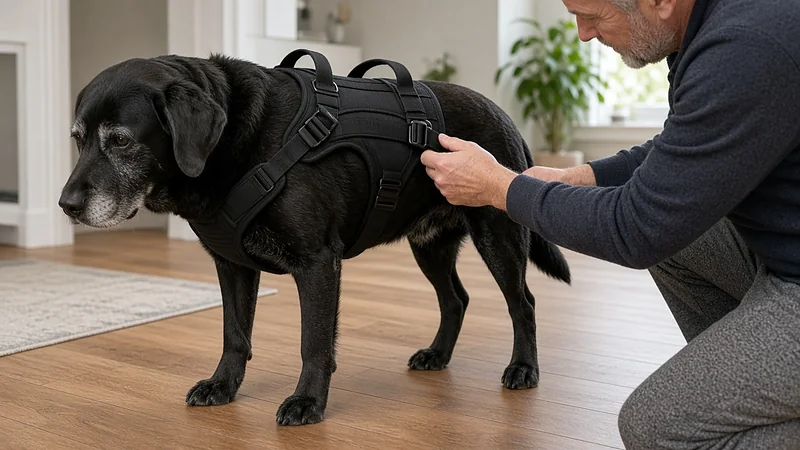
The American Kennel Club describes support harnesses as different from walking harnesses: they give owners leverage to lift and assist dogs that struggle to stand or to manage stairs and hills. For car entry, look for one with a handle over the shoulders and another over the hips, so you can lift both ends evenly.
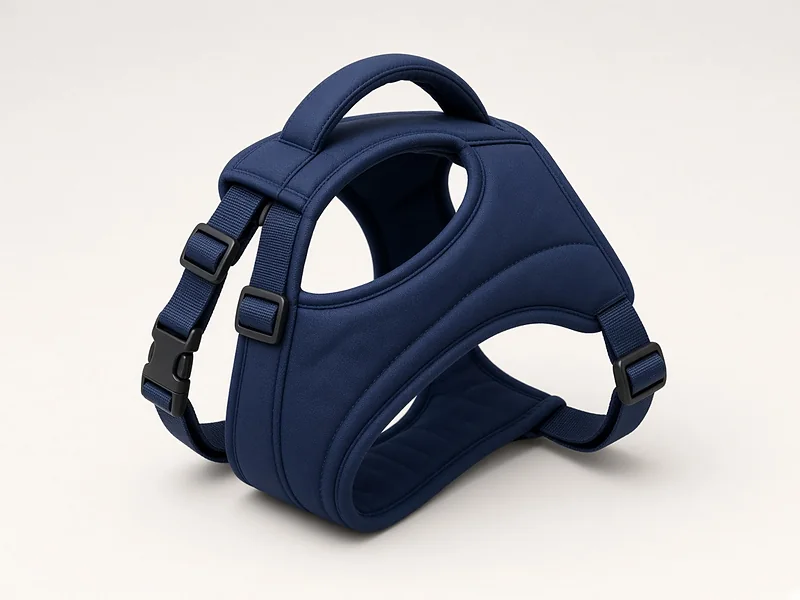
Help 'Em Up Harness
Two-piece full-body harness (front + hip lift), sizes for 10–225 lb, conventional and U-band (male) styles
Pros
- Lifts front, rear or both with separate handles
- Designed to be worn for long periods
- Male (U-band) and conventional versions
Cons
- Most expensive option here
- Sizing is fiddly; the maker suggests sizing the rear down for dogs with muscle loss
The Help 'Em Up is a two-piece harness with a front section and a separate "Hip Lift" rear section, each with a handle. Many owners leave it on for the whole outing, which means it is ready for getting back into the car too. Help 'Em Up's sizing page says most dogs can be sized by weight, but that older dogs with muscle loss in the back end may need to size down the rear section. Our Help 'Em Up review covers fit.
PetSafe CareLift Rear Lifting Aid
Rear-only lifting sling with handles; the linked listing is size Large; check the size chart on the listing
Pros
- Simple, low-cost rear sling
- Quick to slip on for short assists
- Handy as a spare for the car
Cons
- Not meant for all-day wear
- Less padding than GingerLead
If only the back legs are weak, a rear-only lifting aid like the PetSafe CareLift is quicker to put on. Your dog places its front paws on the cargo floor, and you lift the hindquarters with the handles. It does not help with the front end, so it is not ideal for dogs that are weak all over.
GingerLead Dog Support Sling
Padded rear sling with integrated leash, male and female cuts, dogs up to 250 lb, made in USA
Pros
- Padded belly pad spreads the load
- Integrated leash for one-handed walking
- Widely used after orthopedic surgery
Cons
- Rear support only
- Slides on and off rather than staying on all day by default (optional stay-on straps)
A padded belly sling such as the GingerLead supports the middle and back of the dog. It is useful for short lifts, but because it sits under the belly rather than around the legs, you need to be careful with male dogs and with dogs that have abdominal tenderness. The GingerLead is sold in male and female cuts for that reason.
Option 2: The step-by-step lift
Whether or not you use a harness, the technique below is how many owners and rehabilitation staff approach a medium or large dog. Adapt it to your dog and your own back, and get help if either of you is struggling.
- Park on flat ground with room behind the car, and open the tailgate fully.
- Prepare the cargo floor. A non-slip mat or folded blanket stops paws skidding as they land.
- Bring the dog close, facing the car. Let it sniff the cargo floor.
- Front paws first. Encourage the dog to place its front paws on the cargo floor, with a treat if needed. Many dogs can do this even when the back legs are weak.
- Lift the back end. Using the rear harness handle, or with one arm under the dog's hips (not the belly), lift the hind legs up while the dog walks forward. Keep the dog's back level.
- Let the dog settle, then secure it.
Bend your knees, keep the dog close to your body and avoid twisting. A heavy dog is worth a second person: one at the chest, one at the hips, lifting together on a count.
Option 3: A step or block instead of a ramp
A single sturdy step halfway up turns one big jump into two small ones. Some owners use a pet step or a low, non-slip platform. The step must not tip, slide or flex, and it should be wide enough for the dog to stand on with all four feet. Even with a step, guide the dog with a harness for the first few tries. Our guide to steps for sedans and passenger doors covers designs that also suit some SUVs.
Option 4: Use the back seat instead
The rear passenger door of many SUVs opens onto a seat that is lower than the cargo floor. For some dogs, especially medium-sized ones, getting onto the back seat is easier. A hammock-style seat cover or a hard-bottom back-seat extender gives a flat, grippy surface and stops the dog sliding into the footwell. Our car hammocks guide compares them.
URPOWER Hard Bottom Back Seat Extender
Hard bottom 51 x 23.6 in made of detachable honeycomb boards; listed to hold up to 400 lb; zippered side flaps; mesh window and pocket; not recommended for captain's chairs or bucket seats
Pros
- Firm, flat platform over the footwell so the dog does not sink
- Bigger space to lie down
- Boards come out for cleaning
Cons
- Will not fit captain's chairs or bucket seats
- Takes up the whole back seat
- Not a crash restraint
Getting out safely
Many injuries happen on the way out, when a dog decides it has waited long enough and leaps. To stop that:
- Clip the leash on before you open the tailgate, or keep the dog restrained until you are ready.
- Turn the dog to face out, with its front feet near the edge.
- Support the chest with the front handle or your arm and let the front feet step down first. Then lower the back end with the rear handle.
- For a heavy dog, two people again: one supporting the front, one the back.
- Land on a grippy surface. Wet tiles or polished garage floors are slippery.
Keeping your dog secure once it is in
Cornell's Riney Canine Health Center says the safest way for a dog to travel is in a crash-tested harness, seat belt or travel crate, and points to the Center for Pet Safety for recommendations. An older dog may also benefit from a thick, flat bed in the cargo area so it can lie down and does not slide around on corners. If you use a crate, choose one the dog can enter without crouching awkwardly.
Which option suits which dog?
| Product | Key specs | Link |
|---|---|---|
| Help 'Em Up Harness | Two-piece full-body harness (front + hip lift), sizes for 10–225 lb, conventional and U-band (male) styles | Check price on Amazon (opens in a new tab) |
| PetSafe CareLift Rear Lifting Aid | Rear-only lifting sling with handles; the linked listing is size Large; check the size chart on the listing | Check price on Amazon (opens in a new tab) |
| GingerLead Dog Support Sling | Padded rear sling with integrated leash, male and female cuts, dogs up to 250 lb, made in USA | Check price on Amazon (opens in a new tab) |
| URPOWER Hard Bottom Back Seat Extender | Hard bottom 51 x 23.6 in made of detachable honeycomb boards; listed to hold up to 400 lb; zippered side flaps; mesh window and pocket; not recommended for captain's chairs or bucket seats | Check price on Amazon (opens in a new tab) |
Specs are from manufacturer and retailer listings and can change between versions; check the listing before you buy. We don't show prices because they change often; the button shows the current price on Amazon.
- Medium or large dog, weak back legs, can still place front paws: rear lifting aid or a full harness, front-paws-first technique.
- Large dog, weak at both ends: full harness with front and rear handles, two people.
- Small or medium dog, back seat available: rear-door entry onto a seat cover or hard-bottom extender.
- Dog that can manage small steps: a stable intermediate step plus a harness for guidance.
- Dog too heavy for you to lift, even with help: a ramp is probably the right answer after all. See our SUV ramps guide and our lift harnesses for car travel comparison.
Protecting your own back
Owners hurt themselves lifting dogs more often than they expect. Lift with your legs, not your back. Keep the dog's weight close to your chest. Never lift and twist at the same time. If your dog is more than about a quarter of your own body weight, or you have any back problems, plan for a second person, a harness or a ramp. A painful owner and a dropped dog helps no one.
Common mistakes
Lifting a dog by its belly with no support at the chest or hips, which strains the spine. Letting the dog jump down "just this once". Using a slick cargo floor with no mat. Lifting the front end only and leaving the back legs dangling. And waiting until the dog has fallen before changing the routine.
How steep should a dog ramp be? See our ramp angle and length chart.
FAQ
How do I lift a big dog into an SUV?
Let the dog place its front paws on the cargo floor, then lift the hindquarters with a rear harness handle or an arm under the hips. For heavy dogs, use two people.
Is it bad for old dogs to jump out of the car?
Repeated jumping down from a high cargo floor jolts sore joints. Lower the dog with support instead, or use a ramp.
What harness is best for lifting a dog into a car?
One with handles at both the chest and the hips, such as a two-piece full-body harness. Rear-only slings suit dogs whose front legs are still strong.
Is the back seat easier than the boot?
Often, because the seat is lower. A hammock or hard-bottom seat extender gives the dog a stable surface.
Should my dog be restrained in the car?
Cornell recommends a crash-tested harness, seat belt or travel crate as the safest options.
Prices change often, so we do not list them. Check the current price on Amazon.
Sources
- American Kennel Club, Mobility devices for dogs: types, benefits and how to choose.
- Cornell University Riney Canine Health Center, Traveling safely with your dog.
- Help 'Em Up, Choosing a harness.
- VCA Animal Hospitals, Creating a comfortable home for your mobility-compromised dog.
- Product specifications from the linked Amazon listings, checked 2 November 2026.