As an Amazon Associate, SturdyPaws earns from qualifying purchases. This article contains affiliate links; buying through them costs you nothing extra. Read our affiliate disclosure.
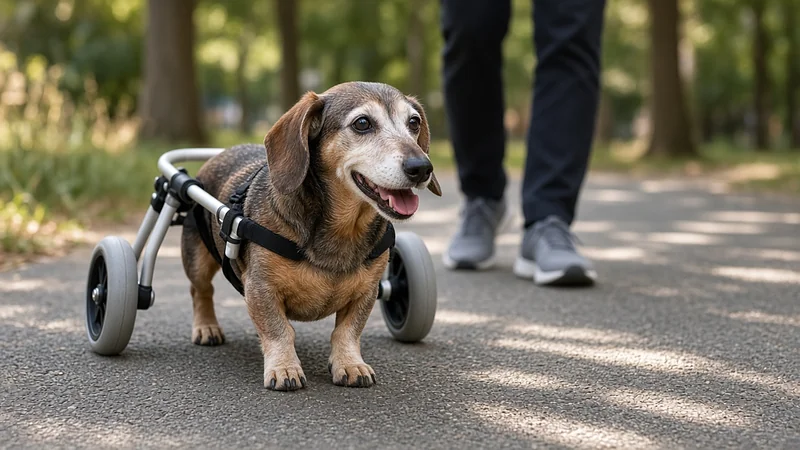
When an older dog can no longer manage the walks it used to, it can lose more than exercise. It misses the smells, sights and people that made those walks the best part of its day. A dog stroller lets a senior dog with arthritis come along on longer outings, rest when it tires and still enjoy being outside.
But a stroller is not a replacement for movement. Controlled exercise is one of the core treatments for arthritis. This guide explains when a stroller helps, how to combine it with short walks, what to look for and how three strollers differ. It draws on VCA Animal Hospitals and an American Kennel Club article quoting veterinarians. We have not tested these strollers ourselves and do not publish ratings or prices.
Key takeaways
- Keep walking. VCA calls controlled, regular exercise one of the core treatments for canine osteoarthritis.
- Use the stroller to extend outings, not to replace walks. AKC's veterinary sources say strollers should complement a dog's activity plan.
- Smaller dogs fit best. A veterinarian quoted by AKC says dogs under 30 lb are often the ideal size.
- Check space, ventilation and a harness tether. Your dog should be able to sit, lie down and turn around.
- Introduce it slowly, with treats.
Why exercise still matters
VCA explains that, left untreated, the chronic pain of arthritis causes a worsening cycle of less movement, weight gain, muscle loss, decreased strength and loss of fitness. It describes controlled, regular exercise as one of the core treatments for osteoarthritis, along with weight control, physical rehabilitation and pain management. Exercise, VCA says, increases circulation to muscles and joints, decreases stiffness, reduces pain and maintains strength.
So the aim is not to stop walking but to change how you walk. VCA recommends walking frequently but for short periods, which reduces the rest time between walks during which joints stiffen. It suggests 10 minutes of walking three times a day as a good starting point for a dog not already in an exercise programme.
Where a stroller fits in
A stroller is useful when your dog can walk a little but not as far as you want to go. AKC's chief veterinarian, Dr Jerry Klein, says tired or older dogs may have arthritis or other conditions that make walking for long periods difficult, and that a stroller can give them a comfortable, safe way to enjoy the outdoors without straining themselves.
AKC also quotes Dr Julie Hunt of Lincoln Memorial University College of Veterinary Medicine, who stresses that strollers are not substitutes for exercise, socialisation or training, and that gentle walking builds heart and muscle strength and helps manage weight. If walking is problematic, she suggests discussing alternatives such as hydrotherapy, physical therapy and medication with your vet.
A practical pattern:
- Walk the first part of the outing at your dog's own pace on a flat surface.
- When your dog slows, lies down or starts to limp, lift it into the stroller.
- Stop at a park or quiet spot and let your dog walk and sniff again for a few minutes.
- Ride home.
For more low-impact ideas, see our guide to enrichment for arthritic dogs.
Which dogs suit a stroller
Dr Hunt says dogs under 30 lb are often the ideal size, and that strollers work best for calm, friendly dogs happy to sit still. Larger dogs may need a specialty stroller or may not fit at all. For big dogs that can still walk but with weak back legs, a dog wheelchair keeps them moving under their own power and may be a better option; ask your vet.
What to look for
- Space. Dr Klein notes that many strollers are essentially "crates on wheels", and like a crate, your dog should have space to sit, lie down and turn around.
- Low, easy entry. For a stiff dog, zipperless or fully opening entries make loading easier.
- Harness tether. AKC notes attachments that secure a leash or harness help prevent escapes while the stroller is moving. Clip to a harness, not a collar.
- Ventilation and shade. AKC advises breathable mesh to prevent overheating, a shade for sunny areas and insulation in cold climates.
- Wheels for your terrain. For grass, trails or uneven ground, AKC suggests durable wheels with sealed bearings and thick tread.
- Brakes. Use them every time you stop.
- Padding. Add a thin foam pad or folded blanket for bony dogs.
- Fold size and weight. Check it will fit in your car and that you can lift it.
Three strollers compared
Pet Gear No-Zip Happy Trails Lite (small dogs)
Pet Gear's Happy Trails Lite is a light small-dog stroller with a zipperless, locking entry, a panoramic window, a three-position canopy, 6 in wheels and front shock absorbers. Its maximum is 25 lb. The small wheels suit pavements and paths better than rough ground.
Pet Gear No-Zip Happy Trails Lite Stroller
Small-dog stroller with zipperless locking entry, panoramic window, 3-position canopy, 6 in wheels, front shock absorbers, parent tray; max 25 lb; listed 13 x 22 x 37 in
Pros
- No-zip entry is quick to open and close
- Light-duty frame for small dogs
- Canopy for shade
Cons
- 25 lb limit
- Small 6 in wheels suit pavements more than trails
- Interior is compact for a dog that lies stretched out
HPZ Pet Rover Premium (small to large dogs)
The HPZ Pet Rover Premium has a stainless-steel frame, one-hand fold, swivelling front wheels, rear brakes and a convertible compartment. It has zipperless entry, a breathable mesh cover and two washable pads. It weighs 22 lb and is rated to 75 lb.
HPZ Pet Rover Premium Stroller
Heavy-duty stainless-steel frame, one-hand fold, anti-vibration Comfort-Ride wheels, 360-degree front wheels, rear brakes, convertible compartment, zipperless entry, reversible handlebar, breathable UV-reflective mesh cover, two washable pads; 22 lb; max 75 lb
Pros
- Carries medium and large dogs up to 75 lb
- Rear brakes and swivel front wheels
- Washable pads and mesh cover
Cons
- 22 lb to lift into a car
- Large when unfolded
- A big dog still has to step in
Ibiyaya Grand Cruiser (large dogs)
Ibiyaya's Grand Cruiser is a foldable four-wheel aluminium pram that the maker says is designed for large, elderly and injured pets. Its canopy opens fully and locks at any angle, with an opening buckle for quick access. It is rated to 110 lb.
Ibiyaya Grand Cruiser Large Dog Stroller
Foldable 4-wheel aluminium pram designed for large, elderly and injured dogs; opening buckle for instant access; canopy fully opens and locks at any angle; one-hand slow-descend feature; max 110 lb; listed 41.3 x 16.5 x 31.5 in
Pros
- Highest weight limit of the three (110 lb)
- Fully opening canopy helps loading
- Aluminium frame
Cons
- Big footprint for storage and cars
- Loading a large dog still needs care
- Heavier dogs make steering and kerbs harder
| Product | Key specs | Link |
|---|---|---|
| Pet Gear No-Zip Happy Trails Lite Stroller | Small-dog stroller with zipperless locking entry, panoramic window, 3-position canopy, 6 in wheels, front shock absorbers, parent tray; max 25 lb; listed 13 x 22 x 37 in | Check price on Amazon (opens in a new tab) |
| HPZ Pet Rover Premium Stroller | Heavy-duty stainless-steel frame, one-hand fold, anti-vibration Comfort-Ride wheels, 360-degree front wheels, rear brakes, convertible compartment, zipperless entry, reversible handlebar, breathable UV-reflective mesh cover, two washable pads; 22 lb; max 75 lb | Check price on Amazon (opens in a new tab) |
| Ibiyaya Grand Cruiser Large Dog Stroller | Foldable 4-wheel aluminium pram designed for large, elderly and injured dogs; opening buckle for instant access; canopy fully opens and locks at any angle; one-hand slow-descend feature; max 110 lb; listed 41.3 x 16.5 x 31.5 in | Check price on Amazon (opens in a new tab) |
Specs are from manufacturer and retailer listings and can change between versions; check the listing before you buy. We don't show prices because they change often; the button shows the current price on Amazon.
Loading a stiff dog
Lifting is the part of using a stroller that can hurt both of you. For a small dog, support the chest and hindquarters together and lower the dog in level, without twisting. For a larger dog, put the stroller on its brake on level ground and help the dog step in with a support harness that lets you lift the back end. Avoid letting your dog jump in or out, which jars arthritic joints. Some owners use a low step for medium dogs.
Introducing a stroller
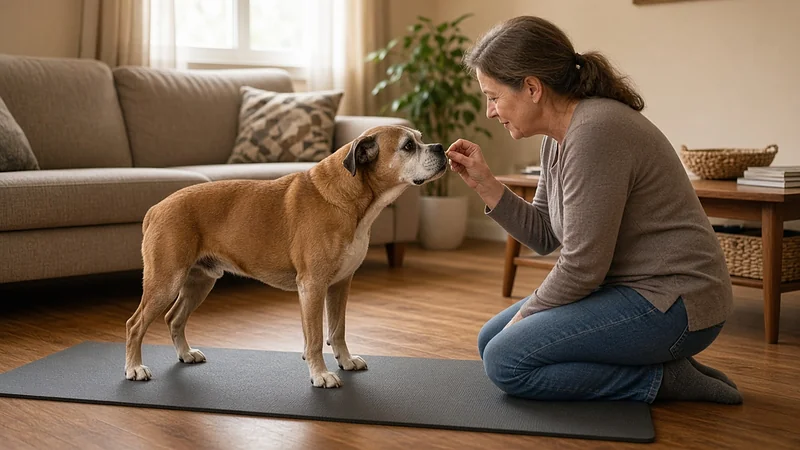
Dr Hunt recommends introducing the stroller gradually and creating positive associations with rewards. She suggests treats given during the walk, or a slow-feeding treat for the ride.
- Leave the stroller open in the house so your dog can sniff it.
- Toss treats inside and let your dog climb in, or lift it in, briefly.
- Clip the tether to the harness and push the stroller a few feet inside the house.
- Go round the block, then build up.
Comfort and safety on outings
- Use the harness tether every time.
- Watch the temperature. Strollers can get hot in the sun, even with a canopy. Check your dog often.
- Take water and a bowl.
- Keep the canopy closed in busy places if your dog gets anxious.
- Bring a towel or pad for wet ground when your dog gets out to walk.
Planning a stroller outing
A little planning makes a stroller outing easier on an older dog. Pick a route with smooth paths and few kerbs, so the ride is not jolting, and with a flat, grassy area where your dog can get out and walk. Go at a cooler time of day in summer. Toilet your dog before you set off and at the halfway point. Keep the first outings short, even if your dog seems happy, and watch how it moves that evening and the next morning: stiffness after an outing is a sign you did too much walking, not too much riding.
Keep a simple diary of how far your dog walked and how it seemed afterwards. Over a few weeks this gives you, and your vet, a clear picture of what your dog can manage and whether its arthritis is changing. If your dog walks less each week, mention it at your next appointment rather than simply riding more.
Common mistakes
- Replacing all walks. Keep short, regular walks.
- Buying too small. Your dog should lie down and turn around.
- No tether. A startled dog can jump out.
- Letting your dog jump out. Lift it down.
- Ignoring soreness. If your dog is sore after outings, talk to your vet.
FAQ
Are dog strollers good for senior dogs?
They can be, as a way to extend outings. AKC's veterinary sources say a stroller should complement, not replace, exercise.
Will my dog lose fitness if I use a stroller?
It might if the stroller replaces walking. VCA describes controlled, regular exercise as a core treatment for arthritis, so keep short walks.
What size dog fits a stroller?
A veterinarian quoted by AKC says dogs under 30 lb are often ideal. Larger strollers are rated to 75 lb or 110 lb.
How long should my senior dog walk?
VCA suggests starting with 10 minutes, three times a day, for dogs not already exercising regularly. Ask your vet for your dog.
Can a stroller be used after surgery?
Ask your vet. During strict rest, any outing should follow their instructions.
Prices change often, so we do not list them. Check the current price on Amazon.
Sources
- VCA Animal Hospitals, Exercising dogs with osteoarthritis.
- American Kennel Club, Are dog strollers good for dogs? Benefits, safety tips, and what to look for.
- Product specifications from the linked Amazon listings, checked 2 November 2026.