As an Amazon Associate, SturdyPaws earns from qualifying purchases. This article contains affiliate links; buying through them costs you nothing extra. Read our affiliate disclosure.
An old dog with sore joints can no longer chase a ball across the park or run with other dogs. Walks get shorter, and it may spend most of the day asleep. It is easy to assume that is simply what old age looks like. But a dog that is physically limited still needs things to do. Boredom can show up as restlessness, attention-seeking or a dog that seems to have switched off.
Enrichment means giving a dog activities that engage its senses and brain. For an arthritic dog, the trick is to swap physical effort for mental and sensory effort. This guide covers activities that ask little of sore joints, drawing on advice from Cornell University's Riney Canine Health Center, the Ohio State University Veterinary Medical Center, Veterinary Partner (VIN) and Clinician's Brief. We have not tested the products mentioned on our own dogs.
Key takeaways
- Swap physical for mental. Clinician's Brief advises focusing on mental and sensory stimulation for pets with reduced stamina.
- Let the nose do the work. Sniff walks, snuffle mats and scent games are tiring without being demanding on joints.
- Old dogs can learn new tricks. Cornell and VIN both recommend simple training with rewards.
- Good footing makes activity possible. Non-slip rugs or mats encourage stiff dogs to move.
- Supervise and adjust. Watch for frustration, pain or chewing pieces off toys.
Why enrichment matters for old dogs
Enrichment is more than entertainment. Clinician's Brief, a journal for veterinary professionals, says enrichment for senior dogs and cats can slow age-related cognitive decline and strengthen the bond between pet and owner. It cites research showing that both short-term and long-term exercise improved memory in elderly beagles.
Veterinary Partner points out that pain is more likely in senior dogs with age-related diseases and can lead to decreased activity, more anxiety and restlessness. While old dogs may not manage long walks, other forms of activity can be "mentally stimulating and tiring". For dogs with cognitive dysfunction, research cited by VCA and AAHA found enrichment added to the benefit of a special diet; see our guide to dog dementia at home.
Start with footing and comfort
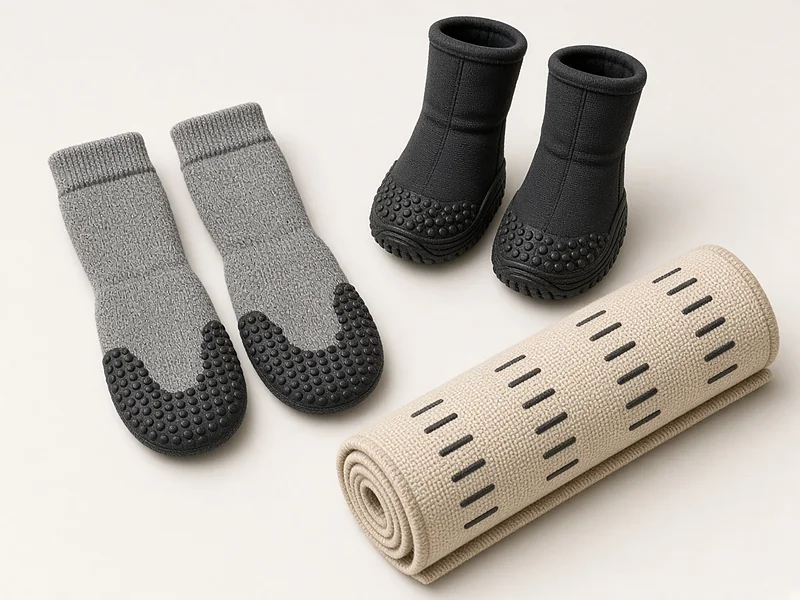
A dog that slips on the floor will not want to play. Clinician's Brief notes that nonslip surfaces such as rugs and mats may give more secure footing and encourage pets to be more active.
Before you start, set up a play area with grip: a rug with non-skid backing or interlocking foam tiles on a hard floor. VCA's arthritis advice suggests both. Foam tiles have the advantage of a little cushioning if the dog lies down to work on a puzzle.
ProsourceFit Exercise Puzzle Mat (1/2 in, 6 tiles)
Six 24 x 24 x 1/2 in interlocking EVA foam tiles with end borders, 24 sq ft total; water-resistant; phthalate-free per listing; clean with warm water and dish soap
Pros
- Covers a whole pen or bed area with no gaps
- Half-inch foam adds cushioning
- Single tiles lift out for cleaning
Cons
- Some dogs chew foam edges
- Liquid can seep through joins
- Foam may dent under heavy objects (per listing)
For paths between rooms, a rubber-backed runner does the same job. Our comparison of foam mats and rugs covers the trade-offs.
Kapaqua Rubber-Backed Custom-Length Runner Rug
22 in wide (other widths in the menu), custom length, 1/4 in low loop pile, rubber backing for hardwood, laminate, vinyl and tile; hand wash only per the current listing
Pros
- Cut to the exact length of your hallway or route, so there are fewer gaps
- Low 1/4 in pile is easy for dragging feet
- Rubber backing made for bare hard floors
Cons
- Not for use on carpet
- Current listing says hand wash only
- 22 in is narrow for a large dog that splays; check wider options
| Product | Key specs | Link |
|---|---|---|
| ProsourceFit Exercise Puzzle Mat (1/2 in, 6 tiles) | Six 24 x 24 x 1/2 in interlocking EVA foam tiles with end borders, 24 sq ft total; water-resistant; phthalate-free per listing; clean with warm water and dish soap | Check price on Amazon (opens in a new tab) |
| Kapaqua Rubber-Backed Custom-Length Runner Rug | 22 in wide (other widths in the menu), custom length, 1/4 in low loop pile, rubber backing for hardwood, laminate, vinyl and tile; hand wash only per the current listing | Check price on Amazon (opens in a new tab) |
Specs are from manufacturer and retailer listings and can change between versions; check the listing before you buy. We don't show prices because they change often; the button shows the current price on Amazon.
Sniff walks
Cornell suggests thinking of walks as "sniffathons": let your dog stroll, snuffle and check everything out, rather than treating the walk as exercise for you. A slow walk where the dog chooses where to sniff is far more tiring mentally than a brisk march, and much easier on joints.
Tips:
- Go somewhere with interesting smells, even if it is just a different street.
- Use a longer, light lead so the dog can investigate.
- Choose soft, even ground over steep or rough paths.
- Keep it short. Veterinary Partner notes that even sitting outside, or a short walk focused on sniffing, can be enriching.
For dogs that can barely walk, a sit in the garden or a slow car ride to a new place for a few minutes of sniffing gives the nose something new.
Snuffle mats
A snuffle mat is a mat of fleece or fabric strips where you hide kibble or treats. The dog sniffs and noses through it to find the food. The Ohio State University Veterinary Medical Center describes snuffle mats as easy to use, often washable, and encouraging natural sniffing and foraging. Importantly for arthritic dogs, it notes they are stationary, can be used by pets with mobility restrictions and can be raised if needed.
Raising the mat a little, on a low, stable surface, may suit a dog with a stiff neck; see our guide to raised bowls for the same principle. Many dogs will happily lie down to work a snuffle mat. You can feed part of a meal this way.
Food puzzles
Food puzzles make the dog work out how to get food out: rolling, nudging, sliding or lifting parts. Cornell recommends them as an indoor way for seniors to exercise mind and nose. The Ohio State guidance notes that strategy toys can keep senior dogs mentally active without needing physical exertion.
Choose carefully:
- Start easy. Ohio State warns that some pets get frustrated if a puzzle is too hard, and lose interest if it is too easy.
- Avoid toys that need chasing. A ball that rolls across the room asks the dog to follow it. For a stiff dog, a puzzle that stays put is better.
- Check materials and durability. Ohio State advises monitoring toys for damage, since swallowed pieces can cause choking or blockages.
- Supervise new toys. Especially with dogs that chew.
DIY options work too. Veterinary Partner suggests kibble in a plastic bottle without its lid, kibble folded inside cardboard tubes, or feeding from a muffin tin with tennis balls on top. Supervise so the dog does not eat the packaging.
Scent games and scavenger hunts
Hide treats or a favourite toy and let the dog find them. Veterinary Partner suggests starting near places the dog already goes, such as beside its bed or water bowl, and expanding from there. Keep hides at nose height, so the dog does not need to jump or climb, and on safe footing.
Simple versions:
- Find it: show the dog a treat, put it under a towel and let it sniff it out.
- Which cup: hide a treat under one of three upturned cups.
- Room search: hide a few treats around one room while the dog waits outside.
If you add scents, Veterinary Partner warns that some essential oils, including cinnamon, tea tree, peppermint and wintergreen, are not safe for dogs.
Training and tricks
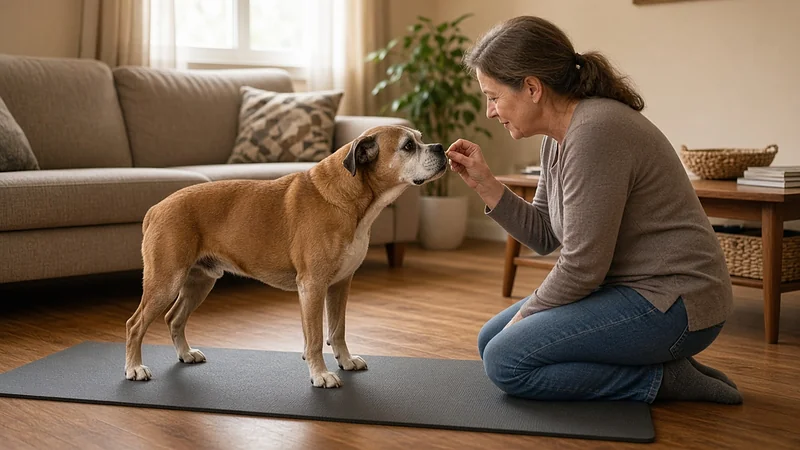
"An old dog absolutely can learn new tricks," says Veterinary Partner, which recommends positive reinforcement training as mentally stimulating without physical exertion. Cornell agrees and advises keeping tricks simple and suited to your dog's physical condition.
Good low-impact tricks include touching your hand with its nose, looking at you on cue, "shake", picking up a toy, or choosing between two objects. Avoid tricks that involve jumping, standing on hind legs, spinning or rolling over for dogs with back or hip problems. Keep sessions to a few minutes and stop while the dog is still keen.
Modified games
Many favourite games can be scaled down. Cornell suggests rolling a ball instead of throwing it, and choosing a ball that glows and makes noise to help dogs with reduced vision and hearing. A short, gentle game of tug with a soft toy, played low and without yanking, suits some dogs; skip it for dogs with neck or front-leg problems.
Social time counts too. Veterinary Partner suggests calm play dates with other senior or calm dogs, watching that your dog chooses to engage.
Gentle physical activity
Enrichment does not replace exercise. VCA says regular, controlled exercise helps most dogs with arthritis, and Clinician's Brief lists slow, controlled lead walks, swimming and hydrotherapy as options for dogs with joint disease. Cornell advises avoiding water with a strong current and keeping swims short and for warm weather. A rehabilitation vet can design exercises for your dog; our guide to muscle loss in the back legs has more.
Adapting for vision and hearing loss
Clinician's Brief notes that eyesight, hearing and sense of smell may all decline in elderly pets. Lean on whichever senses remain strongest. A dog with poor sight may love scent games; a deaf dog can learn hand signals. Approach a sleeping dog with poor senses gently, so it is not startled.
A simple weekly plan
| Day | Activity idea |
|---|---|
| Every day | Short sniff walk; part of one meal in a snuffle mat or puzzle |
| Twice a week | Five minutes of trick training |
| Twice a week | Scent game or scavenger hunt indoors |
| Weekly | A new place to sniff, or a calm visit with a dog friend |
Adjust for your dog. On bad days, keep it to a lying-down puzzle.
Common mistakes
- Making puzzles too hard. A frustrated dog gives up.
- Slippery play areas. Add grip first.
- Overdoing a good day. Cornell notes dogs that want to please may push beyond their limits; watch for stiffness the next day.
- Leaving toys unsupervised. Check for damage regularly.
- Forgetting the calories. Use part of the daily food allowance rather than extra treats.
To extend outings beyond what your dog can walk, see dog strollers for senior dogs.
FAQ
How do I entertain a senior dog with arthritis?
Use activities that work the nose and brain: sniff walks, snuffle mats, food puzzles, scent games and simple tricks.
Are snuffle mats good for old dogs?
Ohio State notes they are stationary, suit pets with mobility restrictions and can be raised if needed.
Can old dogs learn new tricks?
Yes. Cornell and Veterinary Partner both recommend simple, reward-based training for seniors.
How much enrichment does a senior dog need?
Short daily sessions are better than occasional long ones. Watch your dog and adjust.
Does enrichment help dogs with dementia?
Research cited by VCA and AAHA found that enrichment combined with a special diet worked better than diet alone.
Prices change often, so we do not list them. Check the current price on Amazon.
Sources
- Cornell University Riney Canine Health Center, Senior dog enrichment.
- The Ohio State University Veterinary Medical Center, Toys and puzzles for your pet (PDF).
- Veterinary Partner (VIN), Enrichment for senior dogs.
- Clinician's Brief, Environmental enrichment for geriatric veterinary patients.
- VCA Animal Hospitals, Helping your dog with osteoarthritis.
- Product specifications from the linked Amazon listings, checked 2 November 2026.