As an Amazon Associate, SturdyPaws earns from qualifying purchases. This article contains affiliate links; buying through them costs you nothing extra. Read our affiliate disclosure.
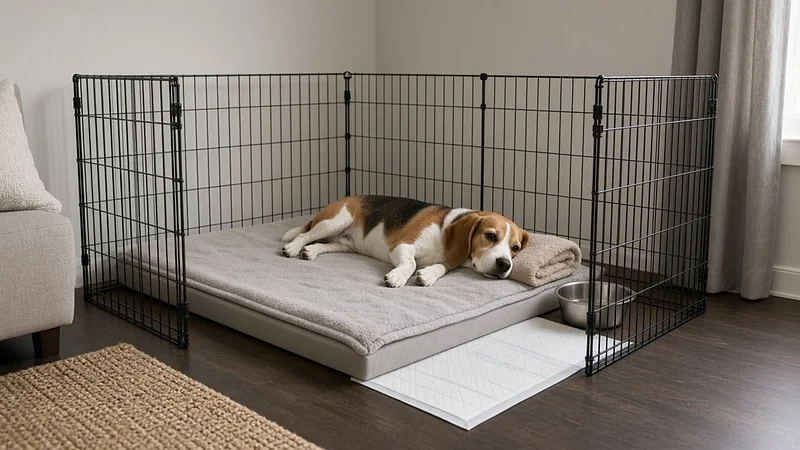
Many dogs spend years sleeping in a crate, and plenty of older dogs still choose to. A crate can be a familiar, safe den. VCA Animal Hospitals describes it as a safe area that can be associated with resting and sleeping. But the thin pad or blanket that suited a young dog may not be enough for an older one with arthritis, bony elbows or a dog recovering from surgery on crate rest.
A crate pad is a flat, crate-shaped mattress. This guide explains how to measure the crate, how thick the foam should be, why the door matters and how to handle accidents. It draws on VCA guidance and manufacturer specifications. We have not tested these pads ourselves, and we do not publish ratings or prices.
Key takeaways
- Measure the crate floor, not the outside dimensions. A pad that bunches up is worse than one slightly small.
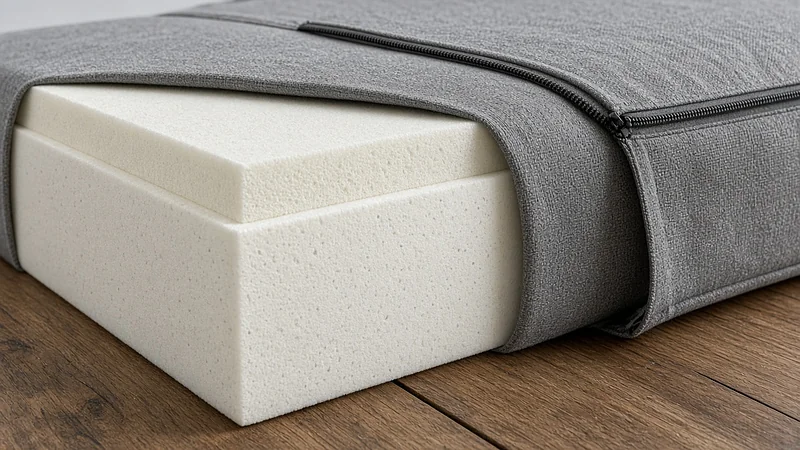
- Choose supportive foam. VCA suggests an orthopedic or memory foam bed to reduce pressure on sore joints.
- Thicker pads raise the floor. Check your dog can still stand comfortably and get through the door.
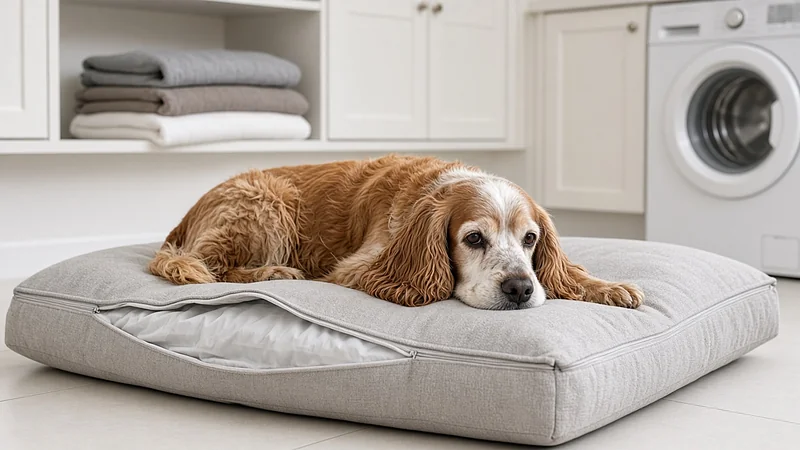
- Washable covers are a must. VCA advises a machine-washable bed or cover in case of urine or faeces.
- Space still matters. VCA says a crate should let your dog lie down and stretch, and stand without hitting its head.
Why crate bedding matters more as dogs age
Older dogs often have less muscle and fat over their bony points. VCA's guidance on caring for pets that cannot move much warns that pressure sores develop over pressure points where bones have less padding, with elbows and hips the common sites, and that soft, thick bedding reduces the risk. A dog that can still move freely is at lower risk, but the principle applies: a hard crate tray with a thin blanket puts pressure on the same points every night.
For arthritis, VCA suggests providing an orthopedic or memory foam bed to reduce pressure on sore joints and improve sleep quality, and choosing bedding that does not retain heat, especially in warm climates.
Measuring the crate
Crate sizes are usually quoted by outside length, but pads need to fit the inside floor. Wire crates have a plastic tray that sits inside the frame, so the usable floor is smaller than the label suggests.
- Take out the existing bedding.
- Measure the inside length and width of the floor tray, wall to wall.
- Measure the inside height from the tray to the roof.
- Note how high the bottom of the door frame sits above the tray.
Choose a pad that is the same size or a little smaller than the floor. A pad that is too big buckles at the edges and creates a lump your dog has to lie across.
For example, our crate rest guide lists the MidWest iCrate 36 at 35.6 x 21.9 x 24.5 in outside. A pad listed at 35 x 22 in may be tight in that crate once you allow for the frame; measure your own crate to be sure.
MidWest iCrate Double Door 36-Inch
35.6 x 21.9 x 24.5 in, listed for adult dogs 40–70 lb, divider panel, leak-proof plastic pan, front and side doors
Pros
- Closed top for dogs that try to climb
- Side door helps sliding a dog in level
- Divider and pan included
Cons
- Too narrow for long recovery in bigger dogs
- Door frames have a lip
- Check length against your dog
Foam thickness and type
Crate pads range from thin fleece mats to 4 in memory foam mattresses. For a senior dog with arthritis, choose something that does not flatten when your dog lies on it. Press down where the hips would sit with your hand; you should not feel the tray through it.
Memory foam and solid orthopedic foam spread weight. Egg-crate (convoluted) foam is lighter and often cheaper but compresses more under a heavy dog. Our guide to foam types compares them in more depth.
Height, headroom and the door
A thick pad takes up height. VCA says a crate should be tall enough for your dog to stand comfortably without hitting its head, and have enough floor space to lie down and stretch out. If a 4 in pad means your dog's head now brushes the roof, the crate is too small for that pad.
The door matters too. Many wire crates have a lip at the door, and a thick pad brings the floor up to or above it. That can make stepping in easier for a stiff dog, but check that the door still closes cleanly and does not trap the pad.
Two crate pads compared
Barker Beds Orthopedic Crate Bed (Medium)
Barker Beds' medium crate bed is 33.2 x 21.2 x 4 in memory foam, made to fit standard 36 x 24 in medium crates. It has a heavy-duty, water-resistant Cordura cover that is removable and machine washable. The listing names it for 25–40 lb dogs and lists a maximum of 70 lb. It is made in Ohio.
At 4 in, it is one of the thicker crate pads, a good choice for a heavier, bony senior dog. Check headroom first.
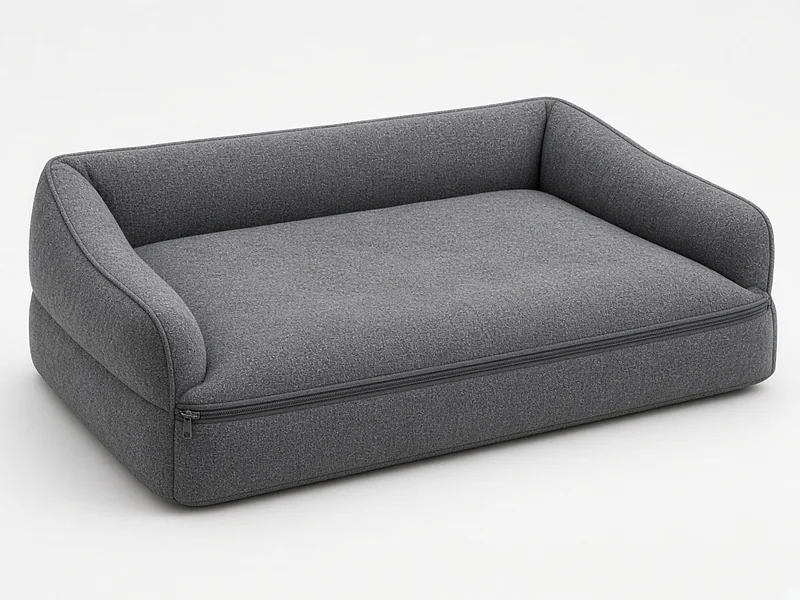
Barker Beds Orthopedic Crate Bed (Medium)
4 in memory foam crate mattress, 33.2 x 21.2 x 4 in, made to fit standard 36 x 24 in medium crates; listed for 25–40 lb dogs (max listed 70 lb); water-resistant Cordura cover, removable and machine washable; made in Ohio, USA
Pros
- 4 in memory foam, thicker than most crate pads
- Durable, water-resistant Cordura cover
- Sized for standard 36 in crates
Cons
- A 4 in pad raises the floor; check door clearance
- Firm Cordura feels less soft than fleece
- Not waterproof inside; add a liner for leaky dogs
Bedsure Egg-Crate Foam Crate Bed (35 x 22)
Bedsure's crate bed is 35 x 22 x 3 in, with high-density egg-crate foam and a sherpa fleece cover. Bedsure lists CertiPUR-US foam and an OEKO-TEX certified fabric, and a removable, machine-washable cover. It is listed for dogs up to 75 lb and is not intended for chewers.
It is softer on top and thinner than the Barker Beds pad, a reasonable choice for a lighter dog or one that runs warm on memory foam.
Bedsure Egg-Crate Foam Crate Bed (35 x 22)
35 x 22 x 3 in crate bed with high-density egg-crate foam, CertiPUR-US certified foam, OEKO-TEX sherpa cover, removable machine-washable cover; listed up to 75 lb; not for chewers
Pros
- Soft sherpa top
- Certified foam and fabric
- Cover unzips for washing
Cons
- 3 in egg-crate foam is thinner than solid memory foam
- Not for chewers
- 35 x 22 in may be tight in some 36 in crates; measure the floor
| Product | Key specs | Link |
|---|---|---|
| Barker Beds Orthopedic Crate Bed (Medium) | 4 in memory foam crate mattress, 33.2 x 21.2 x 4 in, made to fit standard 36 x 24 in medium crates; listed for 25–40 lb dogs (max listed 70 lb); water-resistant Cordura cover, removable and machine washable; made in Ohio, USA | Check price on Amazon (opens in a new tab) |
| Bedsure Egg-Crate Foam Crate Bed (35 x 22) | 35 x 22 x 3 in crate bed with high-density egg-crate foam, CertiPUR-US certified foam, OEKO-TEX sherpa cover, removable machine-washable cover; listed up to 75 lb; not for chewers | Check price on Amazon (opens in a new tab) |
Specs are from manufacturer and retailer listings and can change between versions; check the listing before you buy. We don't show prices because they change often; the button shows the current price on Amazon.
Helping a stiff dog in and out
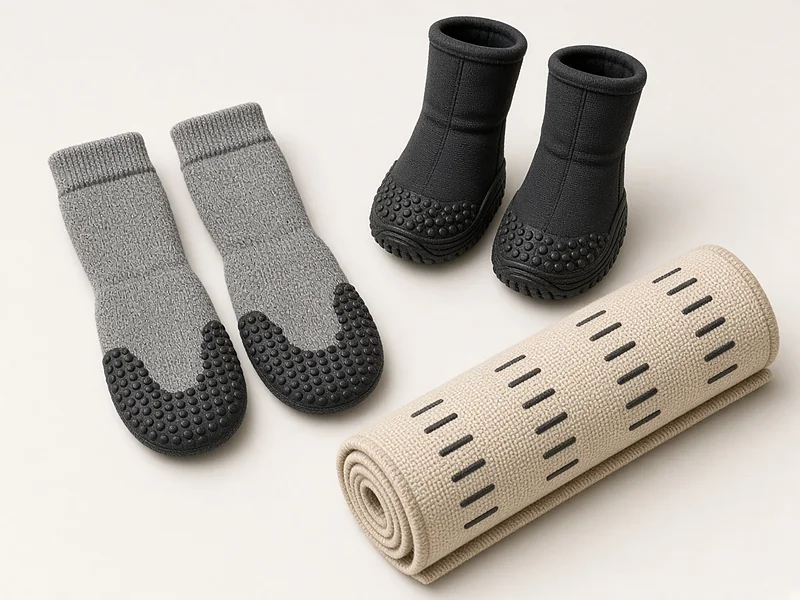
Getting into a crate means ducking the head and stepping over the door frame, which can be hard for a dog with sore hips or a stiff neck. A crate with a side door, a slightly taller crate, or a pad that brings the floor up level with the door lip can all make it easier. Put a non-slip rug outside the door so your dog is not pushing off a slippery floor. If your dog starts hesitating at the crate door, it may be a sign of pain rather than reluctance; mention it to your vet.
Handling accidents
VCA advises choosing a bed or cover that is machine washable to protect against urine or faeces. Neither pad's listing describes a fully waterproof inner liner, so for a dog that leaks, add a waterproof layer under the cover or on top of the pad with a washable absorbent pad over it. Keep a spare cover so the crate is never bare while one is in the wash. Our guide to waterproof beds covers liners in more detail.
Keeping the crate comfortable
- Temperature. VCA advises choosing bedding that doesn't retain heat in warm weather, and keeping arthritic dogs warm and dry. Keep the crate out of drafts and direct sun.
- Water. Clip a bowl to the side so it cannot tip onto the pad.
- Grip. If the pad slides on the tray, a thin rug pad underneath can help.
- Door open when you can. Many older dogs like to come and go. An open crate on a non-slip floor works well as a bed.
- Chews and toys. VCA suggests safe chew toys and food-stuffed toys in the crate; avoid anything your dog could tear the pad with.
Crate pads for crate rest
Dogs on strict crate rest spend almost all day lying down. Ask your vet about bedding: many want thick, supportive foam with a washable cover, checked daily for wetness. VCA warns that dogs who cannot shift position easily can develop pressure sores, so check elbows and hips daily and call your vet if you see redness or sores. Our crate rest setup guide covers pens, beds and how much space to allow.
When to change the pad
Replace or rotate the pad when it no longer springs back, when you can feel the tray through it where your dog lies, or when the cover is torn and the foam is exposed. Foam that has absorbed urine is hard to clean fully, so a waterproof layer helps the pad last.
Common mistakes
- Buying by crate label size. Measure the inside floor.
- Forgetting headroom. A thick pad lowers the roof.
- No spare cover. Accidents happen.
- Too soft for a heavy dog. Press-test for bottoming out.
- Thin pad on crate rest. Ask your vet what they recommend.
FAQ
How thick should a crate pad be for an arthritic dog?
Thick enough that your dog does not feel the tray. Many owners choose 3–4 in foam, but check headroom.
What size crate pad do I need?
Measure the inside floor of the crate and pick a pad the same size or slightly smaller.
Should a senior dog still sleep in a crate?
If your dog likes it and has room to stand and stretch out, a crate can remain a comfortable den. Leave the door open if your dog prefers to come and go.
Are crate pads waterproof?
Many have water-resistant covers rather than waterproof liners. Add a liner if your dog leaks.
Memory foam or egg-crate foam?
Memory foam is usually more supportive for heavier dogs; egg-crate foam is lighter and softer. See our foam comparison.
Prices change often, so we do not list them. Check the current price on Amazon.
Sources
- VCA Animal Hospitals, Crate training your dog.
- VCA Animal Hospitals, Creating a comfortable home for your mobility-compromised dog.
- VCA Animal Hospitals, Helping your dog with osteoarthritis.
- VCA Animal Hospitals, Homecare for paralyzed pets.
- Product specifications from the linked Amazon listings, checked 2 November 2026.