As an Amazon Associate, SturdyPaws earns from qualifying purchases. This article contains affiliate links; buying through them costs you nothing extra. Read our affiliate disclosure.
Strict crate rest is one of the hardest parts of caring for a dog with intervertebral disc disease. Whether your dog has had surgery or is being treated without it, your vet will probably ask you to confine it for weeks so the damaged disc can heal. The setup you build in the first day or two makes a big difference to how well those weeks go, for the dog and for you.
This guide covers how big the recovery space should be, how to choose between a crate, a pen and a small room, and what to put inside. It is based on guidance from Dodgerslist, a long-running IVDD owner resource, and The Rehab Vet, a veterinary rehabilitation practice, with specifications for three MidWest pens and crates whose Amazon listings we checked today. We have not set up these products for a recovering dog ourselves.
Key takeaways
- Size: big enough to stand, turn around and lie fully stretched out, but not big enough to pace or have a separate toilet corner.
- Open-top pens give more floor space and easier access. Choose a closed crate if your dog might climb or jump out.
- Large dogs often outgrow crates. A small, cleared room may work better; ask your vet.
- Inside: a flat, firm bed, a pee pad, padding for extra space and water at head height.
- Dodgerslist cites 4–6 weeks of crate rest for surgical cases and 8 weeks for conservative treatment. Your vet sets the actual length.
Why crate rest matters
In IVDD, a disc between two vertebrae hardens and can bulge or burst, pressing on the spinal cord. Whether the disc is removed surgically or left to settle with medication, the area needs time to stabilise. Movement such as jumping, twisting, running or climbing can make things worse. Dodgerslist describes the recovery space as a way to protect the healing disc: it stops a dog from bolting and stops other pets or children from bothering it. Toys that encourage tugging should be avoided, because sudden neck and back movement can disrupt healing.
On its wheelchair page, Dodgerslist gives typical crate rest periods of 4 to 6 weeks for surgical cases and 8 weeks for conservative treatment with medication and strict confinement. Treat those as typical ranges, not your plan; your vet will tell you how long your dog needs.
How big should the recovery space be?
This is the question owners get wrong most often, in both directions. Dodgerslist says the space should only be big enough for the dog to stand on all four legs, turn around and stretch its legs fully when lying down. It should not be big enough to include a separate toilet area. As a rough guide it suggests a width about equal to the dog's head-to-tail length and a length about 1.5 times that. Any extra room can be padded out with a rolled blanket, which also makes a good headrest and discourages walking around.
The Rehab Vet adds a useful check: the shorter side of the crate should be longer than the dog itself, otherwise it has to turn too tightly. She points out that a recovery crate needs to be much bigger than a puppy-training crate, because the dog will live in it around the clock for weeks, eating, stretching and resting in different positions.
Measure your dog from the tip of the nose to the base of the tail before you buy anything. Then compare that against the inside dimensions of the crate or pen, not just the name of the size.
Crate, pen or small room?
Wire exercise pen
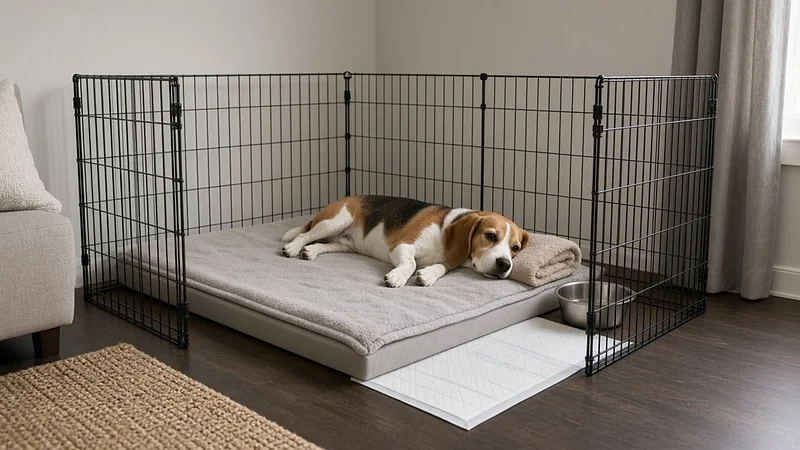
Open-top pens tend to give more floor space than crates, and you can open a door and step in, or lift the dog over the side, without reaching into a box. The Rehab Vet suggests pens for dogs that will definitely not jump out and are not strong or wilful enough to knock the panels over. She notes that most, but not all, dachshunds and pugs are safe in a standard pen. Modular pens can also be set up small at first and opened up later when your vet allows more room.
Closed wire crate
If there is any chance your dog will try to climb out, a crate with a closed top is the safer choice. The Rehab Vet says bouncy small dogs such as terriers are often safer in a very large crate than in a standard-height pen. Dodgerslist prefers wire over plastic travel crates, because a wire suite feels less isolating, and suggests draping a blanket over part of it to create a cosy, restful feel.
A small room
For larger breeds, crates are often simply too small to be comfortable for weeks. The Rehab Vet suggests that if your dog is too big for a crate but too bouncy for a pen, room rest may be the best option, and that you discuss it with your vet. A utility room or a corner of a kitchen, cleared of furniture and with non-slip flooring, can work.
Products that fit these setups
These are MidWest pens and crates whose listings we checked today. They are common and widely available; they are not the only options.
MidWest 30-Inch Exercise Pen (No Door)
Eight 24 x 30 in metal panels, 16 sq ft enclosed area, no-door design, folds flat, tool-free thumb-snap setup
Pros
- Panels can be reconfigured to a smaller rectangle
- No door to get nosed open
- Folds flat after recovery
Cons
- No door, so you lift the dog in and out
- 30 in sides suit calm small-to-medium dogs
- Open top
The 30-inch pen has eight panels that create a 16 sq ft area when set up as an octagon. For crate rest you will usually want a smaller rectangle, which the panels allow. It has no door, so you lift the dog in and out, which suits a small dog that you would be carrying anyway. The 30 in sides suit calm small dogs; a jumper needs a closed crate instead.
MidWest 48-Inch Exercise Pen (Single Door)
Eight 24 x 48 in panels, 16 sq ft area, step-through door with slide-bolt latch and Paw Block
Pros
- Step-through door for you
- Tall sides for larger dogs
- Can attach to a crate
Cons
- Heavy to move
- Door threshold still needs care with a weak dog
- Open top
The 48-inch pen uses taller 24 x 48 in panels and has a step-through door with a slide-bolt latch, so you can walk in to tend a larger dog. It is heavier to move, and any door frame needs care with a dog that cannot lift its paws.
MidWest iCrate Double Door 36-Inch
35.6 x 21.9 x 24.5 in, listed for adult dogs 40–70 lb, divider panel, leak-proof plastic pan, front and side doors
Pros
- Closed top for dogs that try to climb
- Side door helps sliding a dog in level
- Divider and pan included
Cons
- Too narrow for long recovery in bigger dogs
- Door frames have a lip
- Check length against your dog
The 36-inch iCrate measures 35.6 x 21.9 x 24.5 in and is listed for dogs with an adult weight of 40 to 70 lb. It has a front and a side door, a divider and a plastic pan. Before choosing it for crate rest, check that the 21.9 in width is longer than your dog; if not, the dog will struggle to turn, and a larger crate or a pen will be kinder.
| Product | Key specs | Link |
|---|---|---|
| MidWest 30-Inch Exercise Pen (No Door) | Eight 24 x 30 in metal panels, 16 sq ft enclosed area, no-door design, folds flat, tool-free thumb-snap setup | Check price on Amazon (opens in a new tab) |
| MidWest 48-Inch Exercise Pen (Single Door) | Eight 24 x 48 in panels, 16 sq ft area, step-through door with slide-bolt latch and Paw Block | Check price on Amazon (opens in a new tab) |
| MidWest iCrate Double Door 36-Inch | 35.6 x 21.9 x 24.5 in, listed for adult dogs 40–70 lb, divider panel, leak-proof plastic pan, front and side doors | Check price on Amazon (opens in a new tab) |
Specs are from manufacturer and retailer listings and can change between versions; check the listing before you buy. We don't show prices because they change often; the button shows the current price on Amazon.
Watch the door threshold
Most crates and pens have a raised lip at the doorway. The Rehab Vet notes that this lip is too high for many small recovering dogs to step over. If yours has one, guide the dog slowly over it every time, or lift it out with the spine supported. A crate with a side door can make it easier to slide a small dog out level.
What goes inside
Dodgerslist's crate rest guide sets out a simple recovery suite:
- A flat, firm bed. The dog needs a horizontal, supportive surface for its back. A mattress or dog bed wrapped in a plastic bag keeps it dry, with a fleece sheet tucked around it. Avoid deep, squashy beds that the dog sinks into or has to climb out of.
- A pee pad at one end, because accidents are common during recovery.
- Rolled towels or blankets to fill any spare space and give a headrest.
- Bowls at head height, so the dog does not have to bend. Dodgerslist says this matters especially for neck discs.
- A blanket draped over part of the top for a den-like feel.
For a neck injury, Dodgerslist suggests placing the crate on a sturdy raised surface so the dog does not have to lift its head to watch you.
Where to put it
Dodgerslist suggests a central room where you often are, so the dog can see out and feel involved. The Rehab Vet adds that the spot should stay comfortable day and night, away from draughts and direct sunlight. A quiet corner of the living room, rather than a spare bedroom where the dog is alone all day, usually keeps a confined dog calmer.
Toilet trips and getting out
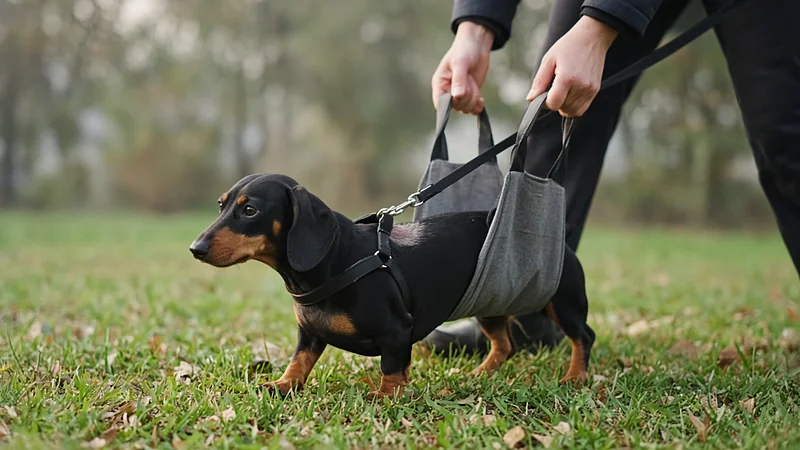
Your vet will tell you how often the dog may come out. Toilet trips are usually short and on a lead, with a sling if the hind legs are weak. Our IVDD sling guide explains how to support the back end without lifting too much. Carry small dogs over any steps with both the chest and back end supported, and keep floors on the route non-slip.
Keeping a confined dog content
Weeks in a small space are boring, and a bored dog fidgets, barks or tries to escape. Quiet company helps most: sitting nearby, talking, gentle stroking if your vet allows. Licking-based food activities can help pass time without the head shaking of tug games. Ask your vet whether any calming support is appropriate if your dog cannot settle.
After crate rest
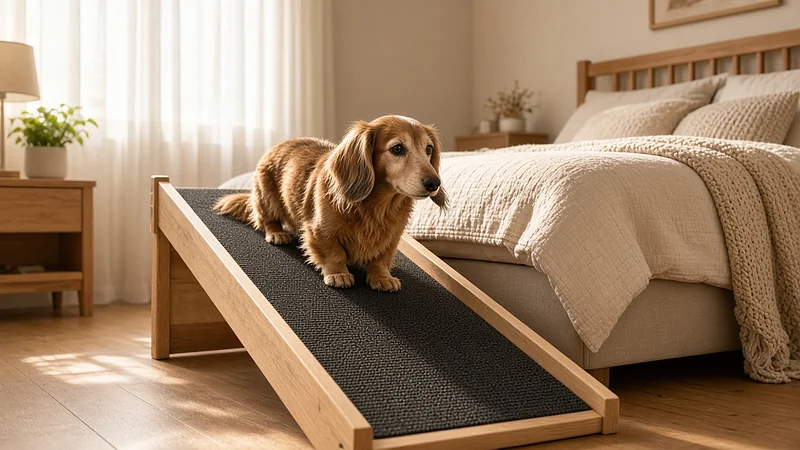
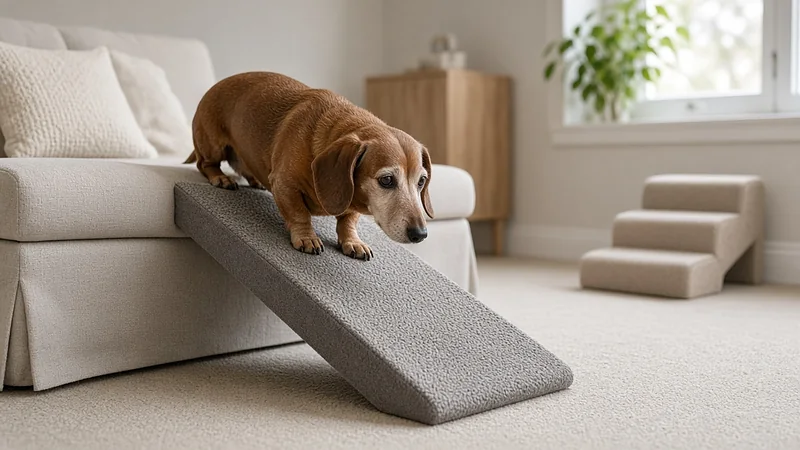
When your vet allows more freedom, open the pen gradually, or add panels, rather than giving the run of the house at once. Block stairs with a gate, and stop jumps on and off furniture with a ramp. See our bed ramps for small dogs with IVDD and ramp vs stairs guides for that stage.
Related reading: our guides to TPLO recovery home setup checklist and foam mats versus rugs.
Dogs in a cone need extra room to turn; see soft cones and recovery suits.
For choosing the mattress itself, see orthopedic crate pads for senior dogs.
FAQ
How big should an IVDD crate be?
Big enough for the dog to stand, turn around and lie fully stretched out, but not big enough to walk about. Dodgerslist suggests roughly the dog's length wide by 1.5 times its length long.
Is a playpen OK for IVDD crate rest?
Yes, for a dog that will not jump or climb out. Pens give more floor space. Use a closed crate for a dog that might escape.
Can my dog sleep on a normal dog bed during crate rest?
Use a flat, firm bed. Dodgerslist stresses a horizontal, supportive surface; avoid deep or squashy beds.
How long does IVDD crate rest last?
Dodgerslist cites 4–6 weeks after surgery and 8 weeks for conservative treatment. Your vet sets the actual length.
What if my dog is too big for any crate?
Ask your vet about room rest in a small, cleared room with non-slip flooring.
Prices change often, so we do not list them. Check the current price on Amazon.
Sources
- Dodgerslist, Tips for strict rest recovery.
- Dodgerslist, What is crate rest? (PDF).
- Dodgerslist, IVDD wheelchairs (crate rest periods).
- The Rehab Vet, Choosing a recovery crate or pen.
- PDSA, IVDD/slipped disc in dogs.
- Product specifications from the linked Amazon listings, checked 2 November 2026.