As an Amazon Associate, SturdyPaws earns from qualifying purchases. This article contains affiliate links; buying through them costs you nothing extra. Read our affiliate disclosure.
Watch an old dog with a stiff neck or sore front legs eat from a bowl on the floor and the case for raising it seems obvious. The dog splays its front legs, drops its head low and shifts its weight forward onto joints that already hurt. Many dogs eat more slowly, stop halfway or drink less than they should.
Raised bowls are one of the simplest home changes vets suggest for arthritic dogs. They also come with a caution that most product listings do not mention: in large and giant breeds, one major study linked raised feeders to a higher risk of gastric dilatation-volvulus (GDV, or bloat), a life-threatening emergency. This guide explains both sides, how to decide for your dog, how to measure the right height and how to set up a feeding station that is easy on joints. It draws on VCA Animal Hospitals, a prospective study published in the Journal of the American Veterinary Medical Association and a critically appraised review in the journal Veterinary Evidence. We have not tested these products on our own dogs.
Key takeaways
- VCA suggests raised bowls for arthritic dogs to reduce neck and back strain, placed between elbow and shoulder height.
- A large study linked raised feeders to bloat in large and giant breeds. Evidence is mixed, but no study found raised bowls reduce bloat risk.
- Ask your vet before raising bowls for a deep-chested large or giant breed, or any dog with a bloat history in the family.
- Raising the water bowl alone is often the easy win. Many stiff dogs struggle more to drink than to eat.
- Put the bowls on a non-slip surface. A dog that slips while eating gets no benefit from the height.
Why raised bowls help stiff dogs
VCA's osteoarthritis guidance lists feeding and water stations among its home changes, saying raised food and water bowls can reduce strain on the neck and back and make mealtimes more enjoyable. It suggests that bowls placed between your dog's elbow and shoulder level are often most comfortable. VCA's advice on making a home comfortable for a mobility-compromised dog makes the same point from the other direction: depending on a dog's size, it can become very difficult to eat or drink from bowls on the floor, and elevating them can make it easier to eat and especially to drink.
The dogs most likely to benefit are those with arthritis in the neck, the front legs, the shoulders or the elbows; dogs with back pain that makes lowering the head uncomfortable; and very tall dogs who have to splay their front legs to reach the floor.
The bloat question
GDV happens when the stomach fills with gas and can twist on itself. It mostly affects large and giant, deep-chested breeds and is fatal without fast treatment.
What the main study found
The best-known study is a prospective cohort study by Glickman and colleagues, published in 2000 in the Journal of the American Veterinary Medical Association. It followed 1,637 dogs of 11 large and giant breeds, including Akitas, Great Danes, Irish Setters, Newfoundlands, Rottweilers, Standard Poodles and Weimaraners. Factors significantly associated with a higher risk of GDV included increasing age, having a first-degree relative with GDV, eating faster and having a raised feeding bowl. The authors attributed about 20 percent of GDV cases among the large-breed dogs, and about 52 percent among the giant-breed dogs, to having a raised feed bowl.
What a later review concluded
A critically appraised topic published in Veterinary Evidence looked for all studies on the question and found only two, with conflicting results. One (the Glickman study) found an effect; the other found no significant effect of feeder height. The review notes that the height that raised risk differed by size: large-breed dogs were at higher risk with bowls one foot high or less, and giant breeds with bowls higher than one foot. It also points out limitations, including that owners' feeding habits may have changed over a follow-up period of up to five years. Its bottom line: no study found that raised feeders reduce GDV risk, so for "at-risk" dogs the safest advice, in the absence of better evidence, is to feed from the floor.
What that means in practice
- For a small or medium dog, or a breed not prone to bloat, the GDV evidence is less relevant, and the joint benefits VCA describes are likely to dominate. Still mention it at your next vet visit.
- For a large or giant, deep-chested breed, or any dog with a parent or sibling that has bloated, the decision is a trade-off that your vet should help you make.
- Ignore claims that raised bowls prevent bloat. Some older advice said so, but the research above does not support it.
- Slow eating was also a risk factor in the Glickman study. Whatever the bowl height, ask your vet about slowing a fast eater down.
Measuring the right height
Use VCA's guideline of somewhere between elbow and shoulder height as a starting point.
- Stand your dog square on a flat floor.
- Measure from the floor to the point of the elbow, and from the floor to the top of the shoulder.
- The rim of the bowl should sit somewhere in that range. Lower in the range for dogs that are comfortable bending a little; higher for dogs with neck pain.
- Watch your dog eat. It should be able to reach the bottom of the bowl without stretching up or crouching down.
- Remember that the product's overall height is not the feeding height. Check what the listing says about where the bowl sits.
A verified example: the Neater Feeder Deluxe with leg extensions
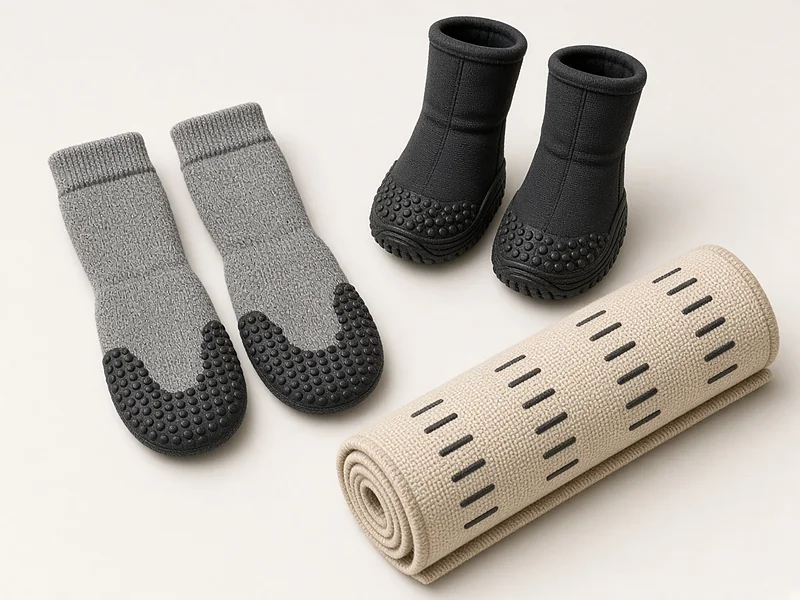
Neater Feeder Deluxe with Leg Extensions (Large Dog)
21 x 13 x 17.5 in with extensions; 11 in feeding height (8 in without extensions per brand table); for dogs over 40 lb with shoulder height over 14 in; 7-cup food and 9-cup water steel bowls; spill-draining basin; non-skid feet
Pros
- Two feeding heights
- Spilled water drains away from the floor
- Non-skid rubber feet
Cons
- Large-dog size only on this listing
- Discuss raised feeding with your vet for bloat-prone breeds
- Listing's digestion claim is not evidence-backed
We picked one example because it addresses two common problems at once: height and spills. The Amazon listing for the large-dog version with leg extensions gives overall dimensions of 21 by 13 by 17.5 inches with an 11-inch feeding height, and says it is recommended for dogs over 40 pounds with a shoulder height over 14 inches. The brand's comparison table shows the same feeder without extensions at an 8-inch feeding height, so the extensions let you choose between the two. Spilled water drains into a lower basin and spilled food stays on top, which helps keep the floor around the bowls dry and less slippery. The listing also mentions non-skid rubber feet.
A note on claims: like many raised bowls, its listing says raised bowls help digestion. We have not found good evidence for that, and as explained above, the research on bloat in large and giant breeds points the other way. Treat it as a comfort and mess-control product, not a health one.
Neater Pets also sells smaller versions for small and medium dogs. Measure first and check the feeding height on the listing for your size.
Other ways to raise bowls
- Adjustable stands let you change height as you find what suits your dog, or as its needs change.
- Wall-mounted or bracket bowls save floor space but need careful installation.
- A sturdy box or step can test whether a raised bowl helps before you buy anything. It must not tip or slide.
- Raise only the water bowl. If your dog has a breed or family risk of bloat and your vet prefers floor feeding for meals, ask whether a raised water bowl is acceptable.
Set up the whole feeding station
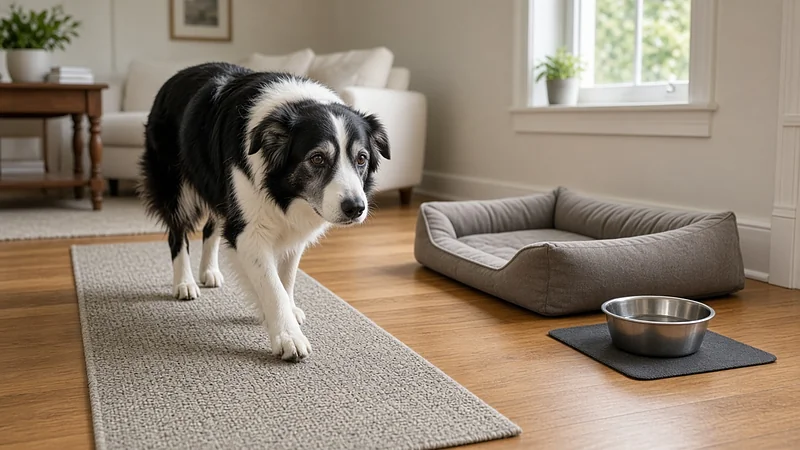
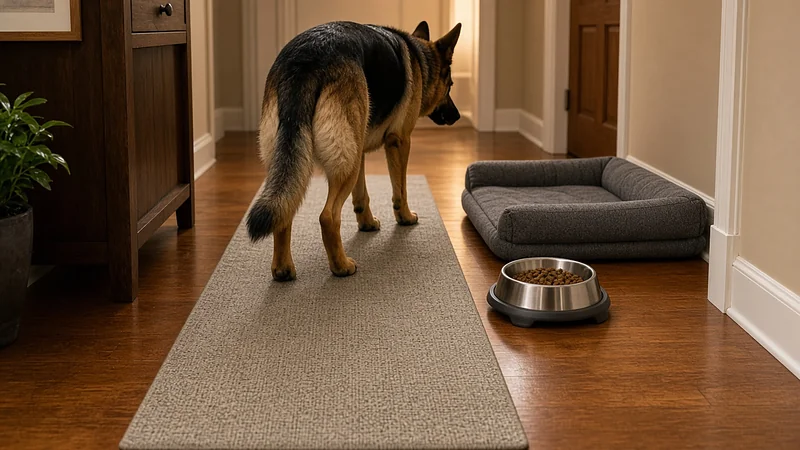
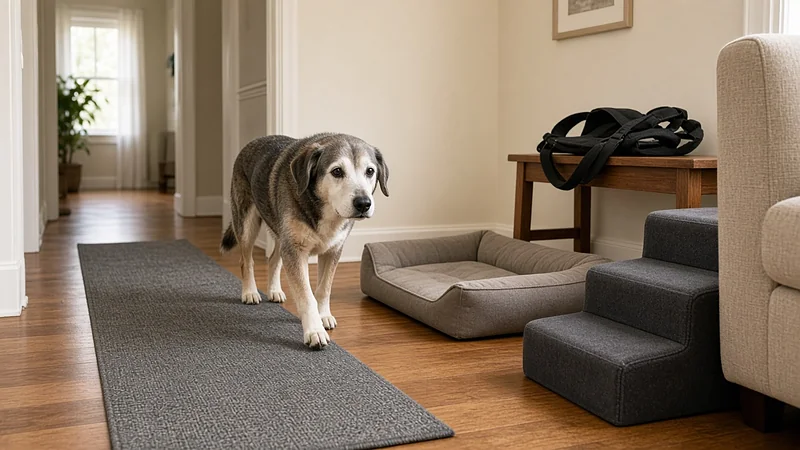
The bowl height is only part of it. A stiff dog standing on a slippery kitchen floor is braced and uncomfortable, whatever the bowl. VCA recommends non-slip rugs or runners where a dog spends time; the feeding area is one of those places, and it is usually tile or vinyl.
- Put a washable, rubber-backed mat under the bowls and where the dog stands.
- Choose a quiet spot so the dog does not have to turn sharply or rush.
- Keep the station close to where the dog rests, especially for a dog that struggles to get up.
- Wipe up spills promptly; wet tile is slippery.
- Check bowls are heavy or held in place so they do not slide away as the dog eats.
Our guides to non-slip runners and arthritis home modifications cover the rest of the house.
Signs your dog would benefit
- It lies down to eat or drink.
- It stops eating partway and walks away, then comes back.
- It splays its front legs wide or bends one elbow to reach the floor.
- It drinks less than it used to, or seems reluctant to lower its head.
- Your vet has found neck, shoulder or elbow arthritis.
Any of these can also signal dental pain, nausea or other illness. Mention them to your vet rather than assuming the bowl is the problem.
Common mistakes
Buying the tallest stand available rather than measuring. Raising bowls for a deep-chested giant breed without discussing bloat risk with the vet. Believing listings that say raised bowls prevent bloat. Putting a raised feeder on bare tile. And forgetting the water bowl, which for many stiff dogs is the harder of the two.
If your old dog seems confused at night, see our guide to dog dementia at home.
FAQ
Are raised dog bowls good for dogs with arthritis?
VCA suggests raised food and water bowls can reduce neck and back strain for arthritic dogs, with bowls between elbow and shoulder height.
Do raised bowls cause bloat?
One large study linked raised feeders to higher bloat risk in large and giant breeds; another found no effect. No study has shown they reduce risk. Ask your vet if your dog is an at-risk breed.
What height should a raised dog bowl be?
VCA says bowls placed between your dog's elbow and shoulder level are often most comfortable. Measure your dog standing.
Should I raise the water bowl too?
Often yes. VCA notes that elevating bowls can make it easier for dogs to drink in particular.
Are raised bowls safe for small dogs?
Bloat is mainly a large and giant breed problem. For small dogs, the main things are the right height and a stable, non-slip set-up.
Prices change often, so we do not list them. Check the current price on Amazon.
Sources
- VCA Animal Hospitals, Helping your dog with osteoarthritis.
- VCA Animal Hospitals, Creating a comfortable home for your mobility-compromised dog.
- Glickman LT et al., Non-dietary risk factors for gastric dilatation-volvulus in large and giant breed dogs, JAVMA 2000 (PubMed abstract).
- Veterinary Evidence, Are dogs that are fed from a raised bowl at an increased risk of gastric dilation volvulus compared with floor-fed dogs?
- Neater Pets, Neater Feeder product range.
- Product specifications from the linked Amazon listings, checked 2 November 2026.