As an Amazon Associate, SturdyPaws earns from qualifying purchases. This article contains affiliate links; buying through them costs you nothing extra. Read our affiliate disclosure.
The first signs are small. Your dog hesitates at the stairs, takes longer to get up, stops jumping onto the sofa, or splays on the kitchen floor. Searching for help brings up hundreds of products: ramps, harnesses, boots, beds, wheelchairs. Most owners do not need most of them, and buying the wrong thing first wastes money and can even make things harder for the dog.
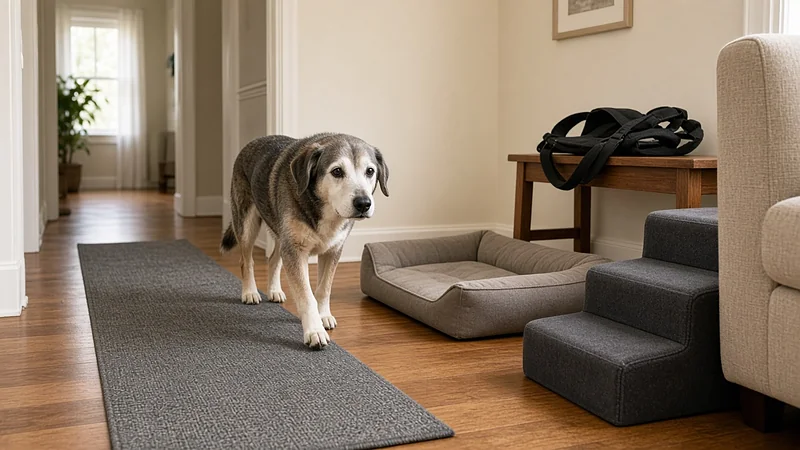
This starter kit puts the common mobility aids in the order we would consider them, based on veterinary guidance and the product research behind all our guides. It is research-based; we have not tested every product on our own dogs. Each section links to a detailed guide.
Key takeaways
- Step 0 is the vet. Pain relief, weight control and rehab usually help more than any product.
- Step 1 is traction: rubber-backed rugs along your dog's routes, short nails and trimmed paw fur. It is the cheapest fix and helps almost every dog.
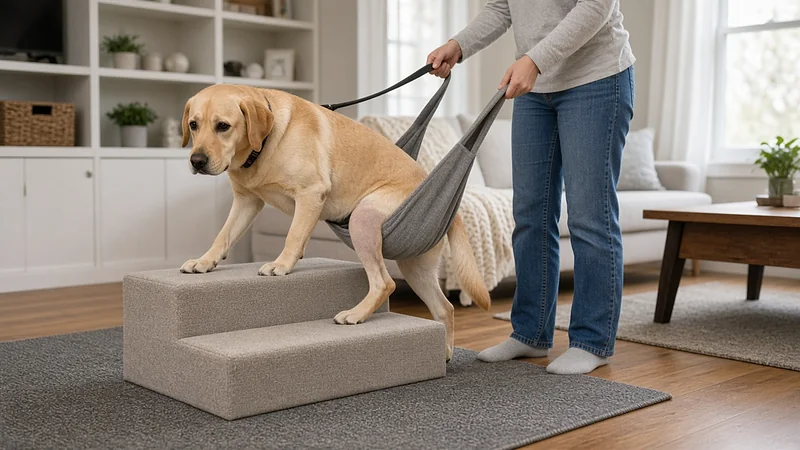
- Step 2 is support: a rear sling for walks and steps, or a full-body harness if your dog needs help to stand or has weak front legs.
- Step 3 is sleep: a supportive, low, washable orthopedic bed.
- Step 4 is access: pet stairs or a ramp for furniture and the car, chosen by height, weight and condition.
- Wait on wheelchairs, braces and specialist gear until a vet or rehab therapist recommends them.
Step 0: See the vet first
VCA Animal Hospitals lists "avoiding slippery floor surfaces" among behaviors that can signal pain in aging dogs. In other words, the slipping you see may be pain, not clumsiness. A vet can examine your dog, discuss pain medication or other treatment, check its weight (extra weight puts more load on sore joints), and suggest exercises or a rehab referral. Ask specifically about stairs, jumping and furniture, and whether your dog has a condition such as IVDD or a cruciate injury that changes the advice.
Step 1: Traction (cheapest, biggest win)
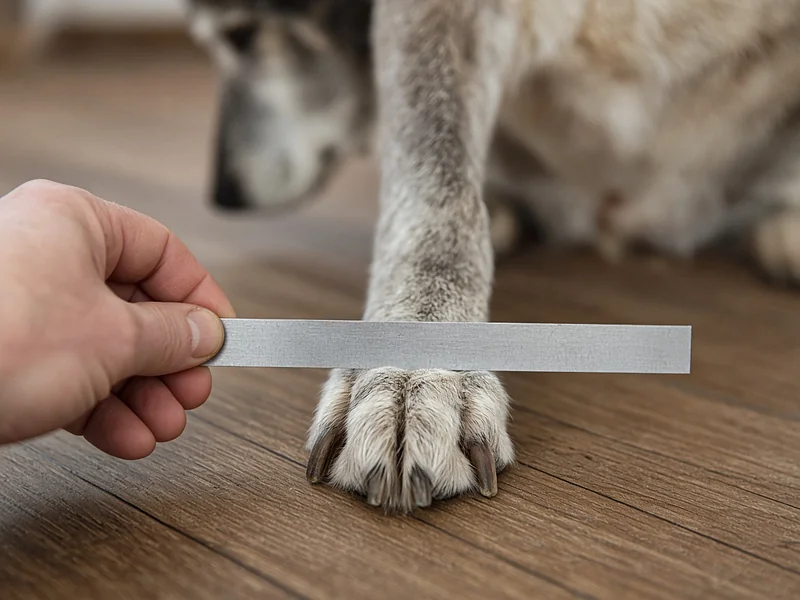
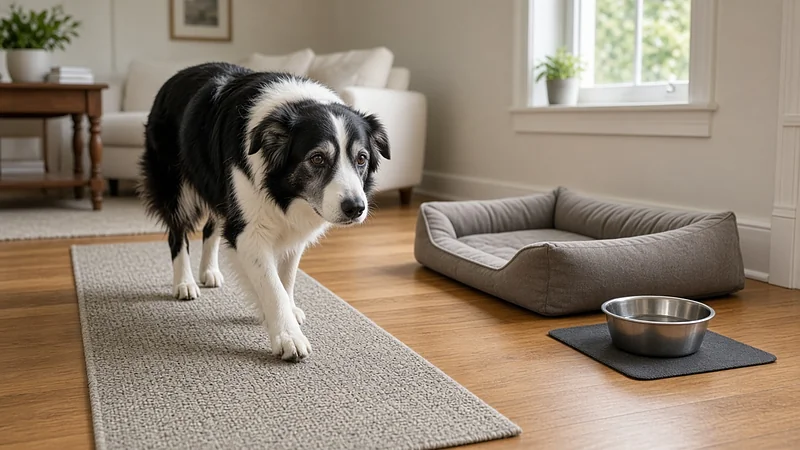
VCA describes dogs with mobility problems walking on hard floors "very cautiously... with a short stride and hunched back to guard against falling". Fixing the floor makes every other movement easier.
- Rugs and runners with non-slip backing along the routes your dog uses: bed to water bowl, sofa to door, and where it gets up.
- Short nails. VCA says most dogs need a nail trim at least once a month.
- Trimmed paw fur between the pads.
- Nail grips if your dog still slips. Boots are mainly for outdoors; socks for short spells.
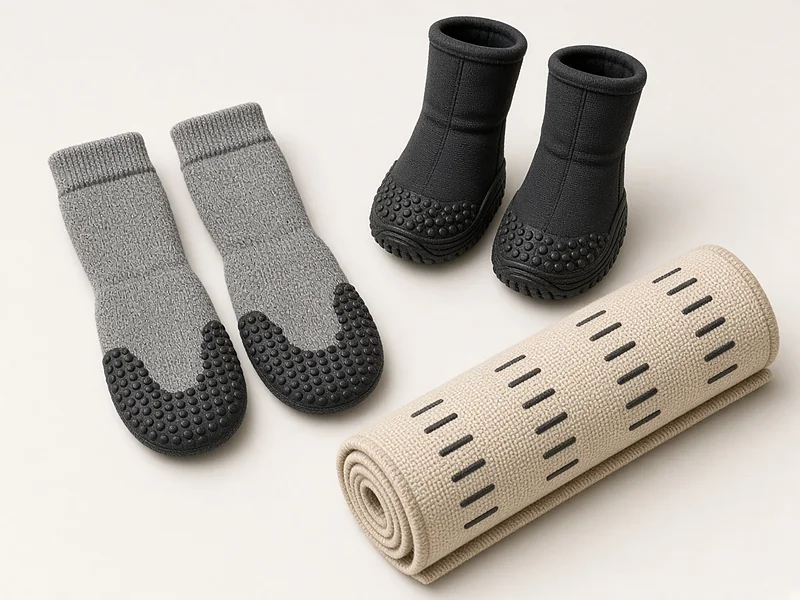
Rubber-backed washable runner rugs
Low-pile, non-slip backing, machine washable
Pros
- Fixes the floor once for every dog in the house
- No fitting needed
Cons
- Need enough coverage on your dog's real routes
- Edges can curl; choose low pile and flat edges
Read more: How to stop a senior dog slipping on hardwood floors and Toe grips vs dog boots vs grip socks. For choosing rugs, see non-slip runner rugs for dogs on hardwood.
Step 2: Support for weak back legs
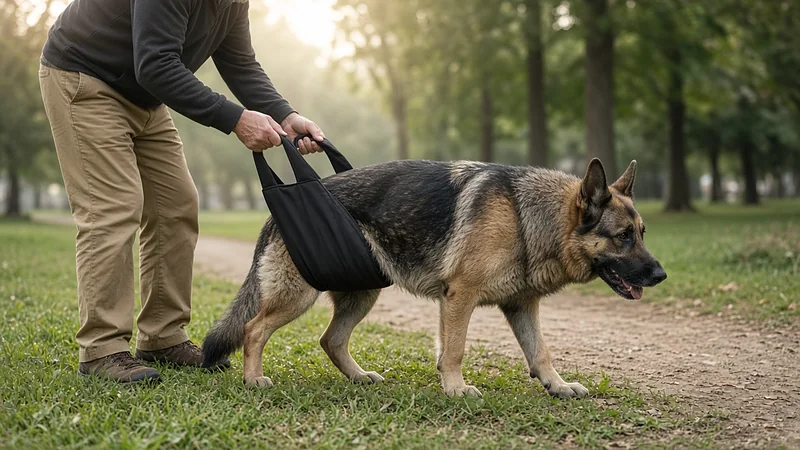
If your dog struggles to stand, wobbles on walks, or needs help on steps, a support aid protects both of you. Lifting a heavy dog with a towel or by the collar is awkward and risks your back.
- Rear sling (such as GingerLead): quick on and off, built-in leash, rear only. Good for walks, steps and post-surgery weeks.
- Full-body harness (such as Help 'Em Up): stays on, with front and rear handles. Good for dogs that need help many times a day or at both ends.
| Product | Key specs | Link |
|---|---|---|
| GingerLead Dog Support Sling | Padded rear sling with integrated leash, male and female cuts, dogs up to 250 lb, made in USA | Check price on Amazon (opens in a new tab) |
| Help 'Em Up Harness | Two-piece full-body harness (front + hip lift), sizes for 10–225 lb, conventional and U-band (male) styles | Check price on Amazon (opens in a new tab) |
Specs are from manufacturer and retailer listings and can change between versions; check the listing before you buy. We don't show prices because they change often; the button shows the current price on Amazon.
Read more: Help 'Em Up vs GingerLead and Rear support harnesses for large senior dogs compared, plus our Help 'Em Up sizing review and lift harnesses for getting into a car.
Step 3: A bed that supports and is easy to get into
VCA recommends padded orthopedic or memory-foam bedding for dogs with osteoarthritis, somewhere warm and draft-free. What matters most:
- Solid foam rather than loose fill or egg-crate, thick enough for your dog's weight: around 3–4 in for small dogs and 6–7 in for very large dogs.
- Low entry, so your dog steps on rather than climbs in.
- Washable cover and a waterproof liner, especially if your dog has started to leak urine.
- Right size: measure your dog stretched out and add 8–12 in.
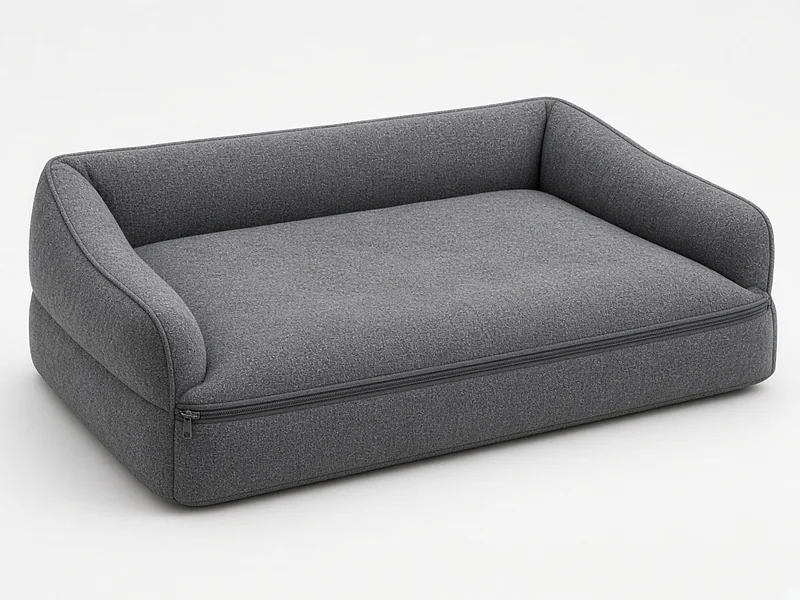
Dogbed4less Orthopedic Gel Memory Foam Dog Bed
4 in single solid gel-infused memory foam pad, 3.2 lb density; waterproof internal zip liner plus washable external cover (Amazon listings add a bonus second cover); 7 sizes from 35x20 to 55x47 in
Pros
- Stated foam density published (3.2 lb), which few brands do
- Liner plus a spare cover suits frequent washing
- Flat, low mattress is easy to step onto; large sizes available
Cons
- No bolster
- 4 in may be thin for the heaviest giant breeds
- Only the inner liner is waterproof, not the outer cover
Read more:
- Best orthopedic dog beds for senior dogs with arthritis
- Best orthopedic beds for large dogs with hip dysplasia
- Best waterproof orthopedic beds for incontinent seniors
- Is the Big Barker bed worth it?
- Best low-entry dog beds for arthritic dogs
Step 4: Stairs and ramps for furniture and the car
Once floors, support and the bed are sorted, look at the places your dog jumps: the sofa, your bed and the car. The right answer depends on the height, your dog's weight and its condition.
- Arthritis: a long, gentle ramp or low, deep pet stairs.
- IVDD-prone breeds (dachshunds, corgis, Frenchies): a long ramp with rails is usually preferred, to stop the jump down.
- After TPLO: follow your surgeon. Several protocols limit stairs to a few steps on leash with a sling, and at least one says ramps are not better than stairs.
- Cars: the higher the vehicle, the longer the ramp needs to be to keep a gentle slope.
| Product | Key specs | Link |
|---|---|---|
| Pet Gear Easy Step II Pet Stairs | 2-step, about 13–19 in tall depending on version | Check price on Amazon (opens in a new tab) |
| PetSafe CozyUp Bed Ramp | 70 x 16 x 25 in tall, wood with carpet, rated to 120 lb | Check price on Amazon (opens in a new tab) |
| PetSafe Happy Ride Extra Long Telescoping Dog Ramp | 47–87 in long, 20 in wide, aluminum, 18 lb, rated to 300 lb | Check price on Amazon (opens in a new tab) |
Specs are from manufacturer and retailer listings and can change between versions; check the listing before you buy. We don't show prices because they change often; the button shows the current price on Amazon.
The AKC's checklist for any stairs or ramp: a slip-resistant surface, enough width for your dog, the right height, and a weight limit that suits your dog.
Read more:
- Dog ramp vs stairs for arthritis, IVDD and after TPLO
- Best bed ramps for small dogs with IVDD
- Best dog stairs for small senior dogs
- Best dog ramps for pickup trucks
- Best dog stairs and ramps after TPLO surgery
- Best dog ramps for SUVs for senior dogs with arthritis
- Best dog ramps and stairs for sedans and passenger doors
What can wait
- Wheelchairs and carts. Useful for some dogs with severe hind-leg weakness, but they need correct fitting and are best chosen with a vet or rehab therapist.
- Knee and hip braces. Fit and the underlying diagnosis matter; ask your vet.
- Supplements. Evidence varies widely by product; discuss with your vet rather than buying on marketing claims.
- Boots for indoors. Most dogs do better with rugs and nail grips.
A simple starter kit by situation
| If your dog… | Start with | Then consider |
|---|---|---|
| Slips on hard floors | Rugs, nail trims, paw fur trims | Nail grips |
| Struggles to stand up | Vet check; rugs by the bed | Full-body harness; low bed |
| Is wobbly on walks | Rear sling | Full-body harness |
| Has stopped jumping on the sofa or bed | Low pet stairs or a long ramp | Block the jump when you are out |
| Can't get into the car | Sling-assisted lift | Long car ramp |
| Leaks urine in its sleep | Vet check; washable pads | Waterproof orthopedic bed |
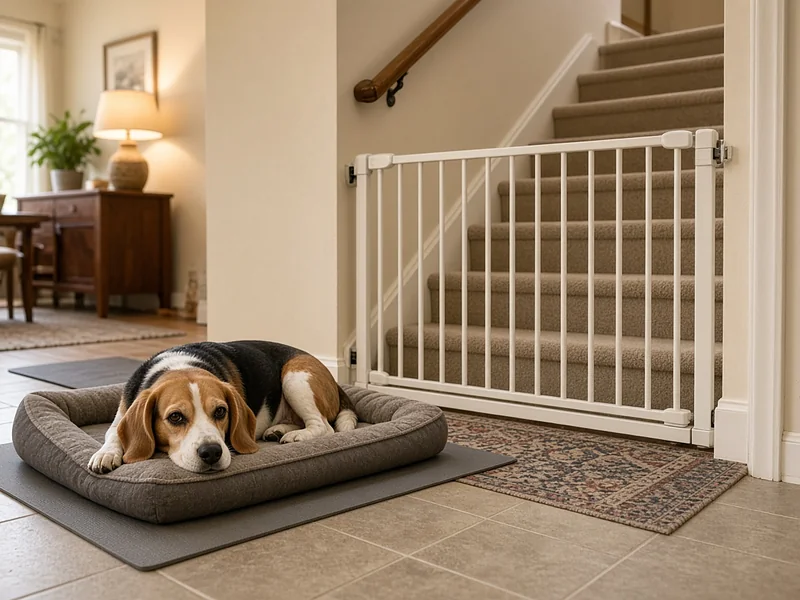
| Just had TPLO | Rugs, sling, baby gate | Low stairs if surgeon allows |
How to introduce any new aid
- Let your dog sniff and explore it first, with treats.
- Use short, positive sessions and stop before your dog gets worried.
- Use a leash or harness for ramps and stairs until your dog is confident, and teach going down as well as up.
- Check fit and skin under anything your dog wears daily.
More guides: arthritis home modifications checklist, couch ramps, full-body lift harnesses, ToeGrips review, orthopedic beds for small dogs and car hammocks for senior dogs.
Going further: if your dog's back legs are thinning, read senior dog losing muscle in the back legs; if walks are no longer possible even with a harness, see our dog wheelchair guide. To keep a dog off the stairs when you're out, see stair gates for senior dogs.
FAQ
What is the first mobility aid I should buy for my senior dog?
For most dogs, non-slip rugs or runners for hard floors. They are cheap, need no fitting, and make every other movement safer. Pair them with a vet check.
Ramp or stairs for an old dog?
It depends on the height and the condition. Long, gentle ramps suit many arthritic dogs and IVDD-prone breeds; low, deep stairs suit smaller dogs and tight spaces. See our ramp vs stairs guide.
Does my dog need a harness or a sling?
A sling for occasional rear support on walks and steps; a full-body harness if your dog needs help to stand many times a day or its front legs are weak.
Are orthopedic beds worth it for senior dogs?
For dogs with arthritis, a supportive foam bed that is easy to step onto is one of VCA's suggested home changes. It is a comfort aid alongside vet treatment, not a replacement.
Prices change often, so we do not list them. Check the current price on Amazon.
Sources
- VCA Animal Hospitals, Creating a Comfortable Home for Your Mobility Compromised Dog.
- VCA Animal Hospitals, Behavior Changes and Pain in Aging Dogs.
- VCA Animal Hospitals, Helping Your Dog with Osteoarthritis.
- American Kennel Club, Dog Stairs vs. Ramps.
- Edmonton Veterinary, TPLO Home Recovery Program (PDF).
- Today's Veterinary Practice, Ask a Specialist: Sports Medicine and Physical Rehabilitation.