As an Amazon Associate, SturdyPaws earns from qualifying purchases. This article contains affiliate links; buying through them costs you nothing extra. Read our affiliate disclosure.
One evening your old dog stands in the corner of the kitchen, staring at the wall. Another night it paces the hallway at 3 a.m., or waits at the hinge side of a door as if it has forgotten which way it opens. It may have an accident on the rug minutes after coming in from the garden. These are the kinds of changes that make owners wonder whether their dog has dementia.
The veterinary name is cognitive dysfunction syndrome (CDS), sometimes called canine cognitive dysfunction (CCD). It is a slowly progressive, age-related decline in brain function, and Cornell University describes it as common and likely underdiagnosed. There is no cure, but treatment and a well-set-up home can make daily life calmer and safer. This guide focuses on the home: what to change, which aids help and what to ask your vet. It draws on VCA Animal Hospitals, the American Animal Hospital Association's 2023 senior care guidelines and Cornell's Riney Canine Health Center. We are not vets and have not tested these products on our own dogs.
Key takeaways
- See your vet first. Pain, arthritis, kidney disease, vision or hearing loss and brain tumours can all look like dementia.
- Treatment works best started early. AAHA says management is most effective when cognitive decline is recognised early.
- Keep the layout predictable. Familiar paths and fixed spots for food, water and bed reduce disorientation.
- Make a safe zone. A pen or gated room protects a wandering dog from stairs and corners at night.
- Keep the brain busy. Diet plus enrichment worked better than diet alone in research cited by VCA and AAHA.
Recognising cognitive dysfunction
Vets use the acronym DISHAA to describe the common signs. VCA explains each letter:
- Disorientation: getting lost in familiar places, failing to find the food bowl, going to the wrong side of a door, not recognising familiar people.
- Interactions: becoming clingier and more demanding, or more withdrawn.
- Sleep-wake cycle: sleeping more in the day and becoming restless or pacing at night.
- House soiling, learning and memory: accidents indoors, forgetting to go outside, not responding to familiar cues.
- Activity: less interest in play, more aimless wandering or pacing.
- Anxiety: new fears, noise phobias or distress when left alone.
AAHA's guidelines say the most common signs in dogs are daytime sleeping with night-time restlessness, decreased interaction, disorientation at home and anxiety. VCA recommends that dogs showing more than one sign have a physical and behavioural evaluation, and notes experts recommend annual screening from about seven years of age. Cornell says dogs may start to develop CDS around nine or older.
Why a vet visit comes first
CDS is largely a diagnosis of exclusion: the vet rules out other causes. AAHA lists pain, organ dysfunction and brain tumours among the conditions that can cause similar signs. VCA gives everyday examples: an arthritic dog may stop getting up to greet you; a dog with kidney disease may be unable to hold its bladder. Treating the real cause can transform the "dementia".
If CDS is confirmed, the vet may discuss medication. Selegiline is the only drug labelled for canine cognitive dysfunction in North America, according to AAHA and VCA, and AAHA reports it is effective in up to 70% of dogs. Diets high in antioxidants and certain fats are another option; VCA says improvements are typically seen within six to twelve weeks if the diet is going to help. Medication for anxiety may also be part of the plan.
The home: principles that help
The home changes below are practical ideas rather than tested medical treatments. They follow a few principles that appear throughout the veterinary advice: reduce confusion, prevent injury, keep a routine and keep the dog mentally engaged.
Keep things where they are
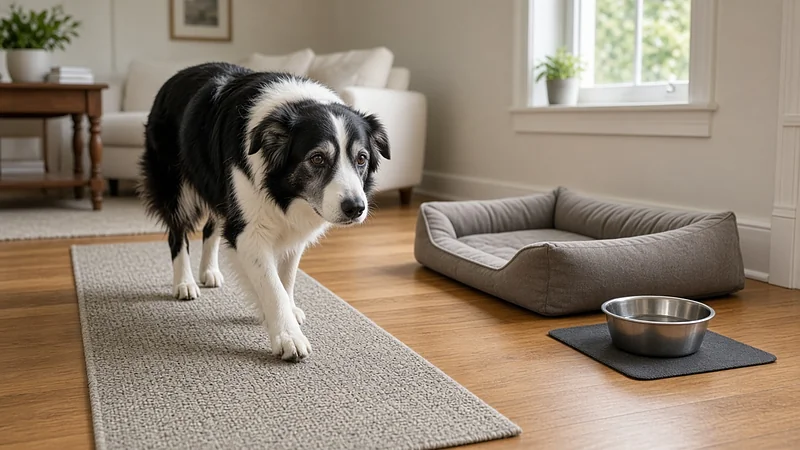
A dog with failing spatial memory relies on what it knows. Moving furniture, the water bowl or the bed can leave it lost. Keep the layout stable, and if you must change something, do it gradually and walk the dog through the new arrangement.
Clear the paths
Disoriented dogs bump into furniture and get stuck behind sofas or in corners. Cornell lists getting stuck in corners among the signs. Look at your home from dog height and close off narrow gaps behind furniture where a confused dog might wedge itself. Keep the routes between bed, water, food and the door clear.
Good footing
Many dogs with CDS are also old and stiff. A wandering, unsteady dog on hardwood is a fall waiting to happen. Rubber-backed runners along the main paths give grip and also act as a tactile trail between key places. Our runner rug guide covers options.

Kapaqua Rubber-Backed Custom-Length Runner Rug
22 in wide (other widths in the menu), custom length, 1/4 in low loop pile, rubber backing for hardwood, laminate, vinyl and tile; hand wash only per the current listing
Pros
- Cut to the exact length of your hallway or route, so there are fewer gaps
- Low 1/4 in pile is easy for dragging feet
- Rubber backing made for bare hard floors
Cons
- Not for use on carpet
- Current listing says hand wash only
- 22 in is narrow for a large dog that splays; check wider options
A safe zone for nights and alone time
Night-time pacing is one of the hardest parts of living with a dog with CDS. A dog that wanders the house at night can fall down stairs, get trapped, or have accidents in every room. A defined safe zone, a small area with the bed, water and washable flooring, limits the risk.
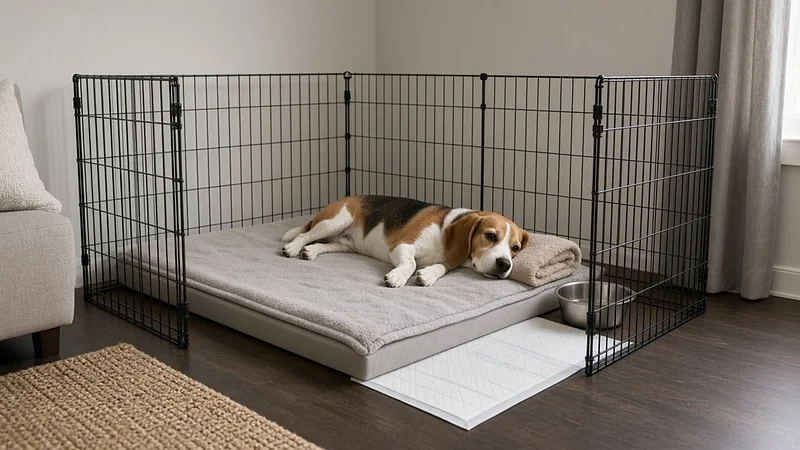
An exercise pen is one way to create it. The pen keeps the dog in a known space without shutting it in a crate, and it can sit next to your bed so the dog can see and smell you. A pen with a door lets you step in without lifting the dog over the panels.
MidWest 48-Inch Exercise Pen (Single Door)
Eight 24 x 48 in panels, 16 sq ft area, step-through door with slide-bolt latch and Paw Block
Pros
- Step-through door for you
- Tall sides for larger dogs
- Can attach to a crate
Cons
- Heavy to move
- Door threshold still needs care with a weak dog
- Open top
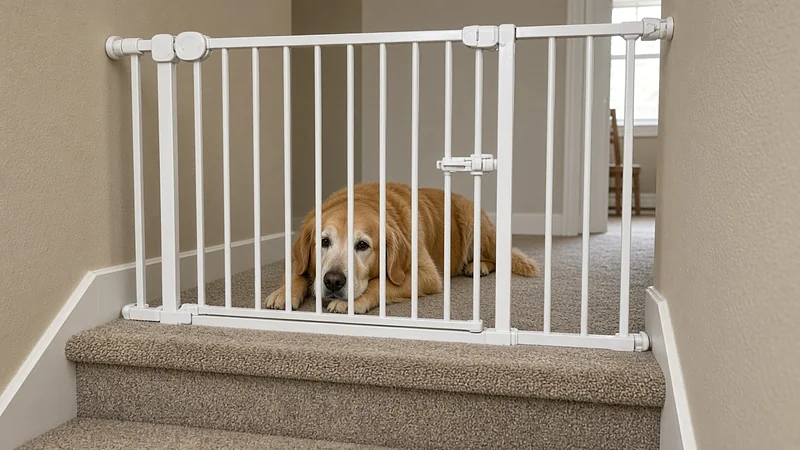
If your dog panics in a pen, a gated room works too. Block the top and bottom of stairs at all times; a confused dog may not judge the drop.
Regalo Easy Step Extra Wide Walk-Thru Gate
Pressure mount with wall cups, 30 in tall, 29–49 in in steps (does not fit 32–34 or 36.5–41.5 in); 16 in door; never for the top of stairs
Pros
- No drilling needed
- Wide range for wide openings
- Walk-through door
Cons
- Not for the top of stairs
- Gaps in the fit range
- Bottom threshold bar to step over
See our stair gate guide for top-of-stair options, which need hardware mounting rather than pressure fitting.
| Product | Key specs | Link |
|---|---|---|
| Kapaqua Rubber-Backed Custom-Length Runner Rug | 22 in wide (other widths in the menu), custom length, 1/4 in low loop pile, rubber backing for hardwood, laminate, vinyl and tile; hand wash only per the current listing | Check price on Amazon (opens in a new tab) |
| MidWest 48-Inch Exercise Pen (Single Door) | Eight 24 x 48 in panels, 16 sq ft area, step-through door with slide-bolt latch and Paw Block | Check price on Amazon (opens in a new tab) |
| Regalo Easy Step Extra Wide Walk-Thru Gate | Pressure mount with wall cups, 30 in tall, 29–49 in in steps (does not fit 32–34 or 36.5–41.5 in); 16 in door; never for the top of stairs | Check price on Amazon (opens in a new tab) |
Specs are from manufacturer and retailer listings and can change between versions; check the listing before you buy. We don't show prices because they change often; the button shows the current price on Amazon.
Helping with night-time restlessness
Sleep problems are hard on dogs and owners. Ideas that many owners find useful, and that are worth discussing with your vet:
- More activity in the day. A dog that sleeps all day is more likely to be awake at night. Short walks, sniffing and gentle play during the day help.
- A last trip outside. Take the dog out just before bed so a full bladder is not the reason it wakes.
- Soft light. Some owners leave a dim light on so a dog with poor vision is less disoriented in the dark. It is an easy thing to try.
- Familiar sound and scent. Keeping the dog's bed near yours, or leaving a worn item of clothing in its bed, may comfort some dogs.
- Talk to your vet. If nights are a struggle, there are medications that can help with sleep and anxiety.
House-soiling
Accidents are common and upsetting, but punishment will not help a dog that has genuinely forgotten. What tends to help:
- Rule out medical causes. Urinary infections, kidney disease and incontinence are common in old dogs. VCA's example of kidney disease is a reminder that soiling is not always cognitive.
- Take the dog out more often, on a regular schedule, and go with it so you can see it actually goes.
- Use washable or waterproof bedding and floor coverings in the safe zone. Our guide to waterproof orthopedic beds covers this.
- Clean accidents thoroughly with an enzymatic cleaner so the smell does not draw the dog back.
Routine
VCA notes that dogs with CDS may not adjust to new schedules or routines as quickly as they once did. Regular times for meals, walks, toilet breaks and bed give a confused dog something to rely on. If you have to change the routine, for a holiday or a house move, change it gradually where possible.
Enrichment
Keeping the brain active matters. VCA describes research in which dogs with CDS benefited from environmental enrichment such as regular exercise, interactive toys and interaction with other dogs, and found that diet combined with enrichment worked better than diet alone. AAHA's guidelines say the diets showed the most positive effect when combined with enrichment: exercise, new toys, cognitive games and tasks.
Keep it simple and achievable. Easy food puzzles, scatter-feeding in a small area, short sniffing walks and simple training games with lots of rewards suit most old dogs. Our guide to low-impact enrichment for senior dogs has more ideas.
Looking after yourself
Caring for a dog with dementia is tiring. Broken sleep, cleaning and worry add up. Many owners find it helps to keep a simple diary of good and bad days and specific behaviours. AAHA notes that questionnaires completed by owners at intervals can be used to track the condition, and a diary gives your vet useful information. It can also help when the time comes to think about quality of life.
Common mistakes
- Assuming it is just old age. Cornell notes CDS is likely underdiagnosed because owners put changes down to ageing.
- Rearranging the house. New layouts confuse a dog that relies on memory.
- Leaving stairs open at night. A wandering dog can fall.
- Punishing accidents. It adds anxiety without fixing anything.
- Waiting too long. AAHA says treatment is most effective when started early.
If accidents are frequent, see diapers and belly bands for incontinent senior dogs.
FAQ
What are the first signs of dementia in dogs?
Common early signs include night-time restlessness, getting stuck or lost at home, changes in how the dog interacts with you, and accidents indoors.
Can dog dementia be treated?
There is no cure, but medication such as selegiline, special diets and enrichment can improve signs in many dogs. Your vet can advise.
How do I stop my old dog pacing at night?
See your vet to rule out pain or other illness. More activity in the day, a predictable bedtime routine and a safe sleeping area may help.
Should a dog with dementia be crated?
Some dogs settle in a familiar crate; others panic. A pen or gated room is a gentler alternative for many.
At what age does dog dementia start?
Cornell says around nine years or older, and VCA notes experts recommend screening from about seven.
Prices change often, so we do not list them. Check the current price on Amazon.
Sources
- VCA Animal Hospitals, Cognitive dysfunction syndrome in senior dogs and cats.
- VCA Animal Hospitals, Nutrition for dogs with cognitive dysfunction syndrome.
- American Animal Hospital Association, 2023 senior care guidelines: managing cognitive dysfunction and behavioral anxiety.
- Cornell University Riney Canine Health Center, Cognitive dysfunction syndrome.
- Product specifications from the linked Amazon listings, checked 2 November 2026.