As an Amazon Associate, SturdyPaws earns from qualifying purchases. This article contains affiliate links; buying through them costs you nothing extra. Read our affiliate disclosure.
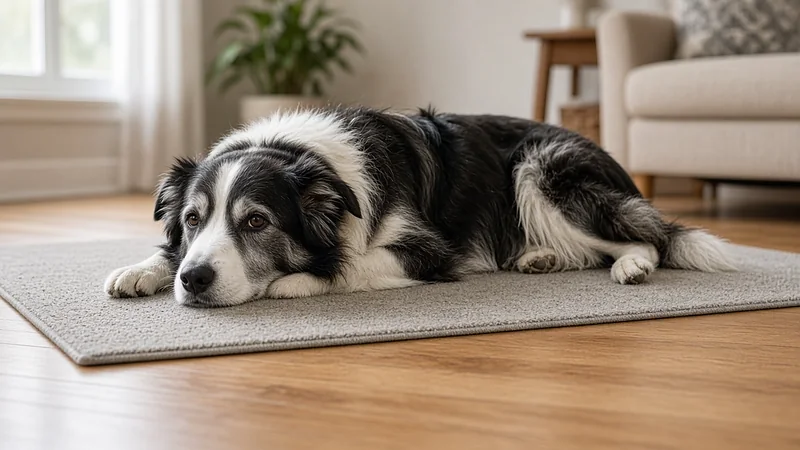
You find a soft, squishy lump on the point of your old dog's elbow. It does not seem to bother the dog, but it was not there last year. In a large, older dog that spends most of the day on hardwood, tile or concrete, a common cause is an elbow hygroma: a fluid-filled pad the body builds in response to repeated pressure.
Most hygromas are managed at home, mainly by changing what your dog lies on. This guide covers what a hygroma is, when it needs a vet, and how bedding, foam tiles and elbow pads help. It draws on VCA Animal Hospitals, the Merck Veterinary Manual and Clinician's Brief, a journal for vets. We have not tested these products on our own dogs.
Key takeaways
- Get any new lump checked once. A vet can confirm it is a hygroma and not a tumour, abscess or something else.
- Padding is the main treatment. VCA says padded bedding may be the only thing needed to stabilise a hygroma.
- Cover the floor where your dog actually lies. Interlocking foam tiles are suggested by VCA for favourite resting spots.
- Elbow pads help dogs that will not stay on a bed. Fit matters more than brand, and research on commercial sleeves is limited.
- Do not drain it at home. Draining and steroid injections carry a real infection risk.
What an elbow hygroma is
VCA describes a hygroma as a fluid-filled swelling under the skin, surrounded by a thick capsule of fibrous tissue. It forms over a bony point. The elbow is by far the most common site, but hygromas can also appear over the outside of the hock or the hip.
They are not tumours but a protective reaction. Each time a heavy dog flops down on a hard floor, the skin over the elbow is pinched between bone and floor. That repeated trauma causes inflammation, and the body builds what VCA calls the equivalent of a pillow. If the pressure continues, it keeps growing.
Early hygromas are small, soft and mobile, and many are never noticed. On hard floors some grow large and firm, and the worst ulcerate and become infected and painful.
Hygroma, callus or pressure sore?
These three are related but not the same, and an older dog can have more than one:
| Problem | What you see | Usual approach |
|---|---|---|
| Callus | Grey, thickened, often hairless skin over the elbow; dry, not squishy | Softer bedding; watch for cracking |
| Hygroma | Soft, fluid-filled lump under the skin over the bone; usually not painful | Vet check, then padding and floor changes |
| Pressure sore | Red or broken skin over a bony point, often in dogs that cannot change position | Vet care, frequent turning, thick padding |
Only a vet can tell you for sure. A lump on a leg can also be a fatty lump, a cyst or a tumour.
Which dogs get them
VCA lists the main risk factors, and they line up closely with senior dogs:
- Large and giant breeds, because more weight means more force on the elbow.
- Sedentary dogs, which spend more hours under pressure.
- Older dogs with arthritis, which rest more and often drop down heavily.
- Hard resting surfaces: hardwood, tile and concrete.
- Extra weight. VCA says keeping large dogs lean is one of the key prevention steps.
If your dog has arthritis or hip problems, the same changes that protect its elbows usually help its joints too. Our room-by-room arthritis checklist covers the rest of the house.
Step 1: Get the right bed, and make it the dog's first choice
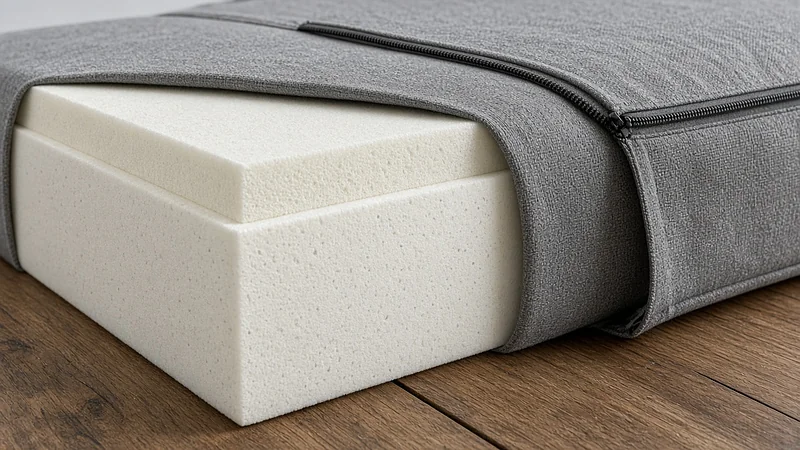
VCA's first step is bedding with enough padding to stop further trauma, naming egg-crate (eggshell) foam and memory foam as the best options. The Merck Veterinary Manual agrees that soft bedding works well for some dogs.
The catch: a bed only helps if your dog lies on it. Many big, older dogs ignore a bed that is too small, too warm, hard to step onto or in the wrong spot. Check these points:
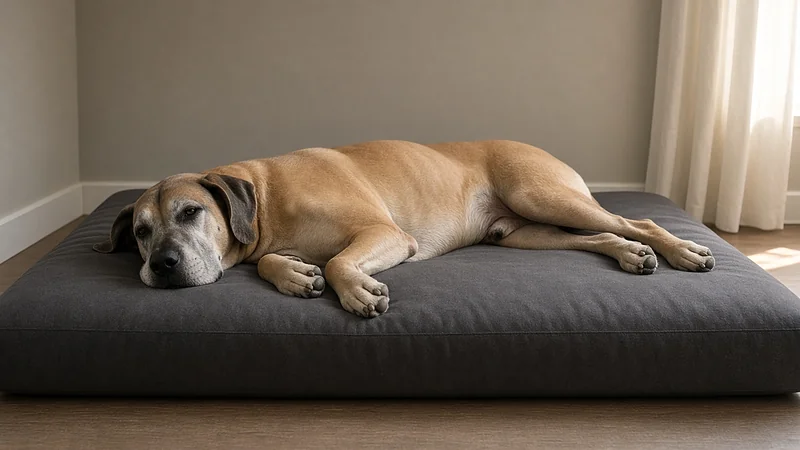
- Size: your dog should fit stretched out on its side with room to spare, so its elbows land on foam, not on the floor beyond the edge.
- Depth: heavy dogs need thicker foam so the elbow does not bottom out. Press the bed with your fist; if you feel the floor, it is too thin for a giant breed.
- Low entry: an open front or a low, flat mattress is easier for a stiff dog to step onto.
- Location: put the bed where your dog already chooses to lie.
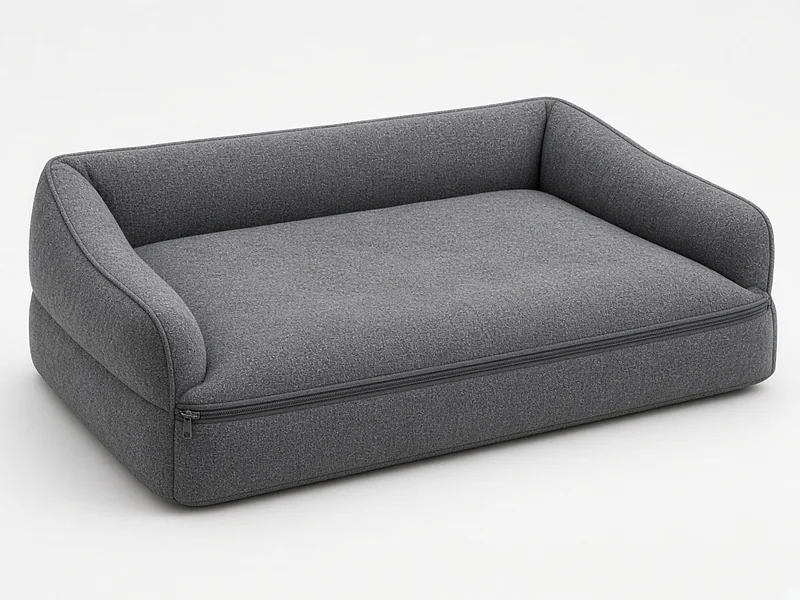
Big Barker 7" Pillow Top Orthopedic Dog Bed
7 in, three foam layers (2 in base, 3 in support, 2 in comfort); Large 48x30, XL 52x36, Giant 60x48 in; CertiPUR-US foam made in USA; 10-year no-flatten warranty (foam must keep 90% of shape)
Pros
- Thickest common option for very heavy dogs; sizes start at Large
- Clear written no-flatten warranty
- Low, flat profile is easy to step onto
Cons
- Highest relative cost in this guide
- Warranty excludes covers, chewing and accident damage
- Overkill for small and medium dogs
For a giant breed with a hygroma, the 7 in Big Barker is one of the thickest common options, and its flat profile is easy to step onto. Our Big Barker review covers the warranty in detail.
PetFusion Ultimate Dog Bed & Lounge
Solid CertiPUR-US memory foam: S 25x20 (2.5 in foam), L 36x28 (4 in), XL 44x34 (4 in), Jumbo 50x40 (6 in); waterproof inner liner; water-resistant machine-washable cover; recycled polyfill bolsters
Pros
- Bolsters on three sides for a head rest
- Inner liner plus water-resistant cover
- Mid relative cost
Cons
- Bolsters add height on three sides; front is the only low entry
- 4 in foam on L/XL is thin for 100 lb+ dogs
- Warranty wording varies by listing: check before buying
If your dog likes to lean against something, a memory foam bed with bolsters gives it a headrest. Check the foam depth for its size: the smaller sizes use thinner foam. Our foam type comparison explains the trade-offs between memory foam, egg-crate and bolster designs, and our guide to beds for large dogs covers dogs of 100 lb and more.
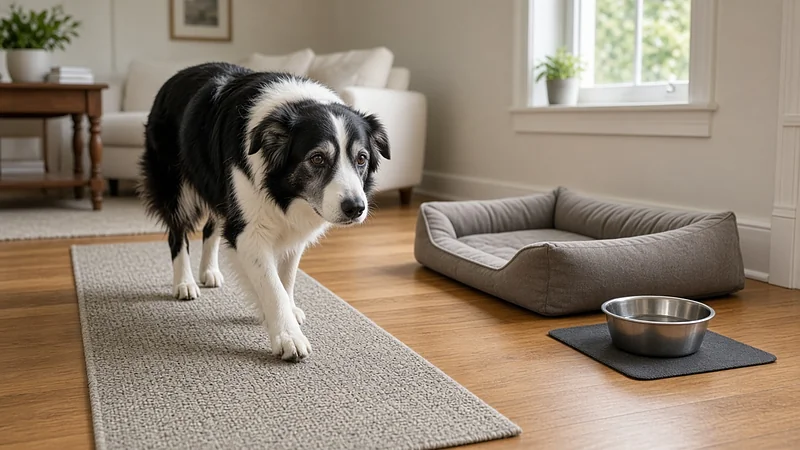
Step 2: Pad the floor where your dog likes to lie
VCA suggests covering the floor in a dog's favourite resting areas with interlocking foam tiles, like those used in gyms and day cares. Many dogs move between spots through the day; you cannot put a bed in each, but you can put down tiles.
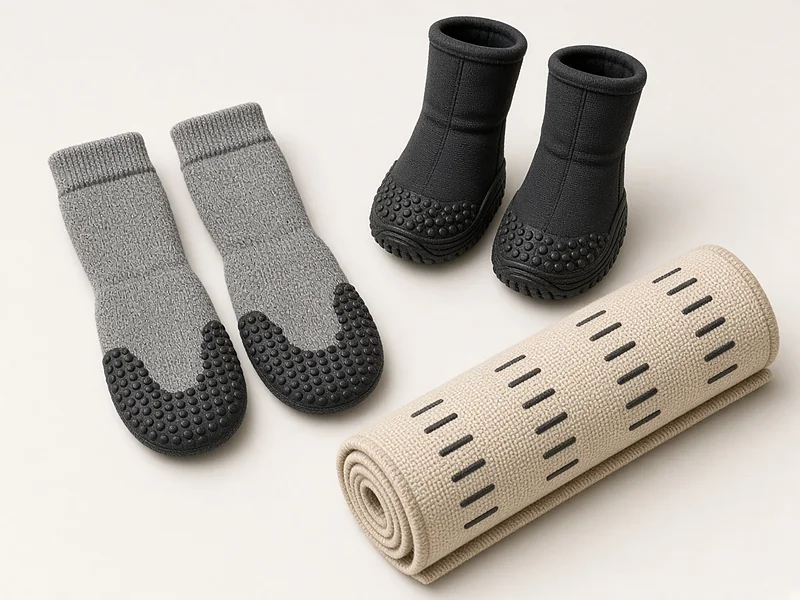
ProsourceFit Exercise Puzzle Mat (1/2 in, 6 tiles)
Six 24 x 24 x 1/2 in interlocking EVA foam tiles with end borders, 24 sq ft total; water-resistant; phthalate-free per listing; clean with warm water and dish soap
Pros
- Covers a whole pen or bed area with no gaps
- Half-inch foam adds cushioning
- Single tiles lift out for cleaning
Cons
- Some dogs chew foam edges
- Liquid can seep through joins
- Foam may dent under heavy objects (per listing)
Half-inch EVA tiles will not replace a bed, but they take the edge off a hard floor and add grip for a dog that slips when getting up. Watch for chewing, especially at the edges. Our foam mats vs rugs guide compares tiles with rubber-backed rugs room by room.
Step 3: Elbow pads for dogs that will not stay on padding
VCA notes that commercial elbow pads exist to protect hygromas and keep them from growing or becoming infected, and that most dogs tolerate them well. The Merck manual says dogs that lie only on hard surfaces can wear padding over pressure points. They are most useful when your dog insists on the floor, spends time in places you cannot pad, or after surgery when your vet wants the area protected.
Keep expectations realistic. A Clinician's Brief review for vets notes that the clinical efficacy of commercial neoprene and polyester padded elbow sleeves has not been formally evaluated. They make sense as a way to add padding, not as a proven cure.
What to look for, based on the veterinary guidance on fit:
- A strap over the back or chest. Elbow pads tend to slide down the leg. A strap across the shoulders keeps the pad on the elbow.
- Sizing by measurement, not breed. Measure the leg as the maker instructs, standing.
- No tight bands. Clinician's Brief warns that a poorly fitted device can cause swelling, skin irritation and sores. Check the skin above and below the pad every day at first.
- Washable. Pads get dirty quickly on a dog that lives on the floor.
Oteengo Padded Dual Elbow Sleeves
Sleeves on both front legs joined by an over-the-back strap across the withers; sized by upper-arm circumference, with forearm and chest checks (chest up to 28.5 / 31.5 / 34.5 in for M / L / XL); machine washable; linked listing is Medium
Pros
- Over-the-back strap is designed to stop the sleeves sliding down
- Covers both elbows at once
- Detailed three-measurement sizing
Cons
- Three measurements to take before ordering
- Maker says sizes do not overlap and not to size up, so measure carefully
- Strap across the back may bother some dogs at first
The Oteengo sleeves cover both front legs and are held up by a strap across the withers, which targets the most common complaint about elbow pads: sliding down. Sizing takes three measurements.
NeoAlly Dog Elbow Brace Protector Pads (Pair)
Padded elbow sleeves sold for left, right or both legs; sized by leg circumference at the elbow: XS 3.8-5.1 in, S 5.1-6.5, M 6.5-8.1, L 8.1-10.0, XL 10-12.2 in; elastic strap; linked listing is the Large pair
Pros
- Published size chart by elbow circumference
- Available as a single sleeve or a pair
- Sizes from XS to XL, so it suits medium dogs too
Cons
- Compression fit: check for rubbing or swelling below the sleeve
- Measure carefully; the linked listing is one size (L pair)
- Maker's 'vet recommended' wording is a marketing claim, not a study
NeoAlly publishes a size chart by elbow circumference and sells single sleeves as well as pairs, handy for a hygroma on one side only. It is a compression fit, so check for marks or swelling below the sleeve.
Miller Eclipse Reinforced Elbow Pads (Large/XL)
Cushioned elbow pads for large and extra-large breeds (not for puppies or small breeds, per listing); wider elastic band; reinforced stitching; machine washable
Pros
- Simple, light pads aimed at big dogs, the group most at risk
- Washable
- Lowest-effort option to try first
Cons
- Listing gives no size chart, so fit on very slim or very muscular legs is a guess
- Elastic-band designs can slip down on some dogs
- Not for small or medium dogs
The Miller Eclipse pads are a simpler, lighter option for large and extra-large dogs only. With no size chart, treat them as a first try; if they slip, move to a design with an over-the-back strap.
What your vet may do
For a small hygroma that is not painful, vets usually start with the padding changes above. Clinician's Brief says conservative management of an uncomplicated hygroma aims for resolution over about two to three weeks, alongside weight control and padding. Other options vets may consider:
- Draining with a needle: sometimes tried, but recurrence and infection are common, so it is not a home job.
- Steroid injections into the hygroma: not recommended by the Merck manual or Clinician's Brief because of the infection risk.
- Surgery or drains: for large, infected or ulcerated hygromas. Surgery does not remove the cause, so padding must continue afterwards, often for life.
A simple daily routine
- Feel both elbows once a day for size, heat and tenderness, and look at the skin.
- Check the bed by pressing it. Replace foam that has flattened.
- If your dog wears pads, take them off daily, check the skin and let it air.
- Help your dog lie down slowly where you can. A rear support harness lets you lower a big dog instead of letting it drop.
- Keep your dog lean. Ask your vet for a target weight.
FAQ
Will an elbow hygroma go away on its own?
Small ones may stabilise or shrink once the dog stops lying on hard floors. Without that change they often keep growing. Your vet can tell you whether yours needs more than padding.
Is an elbow hygroma painful for my dog?
VCA says hygromas are typically not painful. Pain, heat, redness or discharge suggests infection and needs a vet visit.
Do elbow pads for dogs actually work?
Vet sources recommend padding the elbow for dogs that lie on hard surfaces, and VCA says most dogs tolerate pads. However, the clinical efficacy of commercial sleeves has not been formally studied, so use them alongside good bedding, not instead of it.
What is the best bed for a dog with an elbow hygroma?
VCA names egg-crate and memory foam. Choose one thick enough that your dog does not feel the floor, big enough for it to stretch out, and low enough to step onto.
Prices change often, so we do not list them. Check the current price on Amazon.
Sources
- VCA Animal Hospitals, Hygroma in dogs.
- Merck Veterinary Manual, Hygroma in dogs.
- Clinician's Brief, Devices for treating elbow hygromas in canine patients.
- Clinician's Brief, Negative pressure wound therapy for complicated elbow hygroma.
- Product specifications from the linked Amazon listings, checked 4 November 2026.