As an Amazon Associate, SturdyPaws earns from qualifying purchases. This article contains affiliate links; buying through them costs you nothing extra. Read our affiliate disclosure.
If your older dog sleeps upstairs and the staircase in your house is steep, you have probably already searched for a ramp that goes over the stairs. Most owners discover the same thing quickly: a full indoor flight is far too tall and too steep for any pet ramp sold for cars or sofas. So what are the real options when a senior dog can no longer manage a steep set of indoor stairs on its own?
This guide goes through each option honestly, from stair lifts to harnesses to moving the dog's bed downstairs. It is research-based, using veterinary home-care advice and maker specifications. We have not tested a stair lift ourselves, and we only name products whose Amazon listings we checked today.
Key takeaways
- Pet ramps do not fit a full indoor flight. The rise is far too high for a safe slope in the space a staircase takes.
- Stair lifts for dogs exist, and VCA mentions them, but they are a building project rather than a quick purchase.
- For most homes, the working setup is a gate, grip on the treads and a support harness for supervised trips.
- Going down is often the riskier direction, because the dog's weight pitches forward onto sore front legs.
- Sometimes the best answer is to stop using the stairs and set up a sleeping area on the ground floor.
Why steep stairs are so hard for an older dog
Climbing stairs asks a dog to push its whole body weight upward with the hind legs, one step at a time. In a dog with arthritis in the hips or knees, weak back-leg muscles, or hip dysplasia, that is exactly the movement that hurts. VCA's page on hip dysplasia notes that affected dogs may be reluctant to rise or to climb stairs. Coming down is a different problem. The dog's centre of mass shifts forward, so the front legs take a heavy load on every step, and a dog with weak hind legs may not be able to brake its back end. That is when a dog tumbles.
Steep stairs make both directions worse. Each step is taller, so the hind legs have to lift further. The treads are often shallower, so a big dog cannot fit all four feet on a step and ends up taking stairs in awkward bounds. Many staircases are also bare wood or painted, which gives little grip to paws or long nails.
Option 1: a ramp over the stairs (usually not workable)
It is worth understanding why ramps fail here, so you do not spend money on one. A ramp only helps if the slope is gentle. The AKC's guide to dog stairs and ramps and PetMD's advice both stress that a ramp should be long enough for a comfortable angle and should have a non-slip surface. A full staircase in a house rises roughly the height of a room. To cover that at a gentle slope you would need a ramp many times longer than the stairs themselves, which simply does not fit in a hallway.
A shorter ramp laid over the steps only creates a steep slide. A senior dog cannot hold its footing on that angle, especially going down, and a fall on a ramp is no better than a fall on the stairs. Telescoping pet ramps are designed for vehicles, beds and sofas, and their makers list maximum heights well below a full flight. Use ramps where they fit: a couple of porch steps, a sunken living room or a single step into the garden. Our porch and deck ramp guide covers those.
Option 2: a stair lift for dogs
VCA's guide to making a home comfortable for a mobility-compromised dog says plainly that there are stair lifts for dogs to help you get them up and down stairs with less stress. That is true, but it helps to know what that means in practice. A dog stair lift is generally either an adapted human stair lift with a platform or a custom-built platform lift. Both are installed on the staircase and need someone to measure the stairs, check the wall or tread fixings and confirm that the platform is large enough and secure enough for your dog.
This is not a product we can link to. Prices, safety features and installation requirements vary from one installer to the next, so get quotes from local mobility-equipment companies and ask specifically about pet use. Ask whether the platform has sides or a barrier, how the dog will be kept from stepping off mid-ride, and what weight it is rated for. Dogs also need time to accept a moving platform; plan to train it slowly with treats, starting with the lift switched off.
For most families the cost and disruption make a lift a last resort, reserved for a large dog that must reach an upper floor every day and has a long life ahead. For many senior dogs, the next two options are faster and cheaper.
Option 3: gate, grip and a harness (the usual answer)
This is the setup most vet home-care advice points toward, and it has three parts.
Gate the stairs
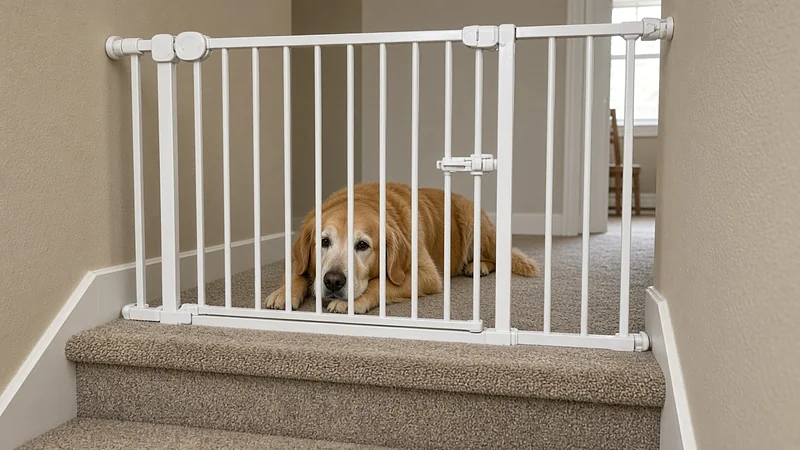
VCA's osteoarthritis guidance suggests preventing access to stairs when nobody can supervise, and notes that a baby gate works well. The goal is that the dog only ever uses the stairs with you beside it. At the top of a staircase you need a hardware-mounted gate, screwed into the wall or banister, because a pressure gate can be pushed out and makers warn against using one there. At the bottom, a pressure-mounted walk-through gate is fine.
Regalo Top of Stairs Hardware-Mounted Gate
Hardware mount, 30.5 in tall, fits 29–43 in (listing title) openings; banister adapters (square 2–4 in, round 3–5 in); gate must swing away from the stairs
Pros
- Made for the top of stairs
- Banister adapters included
- Walk-through door
Cons
- Must be screwed in
- Check opening width first
- Door must swing away from the stairs
Carlson Extra Wide Walk-Thru Pet Gate
Pressure mount, 30 in tall, 29–36.5 in (not 32–34 in); 16.5 in walk-through door plus 7.5 x 7.75 in small pet door; for doorways and the bottom of stairs
Pros
- Small pet door for cats or tiny dogs
- Pressure mount
- Wide walk-through
Cons
- Not for the top of stairs
- Narrower fit range
- Threshold bar
Our stair gates guide explains how to measure the opening and check the fit ranges, which have gaps on some extra-wide gates.
Add grip to the treads
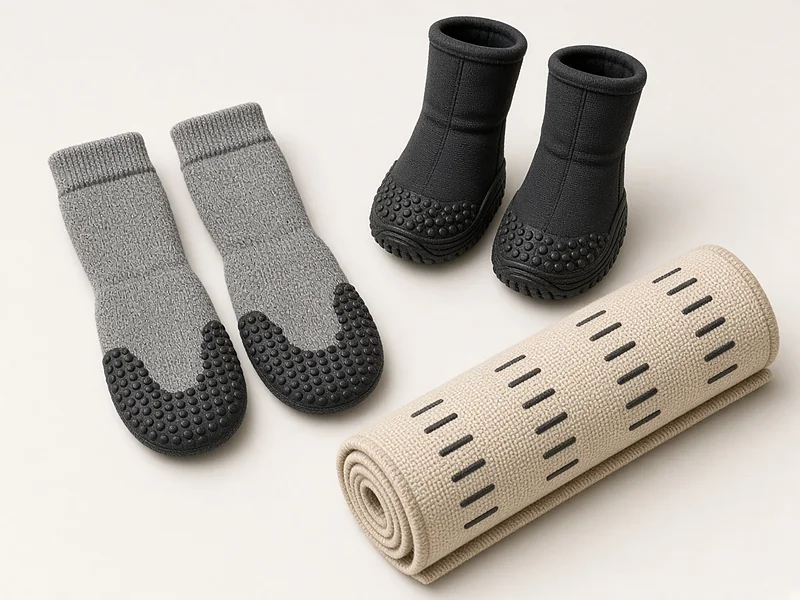
VCA recommends that stairs have a non-slip surface, using a carpet runner or stick-down grip tape. On a steep staircase this matters even more, because a paw that slides off the front edge of a tread throws the dog's weight sideways. Keep nails trimmed short as well; VCA compares long nails on an older dog to high heels on an ice rink. If the stairs are carpeted already, check that the carpet is tight and that no tread edge is worn smooth.
Use a support harness on every trip
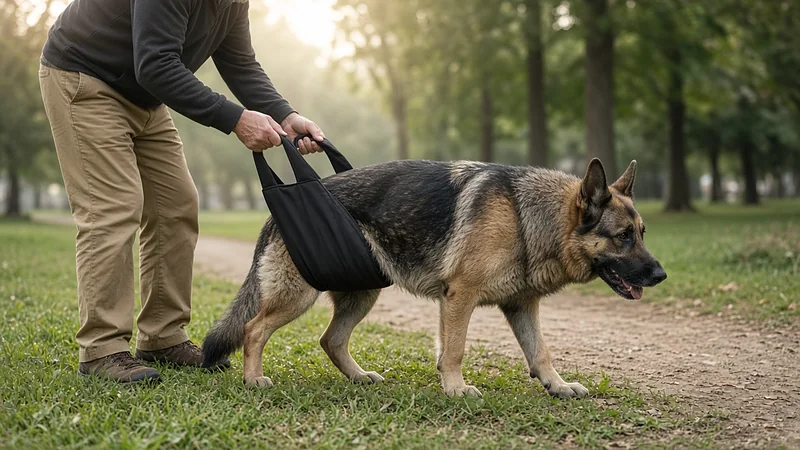
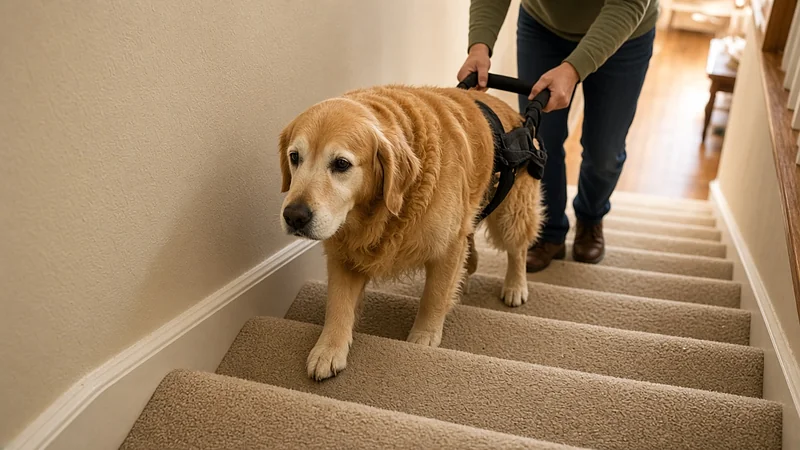
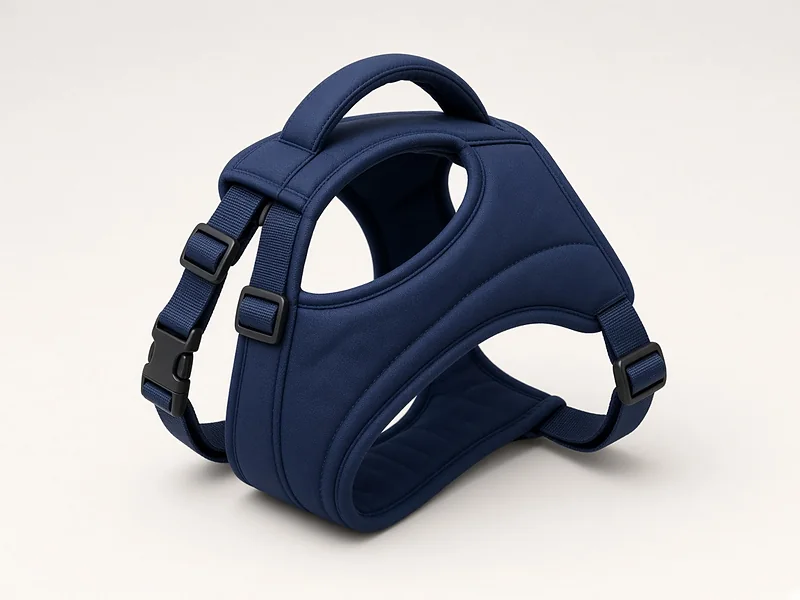
A harness with a handle lets you take some of the dog's weight and, more importantly, catch it if it stumbles. VCA mentions harnesses designed to support a dog's weight with little strain on your back. For stairs, the useful types are a rear-end harness, which supports the hind legs, and a two-piece full-body harness, which gives you handles at both the shoulders and the hips.
Help 'Em Up Harness
Two-piece full-body harness (front + hip lift), sizes for 10–225 lb, conventional and U-band (male) styles
Pros
- Lifts front, rear or both with separate handles
- Designed to be worn for long periods
- Male (U-band) and conventional versions
Cons
- Most expensive option here
- Sizing is fiddly; the maker suggests sizing the rear down for dogs with muscle loss
Walkabout Original Back End Harness
Rear-end harness that wraps the hind legs, top handle, made in USA; 7 sizes (XS–XL) chosen by abdomen and upper-thigh measurement
Pros
- Wraps the legs instead of the belly, so less abdominal pressure
- Easy to leave on for short outings
Cons
- Rear only
- Leg loops need correct sizing to avoid rubbing
A full-body harness such as the Help 'Em Up suits a dog that is weak at both ends or that pitches forward on the way down, because you can hold the front handle to slow the descent. A rear-only harness such as the Walkabout is simpler to put on and suits a dog whose front legs are strong but whose back end gives out. Our rear support harness guide compares more options.
| Product | Key specs | Link |
|---|---|---|
| Help 'Em Up Harness | Two-piece full-body harness (front + hip lift), sizes for 10–225 lb, conventional and U-band (male) styles | Check price on Amazon (opens in a new tab) |
| Walkabout Original Back End Harness | Rear-end harness that wraps the hind legs, top handle, made in USA; 7 sizes (XS–XL) chosen by abdomen and upper-thigh measurement | Check price on Amazon (opens in a new tab) |
| Regalo Top of Stairs Hardware-Mounted Gate | Hardware mount, 30.5 in tall, fits 29–43 in (listing title) openings; banister adapters (square 2–4 in, round 3–5 in); gate must swing away from the stairs | Check price on Amazon (opens in a new tab) |
| Carlson Extra Wide Walk-Thru Pet Gate | Pressure mount, 30 in tall, 29–36.5 in (not 32–34 in); 16.5 in walk-through door plus 7.5 x 7.75 in small pet door; for doorways and the bottom of stairs | Check price on Amazon (opens in a new tab) |
Specs are from manufacturer and retailer listings and can change between versions; check the listing before you buy. We don't show prices because they change often; the button shows the current price on Amazon.
How to help a dog up and down steep stairs
Technique matters as much as gear. These steps are general guidance; your vet or a rehabilitation therapist can adjust them for your dog.
- Going up: stand slightly behind and to one side of the dog. Hold the rear handle and lift just enough to help the hind legs push. Let the dog set the pace, one step at a time.
- Going down: stand below the dog, or beside it on the lower step, so your body blocks a forward fall. Hold the front handle, or the lead on a chest harness, to slow the dog down. Hold the rear handle so the back end does not swing.
- Stop on the landing. On a long flight, let the dog pause halfway.
- Keep your own footing. Wear shoes with grip, keep one hand on the rail if you can, and do not try to carry a big dog down a steep staircase alone.
- Limit trips. Plan the day so the dog goes up once at night and down once in the morning, rather than following you every time you fetch something.
Option 4: carrying a small dog
For a small dog, carrying is often the safest choice on steep stairs. Support the chest and the back end at the same time so the spine stays level. This is especially important for breeds prone to disc disease, such as dachshunds, where an unsupported lift can bend the back. If you have a small dog with IVDD, see our bed ramps for small dogs with IVDD guide for the jumps inside the house too.
Option 5: move the bed downstairs
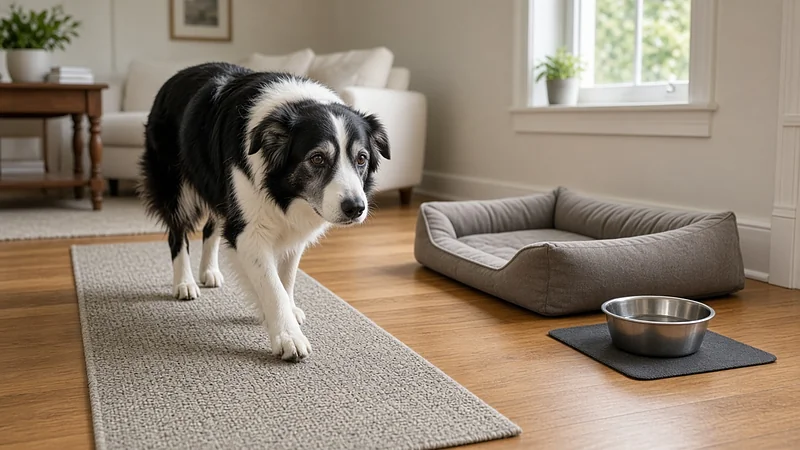
Many owners resist this because the dog has always slept in the bedroom. But if the stairs have become dangerous, a comfortable spot on the ground floor can be kinder than two risky trips a day. Some families take turns sleeping downstairs for the first few nights while the dog settles. Put an orthopedic bed in a quiet corner where the dog can still hear the household, add a non-slip rug around it and keep water nearby. VCA suggests a low or recessed orthopedic bed that the dog does not have to climb onto. Our arthritis home changes guide walks through a whole-house setup.
Which option fits your dog?
| Situation | Best fit |
|---|---|
| Small dog, any stairs | Carry with the spine supported; gate the stairs |
| Medium or large dog, still walks well on the flat | Gate, stair grip and a rear or full-body harness |
| Large dog, weak at both ends | Full-body harness with two people, or sleep downstairs |
| Large dog that must reach an upper floor daily for years | Get quotes for a stair lift |
| Two or three steps, not a full flight | A ramp with side rails |
Common mistakes
The first is buying a ramp for a full staircase. The second is letting the dog use the stairs alone at night because it whines at the gate; one fall can undo months of careful management. A third is pulling on a collar to help the dog up, which puts pressure on the neck and does nothing for the hind legs. And finally, waiting too long. If your dog is hesitating at the bottom of the stairs, it is telling you something, and that is the moment to change the setup.
FAQ
Can I put a dog ramp over my indoor stairs?
Not over a full flight. The slope would be far too steep for a safe ramp. Ramps work for a few steps; for a whole staircase use a harness and a gate, or a stair lift.
Are dog stair lifts real?
Yes. VCA mentions stair lifts for dogs. They are installed on your staircase, so you need a local installer who can confirm the platform is safe for your dog.
Should I help my dog going up or going down?
Both, but going down is often riskier because the dog can pitch forward. Stand below the dog on the way down and use a harness to slow it.
What kind of harness is best for stairs?
A full-body harness with front and rear handles gives the most control. A rear-only harness suits dogs whose front legs are still strong.
Is it cruel to make my dog sleep downstairs?
No. A comfortable, safe bed near family sounds is kinder than repeated risky climbs. Many dogs settle within a few nights.
Prices change often, so we do not list them. Check the current price on Amazon.
Sources
- VCA Animal Hospitals, Creating a comfortable home for your mobility-compromised dog.
- VCA Animal Hospitals, Helping your dog with osteoarthritis.
- VCA Animal Hospitals, Hip dysplasia in dogs.
- American Kennel Club, Dog stairs and ramps.
- PetMD, Does my dog need dog stairs or a dog ramp?
- American Kennel Club, Mobility devices for dogs.
- Product specifications from the linked Amazon listings, checked 2 November 2026.