As an Amazon Associate, SturdyPaws earns from qualifying purchases. This article contains affiliate links; buying through them costs you nothing extra. Read our affiliate disclosure.
Stairs are where many senior dogs get hurt. A dog with arthritis, weak hind legs, a disc problem or poor eyesight can miss a step going down, or lose its back end halfway up. The usual advice from vets is simple: don't let a mobility-impaired dog use the stairs when nobody is there to help. The easiest way to do that is a gate.
But not every gate is safe at every spot. The gate you put at the top of a staircase is a different product from the one that works at the bottom or in a doorway. This guide explains the difference, how to measure, and three gates on Amazon whose maker specs fit a senior dog's home. It is research-based, drawing on maker instructions and veterinary home-care advice. We have not installed these gates ourselves.
Key takeaways
- Top of stairs: hardware-mounted only. Pressure gates can be pushed out, and makers say not to use them there.
- Bottom of stairs or doorways: a pressure-mounted walk-through gate is fine and needs no drilling.
- Measure the exact opening. Many extra-wide gates have gaps in their fit range.
- Swing direction matters. At the top, the door must open away from the stairs.
- A gate is for unsupervised time. When you are home, help the dog on the stairs with a harness, or use a ramp.
Why gate the stairs for a senior dog
VCA Animal Hospitals' advice on living with osteoarthritis suggests blocking stairs with a baby gate when you cannot supervise, and its guide to homes for mobility-compromised dogs lists baby gates alongside non-slip stair runners and grip tape. The reasoning is straightforward. Most stair falls happen when the dog goes alone: following you up at night, coming down for water, or racing to the door when the bell rings. A gate removes the choice.
A gate also helps during recovery. After TPLO, IVDD treatment or other surgery, vets usually restrict stairs for weeks. A gate makes that rule easy to keep; our TPLO stairs guide covers the rest of that setup.
Top of stairs vs bottom of stairs
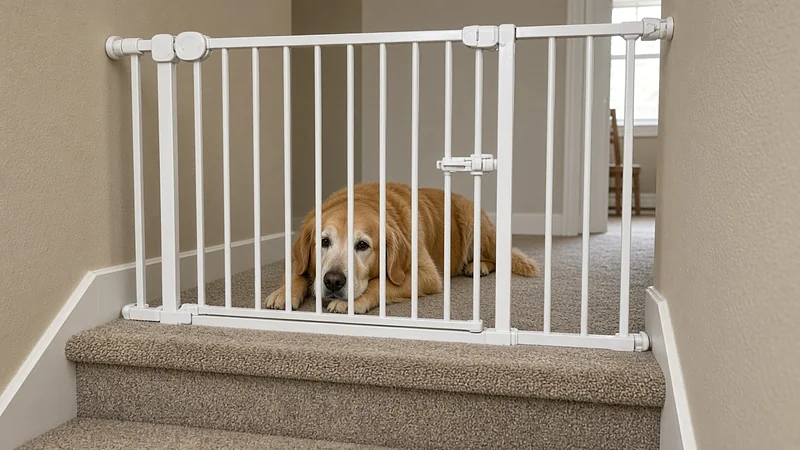
Top of stairs. If a gate fails here, the dog falls the whole flight. Pressure-mounted gates hold by friction against the walls, and a heavy dog leaning or jumping on one can push it out. They also have a bar along the floor that a person carrying something can trip over at the head of the stairs. For these reasons, gate makers say pressure gates must not be used at the top of stairs. Regalo's Easy Step instructions say exactly that. Use a hardware-mounted gate, screwed into the wall or banister, with a door that swings away from the stairs only.
Bottom of stairs. If a dog pushes on a gate here, it simply ends up on the first step. A pressure-mounted gate is fine, and Carlson describes its extra-wide gate for doorways and the bottom of stairs. Pressure gates need no drilling, which suits renters, and you can move them to another doorway later.
Many senior dogs need both: a hardware gate upstairs so they can't come down alone, and a pressure gate at the bottom so they can't start up alone.
How to measure
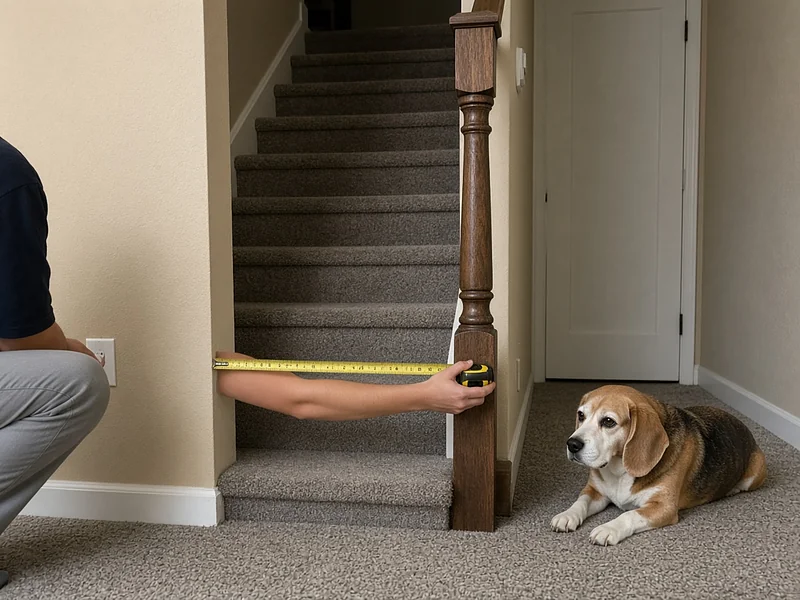
- Measure the opening wall to wall, or wall to banister, at the height where the gate will mount, and again near the floor. Use the smaller number.
- Note what you are fixing to. Drywall needs screws into a stud or proper anchors. A round or square banister post needs an adapter kit.
- Check the fit range in the listing, including any gaps. Extra-wide gates are made from a base gate plus extension pieces, and some widths fall between the combinations.
- Check the height. A 30 in gate stops most senior dogs, which rarely jump. A young, agile second dog in the house may need a taller gate.
Gates compared
| Product | Key specs | Link |
|---|---|---|
| Regalo Top of Stairs Hardware-Mounted Gate | Hardware mount, 30.5 in tall, fits 29–43 in (listing title) openings; banister adapters (square 2–4 in, round 3–5 in); gate must swing away from the stairs | Check price on Amazon (opens in a new tab) |
| Regalo Easy Step Extra Wide Walk-Thru Gate | Pressure mount with wall cups, 30 in tall, 29–49 in in steps (does not fit 32–34 or 36.5–41.5 in); 16 in door; never for the top of stairs | Check price on Amazon (opens in a new tab) |
| Carlson Extra Wide Walk-Thru Pet Gate | Pressure mount, 30 in tall, 29–36.5 in (not 32–34 in); 16.5 in walk-through door plus 7.5 x 7.75 in small pet door; for doorways and the bottom of stairs | Check price on Amazon (opens in a new tab) |
Specs are from manufacturer and retailer listings and can change between versions; check the listing before you buy. We don't show prices because they change often; the button shows the current price on Amazon.
The picks
Best for the top of stairs: Regalo Top of Stairs hardware-mounted gate
Regalo Top of Stairs Hardware-Mounted Gate
Hardware mount, 30.5 in tall, fits 29–43 in (listing title) openings; banister adapters (square 2–4 in, round 3–5 in); gate must swing away from the stairs
Pros
- Made for the top of stairs
- Banister adapters included
- Walk-through door
Cons
- Must be screwed in
- Check opening width first
- Door must swing away from the stairs
This Regalo gate is built for the dangerous spot. It mounts with hardware, stands 30.5 in tall, and fits openings of about 29 to 43 in, per the listing title. It comes with banister adapters for square posts of 2–4 in and round posts of 3–5 in, which solves the most common problem at the top of a staircase: one side is a wall and the other is a banister. The listing describes it for medium to large dogs. Install it so the door swings away from the stairs, never out over them.
Best for: the top of any staircase a senior dog can reach.
Best wide pressure gate for the bottom of stairs: Regalo Easy Step extra wide
Regalo Easy Step Extra Wide Walk-Thru Gate
Pressure mount with wall cups, 30 in tall, 29–49 in in steps (does not fit 32–34 or 36.5–41.5 in); 16 in door; never for the top of stairs
Pros
- No drilling needed
- Wide range for wide openings
- Walk-through door
Cons
- Not for the top of stairs
- Gaps in the fit range
- Bottom threshold bar to step over
The Easy Step fits openings from 29 to 49 in using pressure and wall cups, stands 30 in tall and has a 16 in walk-through door. Its fit range has gaps: it fits 29–32, 34–36.5, 41.5–44.5 and 46.5–49 in, but not 32–34 or 36.5–41.5 in. Measure carefully before buying. Regalo states it must never be used at the top of stairs.
Best for: the bottom of the stairs, wide hallways and open-plan doorways.
Best for homes with cats too: Carlson Extra Wide Walk-Thru gate with pet door
Carlson Extra Wide Walk-Thru Pet Gate
Pressure mount, 30 in tall, 29–36.5 in (not 32–34 in); 16.5 in walk-through door plus 7.5 x 7.75 in small pet door; for doorways and the bottom of stairs
Pros
- Small pet door for cats or tiny dogs
- Pressure mount
- Wide walk-through
Cons
- Not for the top of stairs
- Narrower fit range
- Threshold bar
Carlson's gate is pressure mounted, 30 in tall and fits 29 to 36.5 in, except 32–34 in. As well as a 16.5 in walk-through, it has a small pet door of about 7.5 x 7.75 in. That lets a cat reach the litter box upstairs while the old dog stays down. Carlson describes it for doorways and the bottom of stairs.
Best for: the bottom of the stairs in a home with a cat or a very small second pet. Note that a small dog may fit through that small door.
Installing safely
- Read the maker's instructions in full and follow its placement limits.
- For hardware gates, screw into studs or solid posts, not just drywall.
- Check pressure gates weekly. Vibration and pushing slowly loosen them.
- Close the door every time. A self-closing feature helps in busy homes.
- Put a non-slip mat on each side so a stiff dog isn't standing on a slick floor while waiting for you.
Senior dog extras
Dogs with dementia may wander at night. A gate keeps them away from stairs and out of rooms where they get stuck. Pair it with a night light.
Low-vision dogs learn where a gate is. Keep it in the same position and closed in the same way.
Threshold bars. Pressure gates have a bar across the bottom. A dog that drags its back feet may trip on it. Walk the dog through slowly, or choose a hardware gate there too.
Creating a safe zone. Many owners use gates to create a downstairs living area with a low-entry bed, water and a non-slip runner, so the dog never needs the stairs.
Helping your dog on the stairs when you are home
A gate covers the times you are away. When you are there, many senior dogs can still manage stairs with help. A rear support harness lets you take weight off the hind legs on every step; see our rear support harness guide and the Walkabout review. For a dog that is weak at both ends, a full-body harness such as the one in our CareLift review gives a handle front and back. Stair runners or grip treads reduce slipping; VCA lists both.
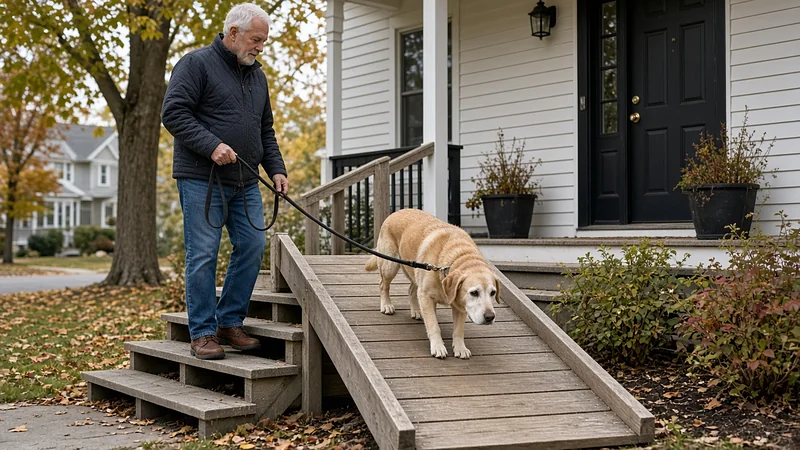
If your dog has outdoor steps too, look at ramps for porch and deck steps.
Which gate where?
| Location | Gate type | Our pick |
|---|---|---|
| Top of stairs | Hardware-mounted, swings away from stairs | Regalo Top of Stairs |
| Bottom of stairs, wide | Pressure-mounted | Regalo Easy Step |
| Bottom of stairs, with cat | Pressure with small pet door | Carlson Extra Wide |
| Doorway to a safe room | Pressure-mounted | Either pressure gate |
Common mistakes
The biggest one is putting a pressure gate at the top of the stairs because it was easier to install. The second is buying an extra-wide gate without checking the gaps in its fit range. A third is leaving the gate door open for convenience; a gate is only useful if it is closed every time. And finally, gating the stairs without giving the dog what it needs on the safe side: water, a comfortable bed, and somewhere near the family.
Related reading: our guides to help with steep indoor stairs and home aids for hip dysplasia.
FAQ
Can I use a pressure gate at the top of stairs?
No. Makers including Regalo say pressure-mounted gates must not be used at the top of stairs. Use a hardware-mounted gate there.
How tall should a gate be for a senior dog?
About 30 in stops most older dogs, which rarely try to jump. A younger, athletic dog in the same house may need a taller gate.
What if my stairs have a banister on one side?
Choose a gate with banister adapters, such as the Regalo Top of Stairs gate, or a separate banister mounting kit.
Will a gate stop my dog falling down the stairs?
It stops the dog using the stairs alone. When you are there, help with a harness and keep stair surfaces non-slip.
Do I need gates if I have a ramp?
Often yes. A ramp helps on steps you choose to use, while a gate stops unsupervised trips on stairs a ramp can't cover.
Prices change often, so we do not list them. Check the current price on Amazon.
Sources
- VCA Animal Hospitals, Helping your dog with osteoarthritis.
- VCA Animal Hospitals, Creating a comfortable home for your mobility-compromised dog.
- Regalo, Safety gates (product instructions and fit ranges).
- Carlson Pet Products, Pet gates.
- Product specifications from the linked Amazon listings, checked 2 November 2026.