As an Amazon Associate, SturdyPaws earns from qualifying purchases. This article contains affiliate links; buying through them costs you nothing extra. Read our affiliate disclosure.
These are the two names you hear most often once a vet says your dog's back legs need support. A veterinarian, Dr. Julie Buzby, recommends both to her patients, but for different jobs. Picking the wrong one is a common, costly mistake. A sling bought for a dog that needs help at the front too will not do the job, and a full harness bought for two weeks of post-surgery potty trips may be more than you need.
This is a research-based comparison, not a hands-on test. We read both makers' pages, Amazon listings, and veterinary commentary, listed under Sources, in November 2026.
Key takeaways
- Help 'Em Up is a fitted, two-piece front and rear harness with handles, designed to stay on for long periods. Best for dogs that need help many times a day, or at both ends.
- GingerLead is a padded rear-only sling with a built-in leash that goes on and off in seconds. Best for walks, steps and short-term recovery when the front legs are strong.
- Rule of thumb from Dr. Buzby: Help 'Em Up as a semi-permanent accessory for dogs that need significant help to rise; GingerLead for on-demand hind-end support.
- GingerLead generally costs less; Help 'Em Up is priced by size and is the higher relative cost for most dogs.
- Each maker sets safety rules. Do not use Help 'Em Up's hip piece alone, and do not lift a dog fully off the ground with a GingerLead clipped to a collar.
The short answer
| Feature | Help 'Em Up | GingerLead |
|---|---|---|
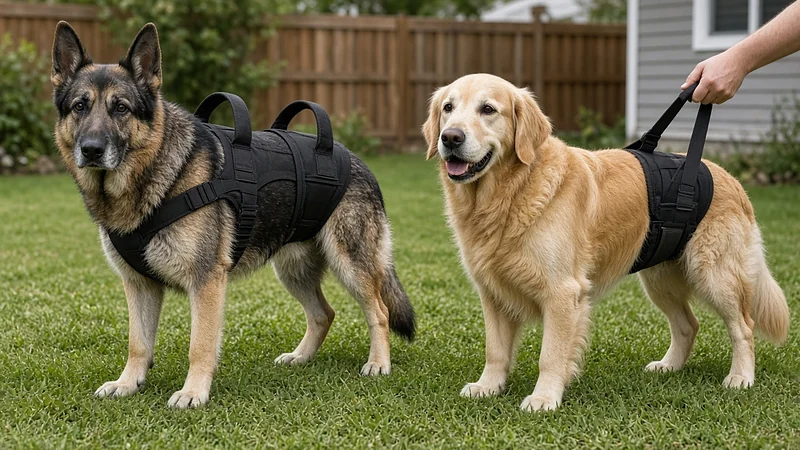
| Type | Two-piece full-body harness (chest piece + hip lift) | Padded rear sling with integrated leash |
| Supports | Front, rear or both | Rear only |
| Worn | For extended periods, per the maker | On demand; not intended to be left on (Dr. Buzby) |
| Weight range | Sizes for about 10–225 lb | Up to 250 lb, per the maker |
| Male/female | Conventional and U-band (male) styles | Unisex design with a cutout for most males (maker); Amazon sells male and female versions |
| Relative cost | Higher | Lower |
| Best for | Daily, long-term help; front-end weakness; large dogs needing full lifts | Walks, steps and car help; post-surgery weeks; front legs strong |
How the Help 'Em Up works
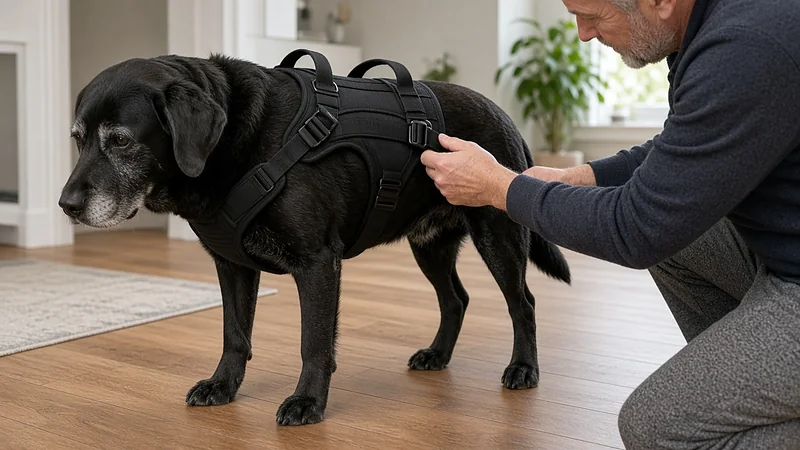
The Help 'Em Up is two pieces that clip together. The front piece has a padded "T" that lifts under the sternum, a front handle and a D-ring for a leash. The rear "hip lift" sits around the pelvis with a second handle. Help 'Em Up says its patented hip lift is designed to lift under the sternum and pelvis without strain on joints, the abdomen or the bladder, and that the harness has 10 adjustment points so it can be left on for long periods.
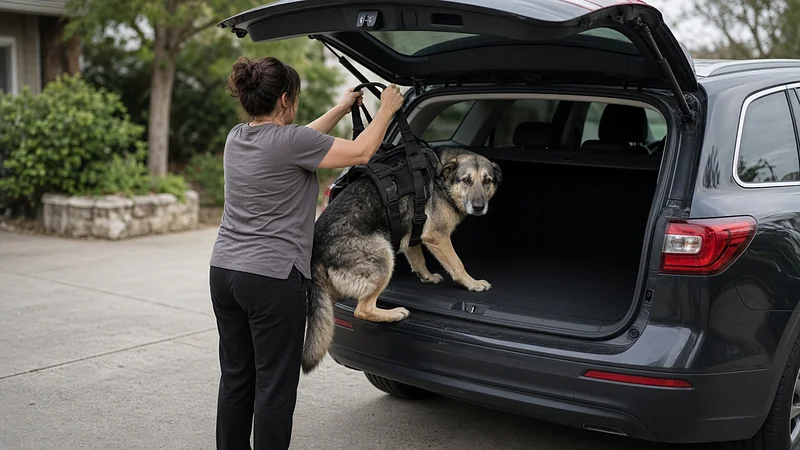
That last point is the reason to buy one. If your dog needs help getting up from bed, on the stairs, into the car and on every walk, a harness that stays on means help is always one grab away. You can lift the front, the rear, or both at once with one handle in each hand.
Points to know:
- Sizing has several parts. The maker sizes the front and rear pieces, and its guidance notes that dogs with muscle wasting in the hind end may need the rear piece sized down. Mix-and-match sizing is offered for that and for barrel-chested dogs.
- Two styles. A conventional harness, and a U-band version for male dogs whose anatomy sits further back.
- Do not use the hip lift alone. La Petite Labs, summarising the maker's instructions, notes the rear piece must connect to the front section to stay in position.
- Accessories. Help 'Em Up sells add-ons such as walking loop handles, which clip to the harness D-rings, for taller owners or two-person lifts.
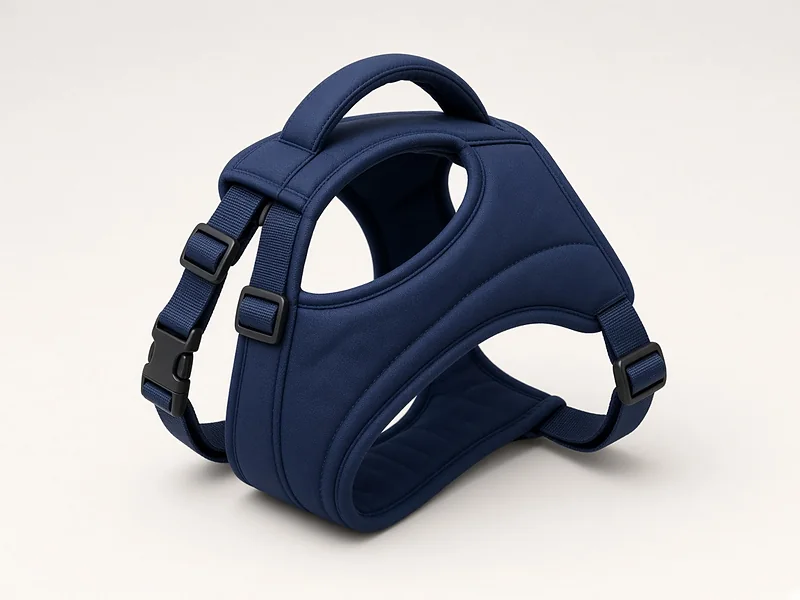
Help 'Em Up Harness
Two-piece full-body harness (front + hip lift), sizes for 10–225 lb, conventional and U-band (male) styles
Pros
- Lifts front, rear or both with separate handles
- Designed to be worn for long periods
- Male (U-band) and conventional versions
Cons
- Most expensive option here
- Sizing is fiddly; the maker suggests sizing the rear down for dogs with muscle loss
How the GingerLead works
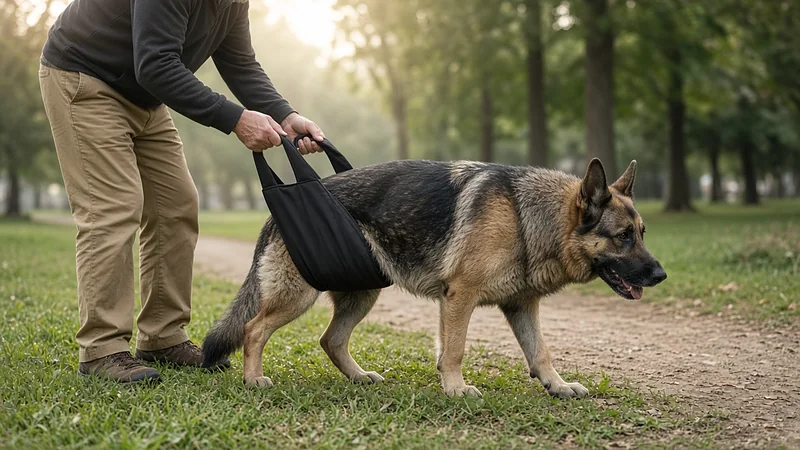
GingerLead is a single padded sling that slides under the belly in front of the hind legs, with straps that come up to a handle and an integrated leash. The maker says it supports dogs up to 250 lb, is made in Colorado with a pack-cloth exterior and soft corduroy where it touches the dog, and is machine washable and dryable (the Mini should be air-dried). It clips to a collar for speed control, or to a chest harness for more support. Optional "stay-on" straps cinch the straps together so the pad stays in place when you let go, for example while your dog toilets.
Because the leash is built in, you can walk your dog and support its rear with one hand. It is quick to fit, which matters for a post-surgery dog that needs a few trips outside each day.
Points to know:
- Rear only. It does nothing for a dog whose front legs are weak, and older dogs may need a separate chest harness.
- Do not fully lift from a collar. La Petite Labs notes GingerLead's instructions prohibit lifting a dog entirely off the ground when the lead is attached to the collar.
- Let the dog do some work. The same source notes GingerLead's instructions say to let the dog use remaining hind-leg movement rather than leaving the legs dangling.
GingerLead Dog Support Sling
Padded rear sling with integrated leash, male and female cuts, dogs up to 250 lb, made in USA
Pros
- Padded belly pad spreads the load
- Integrated leash for one-handed walking
- Widely used after orthopedic surgery
Cons
- Rear support only
- Slides on and off rather than staying on all day by default (optional stay-on straps)
Which one for your dog?
Choose the Help 'Em Up if…
- Your dog needs help to stand up, several times a day, every day.
- The front legs are weak too, or you are not sure.
- You have a large dog that you sometimes need to lift fully, for example into a car.
- The weakness is progressive, as with degenerative myelopathy, and you expect to need support for months.
Choose the GingerLead if…
- Your dog is recovering from knee or hip surgery and needs steadying for a few weeks. See our TPLO stairs and recovery setup guide.
- The front end is strong and only the back end tires or wobbles, especially on walks or steps.
- You want something quick to put on and take off, and do not want a harness left on all day.
Some owners use both
A common progression is to start with a sling after surgery or in early weakness and move to a full harness if "temporary" becomes daily. If cost matters, buying the sling first is reasonable, as long as your dog's front end is strong.
Sizing tips for both
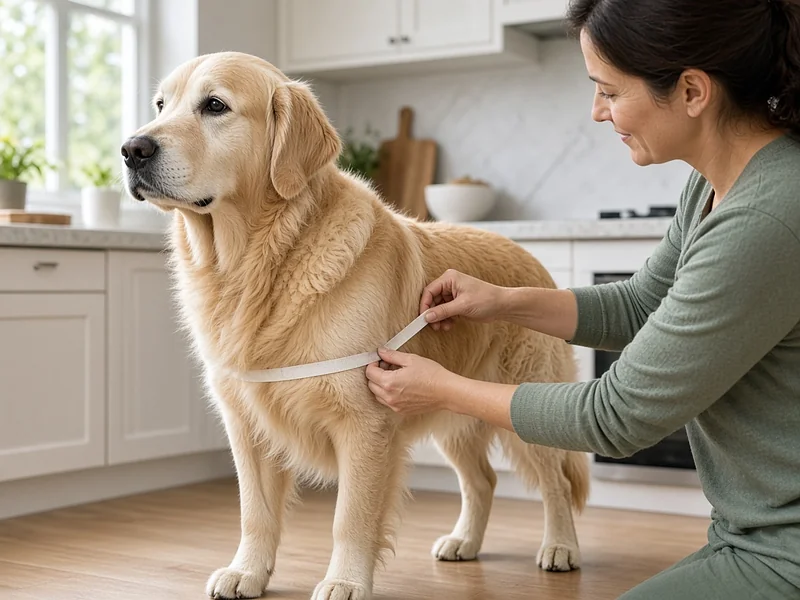
- Measure with a soft tape: chest girth just behind the front legs, and waist just in front of the hind legs. Weigh your dog.
- Use each maker's current chart; do not size by breed name.
- For dogs that have lost muscle in the hind end, check the maker's advice on sizing the rear down.
- Check fit after a few minutes of walking. You should be able to slide two fingers under straps, and nothing should rub behind the legs or under the belly.
- Check skin under any harness worn daily, especially in thin seniors.
Alternatives worth knowing
- Walkabout Back End Harness: wraps the hind legs with a top handle, sized by abdomen and thigh.
- PetSafe CareLift rear lifting aid: a simple rear-only sling with handles. PetSafe sells the CareLift Full Body harness separately.
Both are compared in our rear support harness guide. Browse all lift and support harnesses.
Make lifting easier on you, too
Bend your knees and keep your back straight, and keep the dog close. Use a second person for very large dogs. Pair the harness with traction at home, such as runner rugs (see our hardwood floor guide), so your dog can do more of the work. For the car, a long, gentle ramp may help a large dog; see our SUV ramp guide.
Leaning towards the Help 'Em Up? Our Help 'Em Up review goes deeper on sizing and fit. For car entry specifically, see the best lift harness for getting into a car.
Another rear option that lifts from the thighs rather than the belly is covered in our Walkabout harness review.
FAQ
Is Help 'Em Up or GingerLead better for a dog with weak back legs?
If only the back legs are weak and your dog needs help mainly on walks or steps, GingerLead is simpler and costs less. If your dog needs help standing many times a day, or the front legs are weak too, Help 'Em Up is the better fit.
Can a dog wear the Help 'Em Up all day?
The maker says it is designed to be left on for extended periods. Take it off at night or as your vet advises, and check the skin regularly.
Can I use the GingerLead after TPLO or IVDD surgery?
The maker lists orthopedic surgery recovery and IVDD among its uses. Ask your surgeon how much support they want and whether a sling suits your dog's recovery.
Can I use just the rear part of the Help 'Em Up?
No. The hip lift is designed to connect to the front piece to stay in place.
Prices change often, so we do not list them. Check the current price on Amazon.
Sources
- Help 'Em Up, Help 'Em Up Harness (design, adjustment points and accessories).
- GingerLead, GingerLead Dog Sling Support Harnesses.
- Dr. Buzby's ToeGrips, 18 Things for Senior Dogs (Dr. Julie Buzby on both harnesses).
- La Petite Labs, Lifting Harnesses for Senior Dogs (summary of makers' instructions).
- Help 'Em Up and GingerLead listings on Amazon (titles and sizes checked November 2026).