As an Amazon Associate, SturdyPaws earns from qualifying purchases. This article contains affiliate links; buying through them costs you nothing extra. Read our affiliate disclosure.
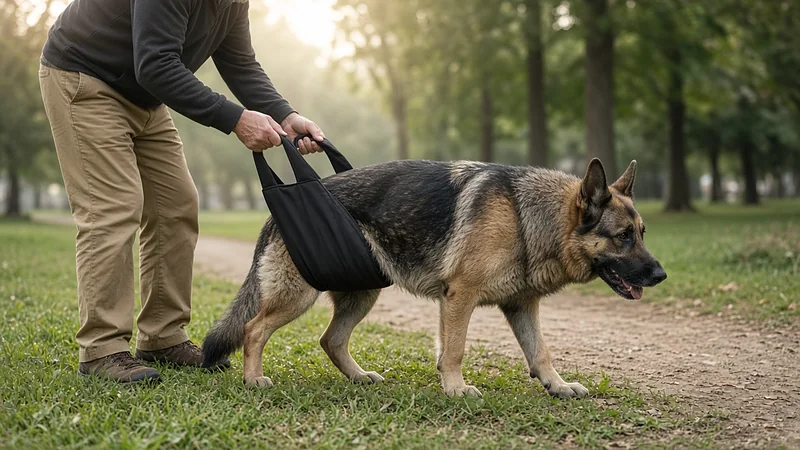
When a senior dog's back legs start to give out, the front end usually keeps working. What the dog needs is someone to take some weight off the hips on walks, stairs and slippery floors. The Walkabout back end harness is one of the oldest products made for exactly that. It's simple: a padded piece that wraps around the hind legs, with a strap handle on top so you can lift the hips while the dog walks.
This review explains how it works, how to measure your dog for the right size (the most common source of problems), the full maker size chart, who it suits and who should look elsewhere. It's research-based, using Walkabout's own product pages and an independent review on Dog Mobility. We haven't fitted a Walkabout on our own dog.
Key takeaways
- Rear support only. It wraps the hind legs and hips, with a top handle.
- Two measurements decide the size: the abdomen just in front of the back legs (A) and the upper thigh where it meets the body (B).
- Seven sizes, XS to XL. Handle length varies by size, from 12 to 26 in.
- Can stay on for the day, the maker says, with clearance for toileting.
- Weak front end too? Look at a full-body harness instead.
How the Walkabout works
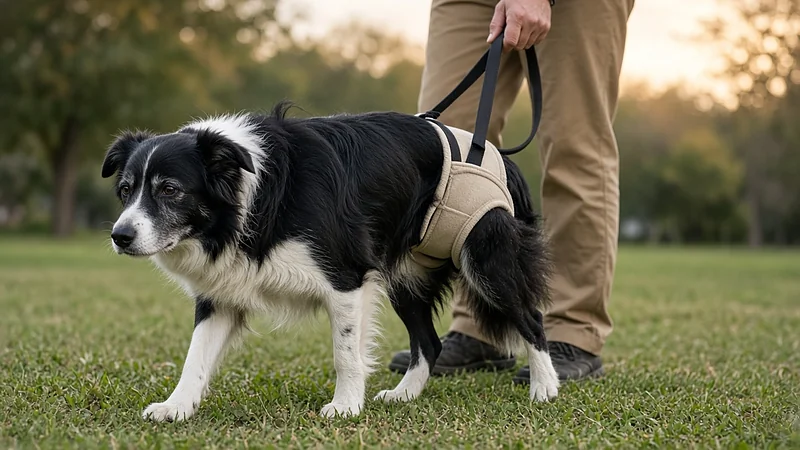
Most rear slings run under the belly. They lift well, but they press on the abdomen, and on male dogs they can sit right where the dog urinates. The Walkabout takes a different route. It wraps around the top of each hind leg and across the hips, so the lift comes from under the thighs and pelvis rather than the belly. The handle sits above the hips and you hold it at a length that keeps your back straight.
Walkabout says its harnesses have been recommended by veterinarians and rehabilitation specialists for 40 years, and that the design leaves room for the dog to toilet while wearing it. Dog Mobility's review notes the company was founded by Cathy Erwin in 1986, which fits that history.
The Walkabout range
This review covers the Original Back End Harness, but the brand makes several related products, described by Walkabout and Dog Mobility:
- Front End harness for dogs that need help with the front legs.
- Combo, using front and back pieces together.
- Airlift One, a rear harness in breathable Airprene.
- Hoistabout and Walkabelly, other support designs listed by Dog Mobility.
- Amputee versions for three-legged dogs, according to Walkabout.
How to measure
Walkabout sizes the back end harness by two measurements, taken with a soft tape while the dog is standing:
- A: abdomen. Around the belly just in front of the back legs.
- B: upper thigh. Around the top of one back leg, where it meets the body.
Measure snugly but not tight, and take each measurement twice. Thin seniors that have lost muscle often have a small thigh for their abdomen, so check both numbers against the chart. If they fall in different sizes, contact Walkabout before ordering.
Size chart
| Size | A: abdomen | B: upper thigh | Handle length |
|---|---|---|---|
| XS | 8–15 in | 3–5 in | 21 in |
| S | 13–17 in | 5–7 in | 21 in |
| MS | 15–22 in | 8–11 in | 26 in |
| M | 18–24 in | 11–14 in | 15 in |
| ML | 25–29 in | 14–16 in | 12 in |
| L | 28–31 in | 16–17 in | 12 in |
| XL | 31–35 in | 18–22 in | 12 in |
From Walkabout's product page, checked 2 November 2026. Walkabout says longer straps are available on request.
Notice the handle lengths. The small sizes have longer handles, because a small dog is further from your hand. The large sizes have a 12 in handle because a big dog's hips are already near hand height. If you're tall, or your dog is short-legged for its size, ask about a longer strap.
The listing we link
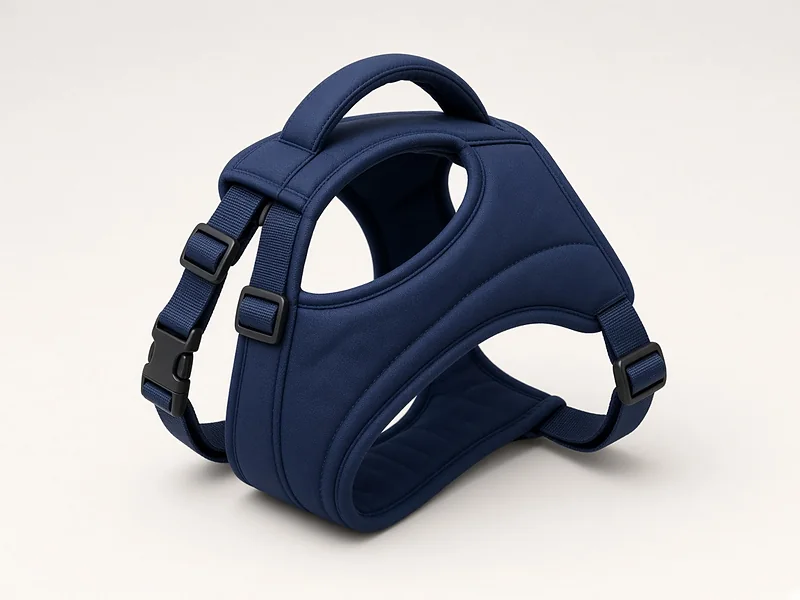
Walkabout Original Back End Harness
Rear-end harness that wraps the hind legs, top handle, made in USA; 7 sizes (XS–XL) chosen by abdomen and upper-thigh measurement
Pros
- Wraps the legs instead of the belly, so less abdominal pressure
- Easy to leave on for short outings
Cons
- Rear only
- Leg loops need correct sizing to avoid rubbing
The Amazon listing we link is the Medium, whose listing title gives a 19–25 in abdomen. That differs slightly from the 18–24 in on Walkabout's chart, so check the sizes in the listing and on the maker's page, and if in doubt, order the size that matches both. Other sizes can be chosen in the listing or bought from Walkabout.
Fitting and first walks
- Open the harness and slide it under the hips, with the leg openings behind the thighs.
- Bring each side around a hind leg and close it. The fabric should sit high on the thigh, not down near the knee.
- Hold the handle and lift gently. The dog's back feet should stay on the ground, just carrying less weight.
- Walk a few steps. Watch for rubbing on the inner thigh and adjust if the dog walks oddly.
- Reward and keep it short the first time.
The aim is support, not carrying. Lift just enough to stop the back end sagging or the feet slipping. Too much lift tips the dog onto its front legs.
Wearing it for longer
Walkabout says the harness can be left on during the day, which saves putting it on for every toilet trip. If you do this, check the skin under the leg wraps daily, take it off for sleep, and keep it clean. Incontinent dogs need extra care; wipe the harness and the dog after accidents, and wash the harness often.
Common sizing mistakes
Sizing by weight. The Walkabout chart has no weight column at all. Two 50 lb dogs can need different sizes if one is lean and long-legged and the other is stocky.
Measuring a sitting dog. The belly and thighs change shape when a dog sits. Measure standing, on a flat floor, with a helper keeping the dog still.
Measuring too far down the leg. Measurement B is at the very top of the thigh, where it meets the body. Lower down, the leg is thinner and you'll get a size that's too small and rubs.
Ignoring the overlap. Several sizes overlap on the chart. If your dog sits in the overlap, the thigh measurement is usually the better guide, because the leg wraps carry the weight.
Not re-measuring. Senior dogs lose muscle over months. A harness that fit last year may now be loose. Check fit every few months.
Using it on stairs and at the car
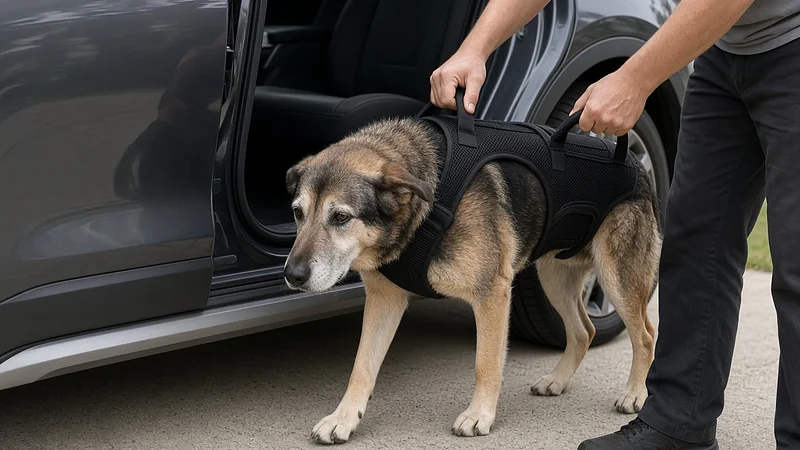
On stairs, stand beside and slightly behind the dog, and lift the hips just as the back legs push off each step. Going down, keep the handle short so the back end doesn't drop suddenly. At the car, let the dog put its front feet in first, then lift the hips with the handle. For a heavy dog or a high SUV, a ramp is easier on your back; see our SUV ramp guide.
Pros and cons
Pros
- Lifts from the thighs and hips rather than the belly.
- Toilet clearance, so it can stay on.
- Seven sizes, with longer straps on request.
- Simple: one piece, one handle.
Cons
- Rear support only. Nothing for the front end.
- Sizing needs two careful measurements.
- Dog Mobility's review lists a con that it's "not made for larger breed dogs". The chart goes to XL (31–35 in abdomen), but owners of giant breeds should check fit carefully.
Walkabout vs other rear harnesses
Compared with the Help 'Em Up, which has a chest piece and is meant to stay on all day, the Walkabout is simpler and covers only the rear. Compared with the GingerLead, a belly sling, it lifts under the legs instead of the abdomen. For a dog that needs help at both ends, the PetSafe CareLift or the Help 'Em Up is a better fit. Our rear support harness guide compares the options, and Help 'Em Up vs GingerLead looks at two of them closely.
Who should buy it
| Dog | Walkabout? |
|---|---|
| Weak back legs, good front end | Yes, its main use |
| Male dog, belly sling gets wet | Yes, the leg design avoids the belly |
| Weak at both ends | Choose a full-body harness |
| Giant breed | Check the XL chart carefully |
| Three-legged dog | Ask about the amputee versions |
Beyond the harness
A harness makes walks possible. Pair it with non-slip floors, stair gates for unsupervised times, and gentle exercises from our guide to muscle loss in the back legs. If walks become too hard even with support, a rear wheelchair may be the next step.
Related reading: our guides to slings for IVDD recovery.
FAQ
How do I measure for a Walkabout harness?
Measure around the abdomen just in front of the back legs, and around the upper thigh where it meets the body, then check both on the maker's chart.
Can my dog pee in the Walkabout?
Walkabout says the design gives toilet clearance, so dogs can go while wearing it.
Can I leave it on all day?
The maker says it can be left on during the day. Check the skin daily and take it off for sleep.
Is it good for large dogs?
Sizes go up to XL (31–35 in abdomen). One reviewer felt it isn't ideal for larger breeds, so measure carefully.
Does it help on stairs?
Yes, it lets you lift the hips on each step. Use a gate when you can't supervise.
Prices change often, so we do not list them. Check the current price on Amazon.
Sources
- Walkabout Harnesses, The Original Walkabout Back End Harness (sizing and handle lengths).
- Dog Mobility, Walkabout harness review.
- Product specifications from the linked Amazon listing, checked 2 November 2026.