As an Amazon Associate, SturdyPaws earns from qualifying purchases. This article contains affiliate links; buying through them costs you nothing extra. Read our affiliate disclosure.
Grip socks look like the perfect fix for an old dog sliding around on laminate. They are soft, cheap and light, and most dogs tolerate them far better than boots. Then you find one sock in the hallway, another twisted round so the grip faces the ceiling and a third half-chewed under the sofa.
Socks that stay on and keep gripping are possible, but design and fit matter a lot. This guide explains why socks come off, the features that help, how to measure and one sock whose Amazon listing we checked today, plus alternatives for dogs that will not keep anything on their feet. It draws on guidance from VCA Animal Hospitals and the American Kennel Club. We have not tested these socks on our own dogs.
Key takeaways
- Socks fall off mainly because they are too big or have no strap. Size by paw width and choose a strap.
- Grip on both sides means a sock that twists still grips the floor.
- Socks are for indoors. Outdoors, they wear through quickly and get wet.
- Buy a pack with spares. The grip wears down, and one sock always goes missing.
- Short nails and rugs come first. Socks add grip; they do not replace the basics.
Why grip socks help older dogs
An older dog's paw pads, nails and muscles all lose some of their grip and control. On smooth hardwood, laminate or tile, that means slipping, splaying and difficulty getting up. VCA explains that dogs who feel unsteady on hard floors walk cautiously with short strides and a hunched back, which leads to stiffness and to moving less. It lists pad coverings and boots as ways to add traction, alongside rugs, runners and short nails, and advises asking your vet or rehabilitation therapist which option suits your dog.
Socks are the gentlest form of pad covering. They weigh almost nothing, they let the paw bend naturally and most dogs walk normally in them within a few minutes. That makes them a good first try for a dog that has never worn anything on its feet.
Why socks fall off
Wrong size
A sock that is too large rotates on the paw and slides down the leg. Most sock makers size by paw width and length. Because knit fabric stretches, many brands advise choosing the smaller size if your dog falls between two. A snug sock stays put; a baggy one migrates.
No strap
A plain tube of fabric relies on elastic alone, and a dog's lower leg narrows toward the paw, so there is little to hold it. A hook-and-loop strap around the leg, above the paw, holds the cuff in place. The strap should be firm but never tight; you should be able to slip a finger under it.
Grip on one side only
Even a well-fitted sock turns a little as the dog walks. If the rubber grip is only on the bottom, a quarter-turn puts fabric on the floor and the sock becomes slippier than a bare paw. Socks with grip printed on both sides keep some rubber in contact however they turn.
Chewing
Some dogs pull socks off with their teeth, especially at first. Distract the dog with a treat or a chew while it gets used to them, and take the socks off when you cannot supervise, so it does not swallow fabric.
Our verified pick
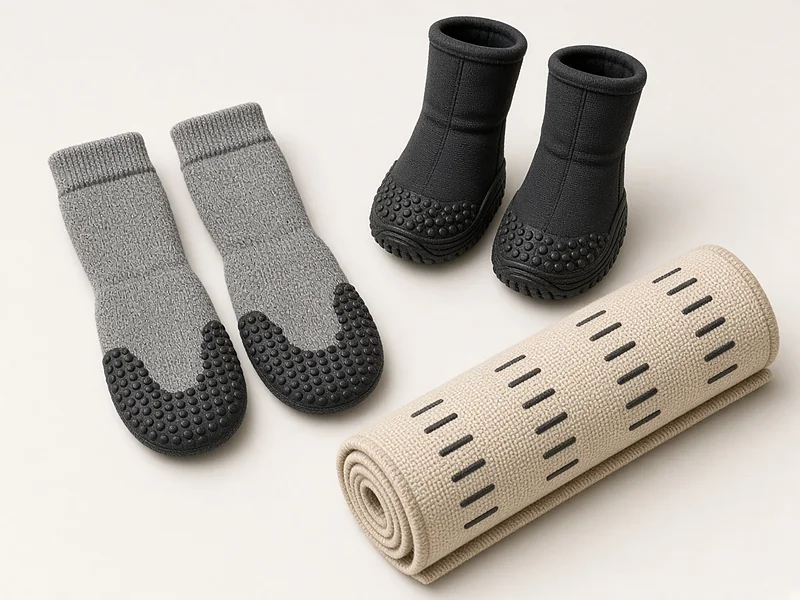
EXPAWLORER Double-Side Anti-Slip Dog Socks
6 socks + 6 detachable straps per pack; grip on both sides; Medium listed as paw width 2.6 in, length 6.3 in; brand says size down if between sizes
Pros
- Grip on top and bottom so a twisted sock still grips
- Straps help them stay on
- Six socks lets you rotate
Cons
- Indoor use; grip wears down
- Sizing varies by listing
- Nails can poke through
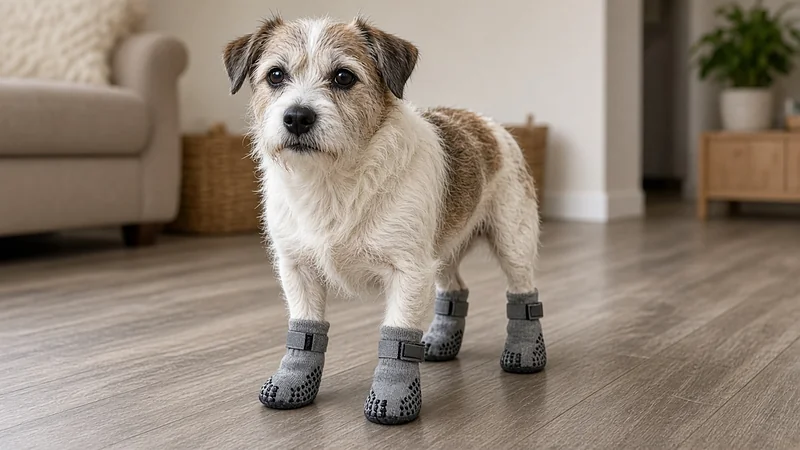
The EXPAWLORER socks address the main problems above. Each pack has six socks and six detachable straps, so you can strap all four paws and keep two spares. The grip is printed on both sides, which the maker says helps with senior dogs that slip on wooden floors. The linked listing is size Medium, listed as a paw width of 2.6 in and a length of 6.3 in, and other sizes are available. The maker advises choosing the smaller size if your dog is between sizes, and it does not recommend long outdoor walks in them.
Two practical notes. The listing's sizing has changed over time, so check the current size chart against your own measurements rather than going by a size name. And on dogs with long nails, nails can push through the toe of a knit sock; keeping nails trimmed helps both grip and sock life.
Alternatives if socks don't work
Dr. Buzby's ToeGrips
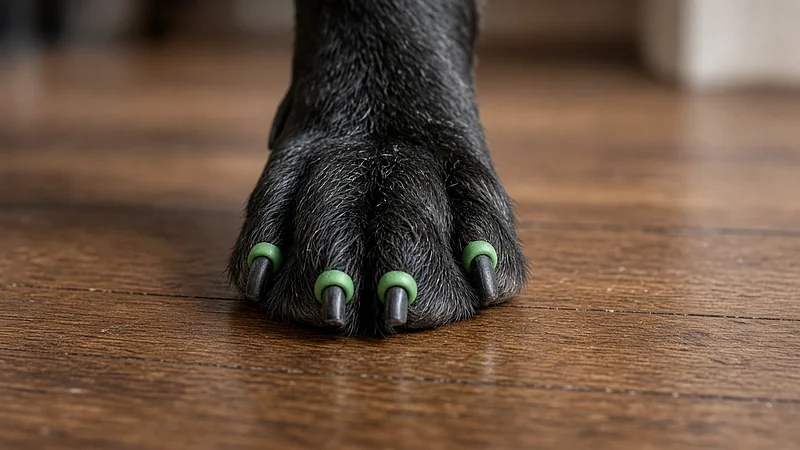
Rubber rings that slip over toenail tips; sized by nail; 20 per pack (16 weight-bearing nails plus 4 spares); last 1–3 months per the maker. Linked listing is Medium (the listing says Medium suits dogs with an ideal weight of 15–39 lb)
Pros
- Leaves paw pads free; nothing over the foot
- Developed by a veterinarian
Cons
- Fitting takes patience and correct sizing
- Can fall off or need replacing every 1–3 months
- Not suitable for every nail shape
Dr. Buzby's ToeGrips are rubber rings that slip over each nail, so nothing covers the paw at all. They suit dogs that refuse socks or boots. They take longer to fit and need replacing every one to three months, according to the maker. See our ToeGrips review.
Pawz Rubber Dog Boots
Thin natural-rubber disposable boots, reusable for a while
Pros
- Inexpensive and thin, so many dogs tolerate them
- Waterproof
Cons
- Tear with nails and heavy use
- Can trap moisture if worn for hours
Pawz rubber boots are a thin, balloon-like option that grips well and handles wet walks, though some dogs dislike the feel of rubber. Our dog boots guide covers rubber-soled boots in more detail.
Kapaqua Rubber-Backed Custom-Length Runner Rug
22 in wide (other widths in the menu), custom length, 1/4 in low loop pile, rubber backing for hardwood, laminate, vinyl and tile; hand wash only per the current listing
Pros
- Cut to the exact length of your hallway or route, so there are fewer gaps
- Low 1/4 in pile is easy for dragging feet
- Rubber backing made for bare hard floors
Cons
- Not for use on carpet
- Current listing says hand wash only
- 22 in is narrow for a large dog that splays; check wider options
And for dogs that will not wear anything, a rubber-backed runner along their main routes gives grip with no fitting at all. See our runner rug guide.
| Product | Key specs | Link |
|---|---|---|
| EXPAWLORER Double-Side Anti-Slip Dog Socks | 6 socks + 6 detachable straps per pack; grip on both sides; Medium listed as paw width 2.6 in, length 6.3 in; brand says size down if between sizes | Check price on Amazon (opens in a new tab) |
| Dr. Buzby's ToeGrips | Rubber rings that slip over toenail tips; sized by nail; 20 per pack (16 weight-bearing nails plus 4 spares); last 1–3 months per the maker. Linked listing is Medium (the listing says Medium suits dogs with an ideal weight of 15–39 lb) | Check price on Amazon (opens in a new tab) |
| Pawz Rubber Dog Boots | Thin natural-rubber disposable boots, reusable for a while | Check price on Amazon (opens in a new tab) |
| Kapaqua Rubber-Backed Custom-Length Runner Rug | 22 in wide (other widths in the menu), custom length, 1/4 in low loop pile, rubber backing for hardwood, laminate, vinyl and tile; hand wash only per the current listing | Check price on Amazon (opens in a new tab) |
Specs are from manufacturer and retailer listings and can change between versions; check the listing before you buy. We don't show prices because they change often; the button shows the current price on Amazon.
How to measure for socks
Use the same tracing method the AKC recommends for boots. Put a sheet of paper on a hard floor, have your dog stand with one paw on it so the toes spread naturally, trace around the paw and measure the widest part. For socks, also measure the length from the back of the main pad to the tip of the longest toe, since many sock charts list both. Measure a front and a back paw; front paws are often larger.
Compare your numbers with the chart on the listing you are buying. If you are between sizes and the maker suggests sizing down, do so.
Putting socks on a senior dog
- Do it with the dog lying on its side on a bed or rug, so it does not have to balance on three legs.
- Roll the sock down, slip it over the paw and check that the grip pad sits under the main pad.
- Fasten the strap above the paw, snug but with room for a finger.
- Reward the dog, then let it stand on a rug before walking onto the hard floor.
- Check after a few minutes that the sock has not rotated.
The AKC suggests introducing paw coverings gradually with praise and treats, starting with short periods indoors and watching for signs of stress. The same approach works for socks.
Which dogs do best in socks?
Socks tend to suit dogs that slip mainly indoors, still lift their paws properly when they walk and do not mind having their feet handled. A small or medium senior dog that splays on a kitchen floor but walks well on carpet is a typical candidate. They are less suited to dogs that drag the tops of their paws, because the knit wears through quickly and the real problem is strength or nerve function, not grip. Very large dogs can wear socks too, but the extra weight on each paw wears the rubber dots faster, so expect to replace them more often. If you are unsure, try one pair on the back paws first, since that is where most senior dogs lose their footing, and watch how your dog walks for a few days before buying more.
Caring for the socks and the paws
Take socks off at least overnight so the skin can breathe, and check for rubbing under the strap. Wash them as the maker directs; dirt and fur build-up reduce grip. Replace socks when the rubber dots wear smooth, because a worn sock can be slippier than a bare paw. If your dog licks its paws a lot, or the skin under the sock looks red, stop and ask your vet.
Keep the basics in place
Socks work best as one part of a traction plan. VCA recommends trimming nails at least once a month and trimming fur between the toes, and non-slip rugs or runners where your dog spends most time. Its osteoarthritis guidance also suggests yoga mats or foam floor tiles and baby gates to keep a dog out of slick rooms. Our slippery floors guide covers these.
Common mistakes
Buying by size name rather than measuring. Choosing socks without straps for a dog that is active around the house. Leaving socks on overnight. Using socks outdoors, where they get wet and wear through. And keeping worn-out socks in use because the dog seems fine in them.
Related reading: our guides to paw wax versus traction products and foam mats versus rugs.
FAQ
How do I keep dog socks from falling off?
Measure the paw and choose a snug size, use socks with a strap above the paw, and pick double-sided grip so a twisted sock still grips.
Are grip socks safe for senior dogs?
Generally yes, indoors and under supervision. Take them off for sleep, check for rubbing, and ask your vet if your dog has paw or nerve problems.
Can dogs wear grip socks outside?
Not for long. Makers generally recommend them for indoor use. Use boots for walks.
How often should I replace grip socks?
When the rubber grip wears smooth. Packs with spare socks let you rotate.
Socks or toe grips?
Socks are quicker to put on; toe grips leave the paw uncovered and suit dogs that hate socks. See our comparison of toe grips, boots and socks.
Prices change often, so we do not list them. Check the current price on Amazon.
Sources
- VCA Animal Hospitals, Creating a comfortable home for your mobility-compromised dog.
- VCA Animal Hospitals, Helping your dog with osteoarthritis.
- American Kennel Club, Choosing the right dog boots or shoes for your dog.
- Product specifications from the linked Amazon listings, checked 2 November 2026.