As an Amazon Associate, SturdyPaws earns from qualifying purchases. This article contains affiliate links; buying through them costs you nothing extra. Read our affiliate disclosure.
Your old dog was fine at breakfast. By afternoon it is leaning hard to one side, walking in circles, or cannot stand without falling. The eyes may flick rapidly side to side. Many owners think it is a stroke. Often it is vestibular disease: a sudden upset in the balance system in the inner ear or brain.
VCA Animal Hospitals and the UK charity PDSA both describe idiopathic ("old dog") vestibular disease as common in seniors, usually improving over days to a couple of weeks with nursing care. This guide is about that home nursing: how to set up a safe room, which floors and gates matter, and which support slings, mats and beds help while your dog recovers. It is research-based, not hands-on testing, and it is not a substitute for a vet visit.
Key takeaways
- Call your vet the same day if your dog is vomiting, distressed, cannot stand or cannot eat and drink. Do not wait to "see if it passes".
- Create a small, quiet safe zone with soft bedding, no stairs and no raised rug edges that can trip a dizzy dog.
- Non-slip flooring is essential. Carpet or rubber-backed runners beat bare hardwood while balance is poor.
- Use a sling or harness to support walking and toileting rather than carrying the dog whenever you can; paws on the ground help retrain balance.
- Keep bowls close and feed upright. Hand-feed if needed for the first days.
What vestibular disease looks like
VCA lists the usual signs: sudden loss of balance, disorientation, falling or circling to one side, a head tilt, involuntary darting eye movements (nystagmus), reluctance to stand or walk, and nausea or reduced appetite. PDSA adds a wide-legged stance and collapsing. Signs often appear in less than an hour.
Idiopathic vestibular syndrome is the label used when no specific cause is found. VCA notes it is typical in older dogs, starts suddenly, and improves rapidly with little or no medical intervention beyond supportive care. PDSA says most dogs with geriatric vestibular disease improve over two to three days with nursing and anti-sickness medicine if needed, and many recover within one to two weeks, though a head tilt can remain.
That timeline is reassuring, but it is not a reason to skip the vet. The same page at VCA lists middle- and inner-ear infections, trauma, tumours, hypothyroidism and certain ear-toxic medicines as other causes. Those need different treatment.
Vestibular disease vs stroke vs dementia
| Problem | Typical pattern | Home focus |
|---|---|---|
| Idiopathic vestibular | Sudden tilt, circling, nystagmus; often improves in days | Safe zone, traction, sling support, anti-nausea per vet |
| Stroke / brain disease | Can look similar; may worsen or add other neurologic signs | Urgent vet care; do not assume "old dog vestibular" |
| Dementia (CCD) | Slow weeks-to-months: night pacing, confusion, accidents | Routine, night lights, gated stairs — see our dog dementia home guide |
Southeast Veterinary Neurology also stresses that idiopathic cases are managed with supportive care once other causes are ruled out. If signs do not improve within a few days, or they get worse, VCA and PDSA both recommend further tests.
Step 1: Build a small safe zone
PDSA's home-nursing advice is clear: keep the dog confined to a small area with soft furnishings and flooring so it cannot walk into furniture, fall or hurt itself. Southeast Veterinary Neurology recommends a quiet, comfortable resting place, obstacles cleared, and stairs and pools blocked.
Practical setup for the first 48–72 hours:
- One room or a pen. A spare bedroom, laundry room or a wire exercise pen on carpet works. Keep the footprint small enough that the dog cannot gather speed and fall hard.
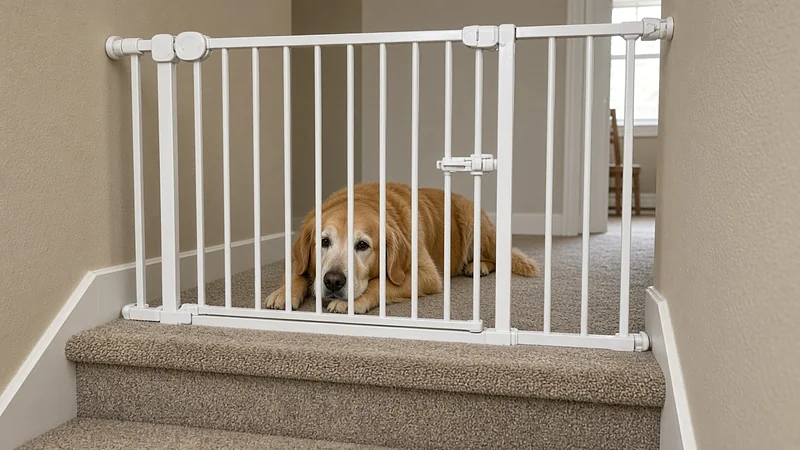
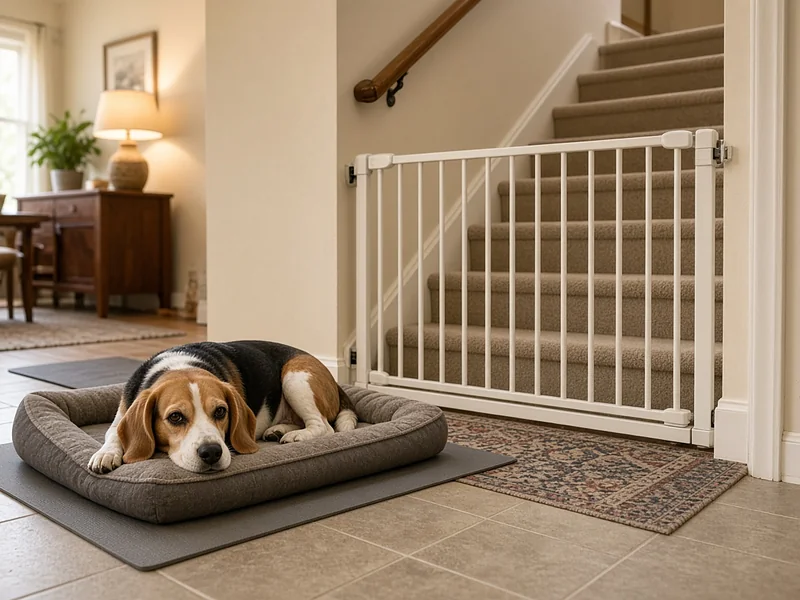
- Block every stair. A dizzy dog does not judge drops. Use a hardware-mounted gate at the top of stairs; pressure gates belong at the bottom or in doorways only. Our stair gate guide covers the difference.
- Soft landing. A low, open-front orthopedic bed plus foam tiles or a flat rug (no curled edges) around it.
- Quiet and lit. The Vestibular Disorders Association notes that pets use vision to compensate for a faulty balance system, so good lighting helps. Keep the TV and busy household traffic away from the rest area.
- Rolled-blanket "nest". Several neurology sources suggest rolling a thick blanket into a C-shape around the dog so it has something solid to lean against without tumbling off a raised bed.
Regalo Top of Stairs Hardware-Mounted Gate
Hardware mount, 30.5 in tall, fits 29–43 in (listing title) openings; banister adapters (square 2–4 in, round 3–5 in); gate must swing away from the stairs
Pros
- Made for the top of stairs
- Banister adapters included
- Walk-through door
Cons
- Must be screwed in
- Check opening width first
- Door must swing away from the stairs
At the top of any staircase on the route out of the safe zone, mount a hardware gate that swings away from the stairs. The Regalo top-of-stairs gate is a common fit for openings in the mid-20s to low-40s inches; measure before you order.
Regalo Easy Step Extra Wide Walk-Thru Gate
Pressure mount with wall cups, 30 in tall, 29–49 in in steps (does not fit 32–34 or 36.5–41.5 in); 16 in door; never for the top of stairs
Pros
- No drilling needed
- Wide range for wide openings
- Walk-through door
Cons
- Not for the top of stairs
- Gaps in the fit range
- Bottom threshold bar to step over
For doorways into the recovery room, a pressure walk-through gate is usually enough. Never use a pressure-only gate at the top of stairs.
Step 2: Fix the floor before you fix the harness
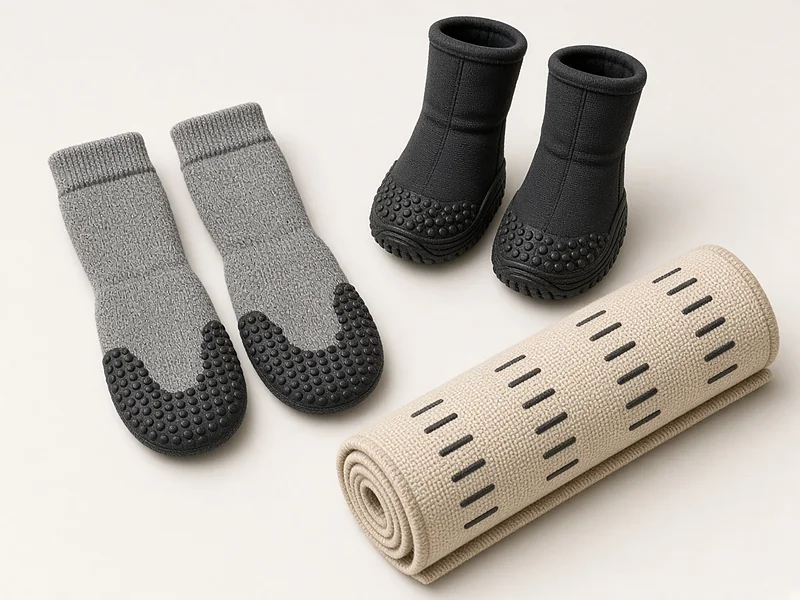
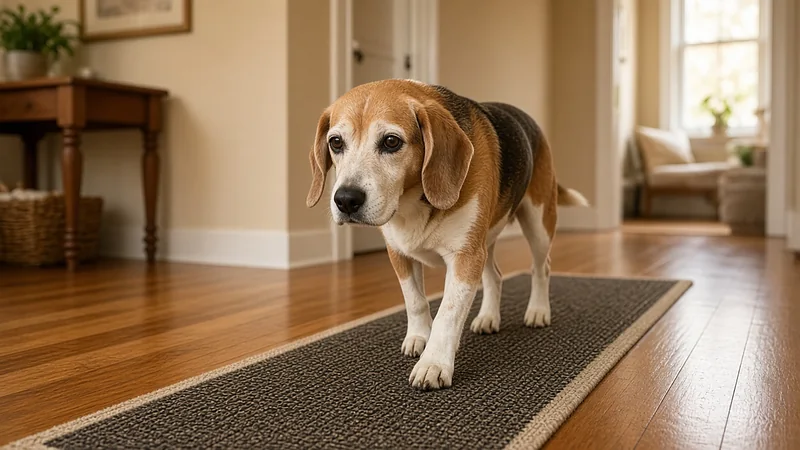
A vestibular dog already feels the room spinning. Hardwood, laminate and tile turn every attempt to stand into a scramble. PDSA specifically recommends carpet or a non-slip mat without raised edges. Put traction down first; then add a sling.
Kapaqua Rubber-Backed Custom-Length Runner Rug
22 in wide (other widths in the menu), custom length, 1/4 in low loop pile, rubber backing for hardwood, laminate, vinyl and tile; hand wash only per the current listing
Pros
- Cut to the exact length of your hallway or route, so there are fewer gaps
- Low 1/4 in pile is easy for dragging feet
- Rubber backing made for bare hard floors
Cons
- Not for use on carpet
- Current listing says hand wash only
- 22 in is narrow for a large dog that splays; check wider options
Rubber-backed runners along the path from bed to door give a continuous grip strip. Cut length to fit so there is no loose end. Details and sizing tips are in our hardwood slipping guide and runner rug guide.
ProsourceFit Exercise Puzzle Mat (1/2 in, 6 tiles)
Six 24 x 24 x 1/2 in interlocking EVA foam tiles with end borders, 24 sq ft total; water-resistant; phthalate-free per listing; clean with warm water and dish soap
Pros
- Covers a whole pen or bed area with no gaps
- Half-inch foam adds cushioning
- Single tiles lift out for cleaning
Cons
- Some dogs chew foam edges
- Liquid can seep through joins
- Foam may dent under heavy objects (per listing)
Half-inch interlocking foam tiles pad favourite resting spots and add grip for stand-up attempts. Watch chewing at the edges. Our foam mats vs rugs comparison helps you choose room by room.
Step 3: Support walking without carrying every time
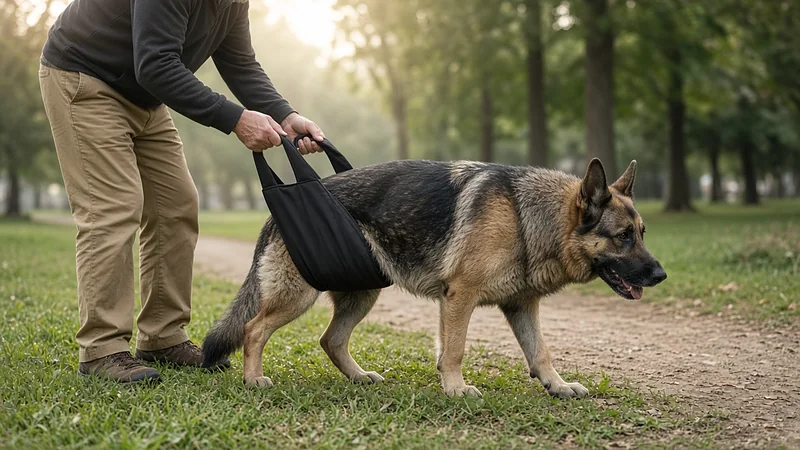
PDSA says you may need to carry a small dog, or support a large one with a towel, sling or blanket under the belly for toileting walks. The Vestibular Disorders Association goes further: avoid carrying when you can, because paw contact with the ground helps the dog recalibrate. Prefer a hands-on flank support or a sling so the feet stay on the floor.
For a heavy senior, a purpose-built rear sling or full-body harness is kinder on your back than a bath towel. Use it for outdoor toilet trips and short assisted walks once your vet says movement is safe.
GingerLead Dog Support Sling
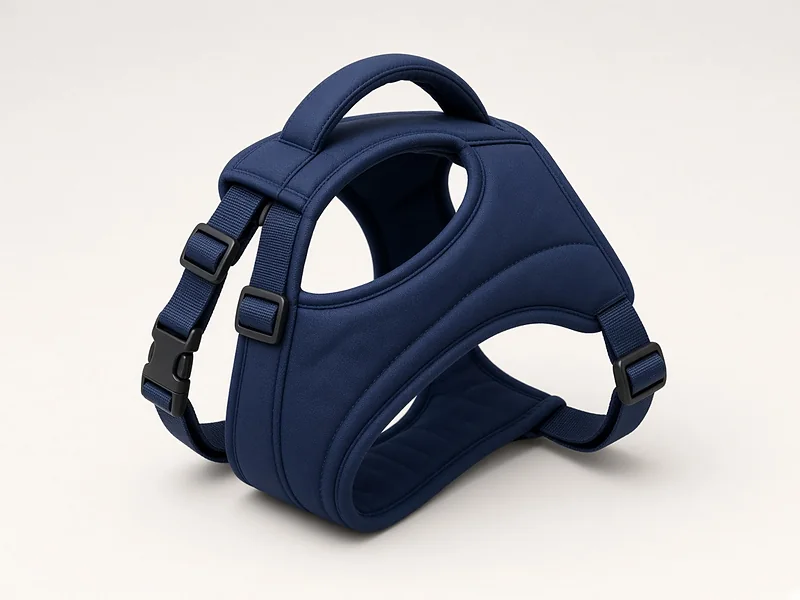
Padded rear sling with integrated leash, male and female cuts, dogs up to 250 lb, made in USA
Pros
- Padded belly pad spreads the load
- Integrated leash for one-handed walking
- Widely used after orthopedic surgery
Cons
- Rear support only
- Slides on and off rather than staying on all day by default (optional stay-on straps)
The GingerLead is a padded rear sling with an integrated leash, useful when the front end is still strong and you mainly need to stop the hind end from collapsing sideways. Male and female cuts matter for comfort.
Help 'Em Up Harness
Two-piece full-body harness (front + hip lift), sizes for 10–225 lb, conventional and U-band (male) styles
Pros
- Lifts front, rear or both with separate handles
- Designed to be worn for long periods
- Male (U-band) and conventional versions
Cons
- Most expensive option here
- Sizing is fiddly; the maker suggests sizing the rear down for dogs with muscle loss
If the dog is weak at both ends, or you need to lift into a car later in recovery, a full-body harness such as Help 'Em Up gives front and rear handles. Size carefully on muscle-wasted seniors. Our rear support harness comparison and full-body lift guide go deeper on fit.
Step 4: Bedding, bowls and toileting
VCA's treatment notes for less severe cases centre on nursing: help the dog get up, walk and toilet, and help with eating, drinking and cleanliness after accidents. PDSA adds that you may need to hand-feed for the first few days, then keep bowls close to the bed.

PetFusion Ultimate Dog Bed & Lounge
Solid CertiPUR-US memory foam: S 25x20 (2.5 in foam), L 36x28 (4 in), XL 44x34 (4 in), Jumbo 50x40 (6 in); waterproof inner liner; water-resistant machine-washable cover; recycled polyfill bolsters
Pros
- Bolsters on three sides for a head rest
- Inner liner plus water-resistant cover
- Mid relative cost
Cons
- Bolsters add height on three sides; front is the only low entry
- 4 in foam on L/XL is thin for 100 lb+ dogs
- Warranty wording varies by listing: check before buying
A low memory-foam bed with an open front is easier to step onto than a high bolster cave while the dog is still tipping. Choose a size that lets the dog stretch out without hanging an elbow off the edge onto hard floor. More bed options sit in our low-entry bed guide.
Neater Feeder Deluxe with Leg Extensions (Large Dog)
21 x 13 x 17.5 in with extensions; 11 in feeding height (8 in without extensions per brand table); for dogs over 40 lb with shoulder height over 14 in; 7-cup food and 9-cup water steel bowls; spill-draining basin; non-skid feet
Pros
- Two feeding heights
- Spilled water drains away from the floor
- Non-skid rubber feet
Cons
- Large-dog size only on this listing
- Discuss raised feeding with your vet for bloat-prone breeds
- Listing's digestion claim is not evidence-backed
Southeast Veterinary Neurology warns that dogs should be fed with the front end upright; feeding on the side raises the risk of inhaling food. An elevated feeder with a spill basin keeps bowls in one place next to the bed and reduces mess if the dog is still wobbly. Our raised bowl guide covers height choices.
- Water within reach of the bed, checked several times a day.
- Absorbent pads under and beside the bed for the first nights.
- Outdoor toilet support with the sling; male dogs need the sling placed so it does not block urination.
- Turn a dog that cannot reposition itself to reduce pressure sores, as Southeast Veterinary Neurology notes for severely affected patients.
A simple first-week routine
- Vet exam on day one; follow anti-nausea and other medicine exactly.
- Safe zone ready before you bring the dog home from the clinic if it was hospitalised.
- Help stand and toilet every few hours while signs are severe; do not force long walks.
- Offer small, aromatic meals upright; hand-feed if the dog will not lower its head safely.
- Check eyes, hydration and whether the head tilt or circling is easing each evening; call the clinic if things worsen.
- As walking steadies (often after 72 hours per VCA's typical course), widen the safe zone slowly and keep stairs gated longer than you think you need.
What improvement usually looks like
VCA reports signs are often worst in the first 24 to 48 hours, with many dogs beginning to improve within 72 hours. Head tilt and stumbling commonly ease over seven to ten days, and most dogs recover within two to three weeks, sometimes with a lasting mild tilt. PDSA's window for geriatric vestibular disease is similar: clear improvement in a couple of days and recovery in one to two weeks for many dogs. Dogs can have more than one episode in a lifetime.
If there is no improvement after a few days, or new signs appear (seizures, severe weakness on one side, changing consciousness), go back to the vet. That pattern is not the typical idiopathic course.
FAQ
Is old dog vestibular disease the same as a stroke?
Not usually, but they can look alike. Only a veterinary exam can tell. Do not diagnose idiopathic vestibular disease at home.
How long does vestibular disease last in old dogs?
VCA describes major improvement often within days and recovery over about two to three weeks for idiopathic cases. PDSA cites one to two weeks for many geriatric cases. A head tilt can linger.
Should I carry my dog during a vestibular episode?
Carry a small dog if that is the only safe option. For larger dogs, prefer a sling or harness so the paws stay on the ground when possible, which helps retrain balance.
Do I need a stair gate if my dog can barely walk?
Yes. As soon as the dog can stagger, stairs are a fall risk. Gate the top with a hardware-mounted gate.
Can vestibular disease come back?
PDSA notes that idiopathic vestibular disease can recur. Keep the safest parts of your setup (runners, a sling you already own, a clear path) even after recovery.
Prices change often, so we do not list them. Check the current price on Amazon.
Sources
- VCA Animal Hospitals, Vestibular disease in dogs.
- PDSA, Vestibular disease in dogs.
- Southeast Veterinary Neurology, Vestibular disease in old dogs.
- Vestibular Disorders Association, Vestibular disease in dogs and cats (PDF also circulated via vestibular.org).
- Product specifications from the linked Amazon listings, checked 6 November 2026.